
Artificial Intelligence improves MALDI-TOF identification of bacteria and viruses
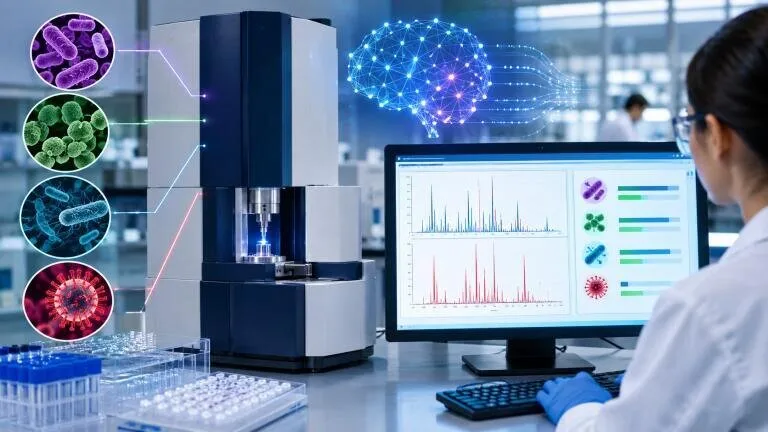
Artificial intelligence combined with MALDI-TOF mass spectrometry gives better classification bacterial and viral microorganisms although performance fell when models were tested against an external dataset
A team of researchers drawn from universities in Greece, Estonia and Belgium have combined artificial intelligence (AI) with matrix-assisted laser desorption/ionisation time-of-flight mass (MALDI-TOF) spectrometry to improve the classification of bacteria and viruses, with results that also highlight the challenge of transferring AI models between laboratories.
The study assessed eight machine-learning and two deep-learning models with mass spectra from seven bacterial species and five viral agents. The researchers generated 255 spectra, comprising 165 bacterial and 90 viral spectra, before they trained the models with five-fold cross-validation.
Matrix-assisted laser desorption/ionisation time-of-flight mass spectrometry has become an established technique in clinical microbiology because it can identify microorganisms rapidly from characteristic protein fingerprints. However, conventional approaches can struggle to distinguish closely related species, while incomplete spectral databases can restrict identification of rare microorganisms. Viral analysis presents additional difficulties because of low biomass, interference from host material and limited virus-specific databases.
The researchers investigated whether AI could extract additional information from MALDI-TOF spectra. Eight of the ten models achieved 100 per cent average accuracy when they distinguished bacterial from viral spectra within the internal dataset. Seven achieved 100 per cent accuracy when they classified bacteria according to Gram type. Seven models also achieved perfect performance when they classified the complete panel of seven bacterial species and five viral agents.
However, the team also examined whether this performance would transfer to data produced elsewhere. Three of the strongest models – Extra Trees Classifier, Support Vector Classifier and a one-dimensional convolutional neural network – were tested against 285 bacterial spectra from an external MALDI-TOF database curated by the Robert Koch Institute, Berlin, Germany.
The Extra Trees model retained 100 per cent accuracy for Gram-type classification, while the convolutional neural network and Support Vector Classifier achieved 97 and 93 per cent respectively with species-level identification proving more difficult. Extra Trees achieved 80 per cent accuracy, compared with 71 per cent for the convolutional neural network and 54 per cent for the Support Vector Classifier.
Differences in sample preparation, bacterial inactivation procedures and instrument calibration between laboratories may have contributed to the reduced performance. Bacillus cereus and Bacillus subtilis proved particularly difficult to distinguish in the external dataset.
The researchers acknowledged that the relatively small internal dataset increased the risk of overfitting. The spectra also came from reference strains under controlled conditions rather than complex clinical or environmental samples.
They concluded that larger, more diverse datasets from multiple laboratories will be necessary before AI-enhanced MALDI-TOF classification can achieve sufficient robustness for wider real-world use.
For further reading please visit: 10.1038/s41598-026-54426-y
Related Stories
 AI News
Exclusive: German AI startup Atira raises $17.5 million to unclog the paperwork bottleneck in industrial dealmaking
53 minutes ago
 AI News
Artificial Intelligence (AI)
54 minutes ago
 AI News
Nvidia to spend $13 billion on Hugging Face, which will remain an open source platform
54 minutes ago
 AI News
Artificial Intelligence Stocks Worth Watching
54 minutes ago
New York City will ban the use of artificial intelligence for students in public schools through eighth grade, a source close to the matter told Agence France
4 hours ago
 AI News
Garber Touts AI For Research as Harvard Embraces Classroom Use
4 hours ago
 AI News
Artificial Intelligence in Retail Inventory Management Market: Trends, Growth & Forecast to 2030
4 hours ago
 AI News
YC-backed Zeit AI raises €5 million to build Europe’s “autonomous data engineer”
4 hours ago