
‘It’s really disturbing’: Yukoners say AI
‘It’s really disturbing’: Yukoners say AI-generated website dangerous
WE NEWS features AI journalists it claims are Indigenous northerners
A website using artificial intelligence to generate articles masquerading as journalism is prompting some Yukon First Nations people to say the problem is reaching a tipping point.
The website, called WE NEWS, has been lifting the work of actual northern journalists.
The website lists three Northern “correspondents” — which it claims are Indigenous — that are also a sham. One is named Kaylee Johns, who is described as “a member of a Yukon First Nation.” The website doesn’t indicate which community.
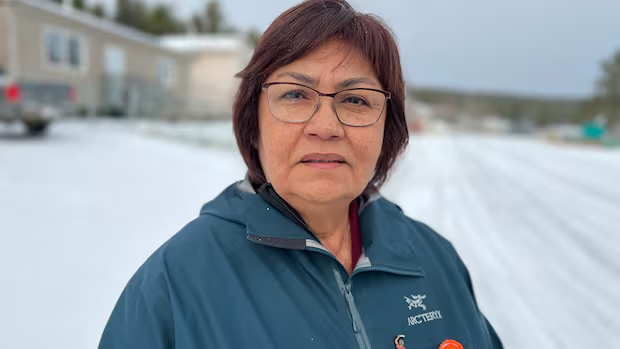
In fact, the real Johns are a large, influential family of the Carcross/Tagish First Nation in Yukon. Sheena Johns, who's Tlingit and Tagish Kwan of the Daḵłʼaweidí Clan, is a member.
To her, the website represents another form of theft.
“When you hear Johns, I think of a family, I think of a face. I think of it as a trusted source,” Sheena said.
“We’re one of the originals in Carcross. We still have a family camp. We still spend our summers out in the bush. We try to stick to the traditional values. That's why it threw me off when I'm like, AI? If my Grandpa heard about that, he'd be like, 'What the hell?'”
Doris Bill, a former CBC journalist and former chief of the Kwanlin Dün First Nation in Whitehorse, said the website reaffirms that the scourge of AI in the digital space is a free-for-all, with real-world implications.
Leaders of whichever government they represent — First Nations or Canadian — need to act, she said, adding that comes by way of fine-tuned, legislated guardrails.
Under its modern treaty, Kwanlin Dün can enact its own laws — and Bill said her First Nation and others should consider that.
“We really need to put some parameters around what we’re doing here with AI, to examine how it’s being used,” she said. “If you can’t rely on the information that is being produced on the internet, that’s a problem.”
The problem is global and that makes accountability a convoluted mess. The website is published by a company called AZ Medias Limited. It is incorporated in Hong Kong, with its hosting provider located somewhere in France.
Bill said it's important to consider the real-world implications.
“It’s really disturbing to find that they’re taking our material and manipulating it and producing something to their own ends,” she said. “It makes me think about intellectual property of our stories, of our culture, of our language.”
“We have to start talking about how are we going to protect those things from AI,” she said.
All of this is happening as many First Nations work to control, manage and protect information that's rightfully theirs. It's called data sovereignty. Information includes traditional knowledge, governance systems and languages.
Bill said while Yukon First Nations are indeed working on a data sovereignty project, it’s early days yet.
“I think we’re just at the beginning of that conversation. I think these incidents that I spoke of have served to really heighten the conversation. I think we really need to start paying attention here,” she said.
“I'm worried about my own personal data ending up all over the place, and we have no control over that. Not enough of us are talking about AI and its impacts on our data.
"We need to start talking about that.”
Julien Greene is a reporter with CBC Yukon. A Kanyen’kehá:ka member of Six Nations of the Grand River Territory and settler, he writes about First Nations' rights, the land and water. Among other newsrooms, Julien has worked at APTN, The Globe and Mail, the Toronto Star and The Narwhal. He earned his Bachelor of Journalism degree at Carleton University and lives in Whitehorse. He can be reached at julien.greene@cbc.ca
Related Stories
 AI News
These AI Stocks Took Off Or Tumbled In Q3. Here’s Why.
58 minutes ago
 AI News
Nvidia unveils security platform to stop AI agents from going rogue
58 minutes ago
 AI News
Artificial intelligence is here to stay
58 minutes ago
 AI News
Artificial Intelligence tool predicts stable hydrogen positions in drug-like molecules
1 hour ago
 AI News
What Mature Security Programs Need Before Deploying AI
1 hour ago
 AI News
Flipkart Ventures backs AI startups Alive and Keploy
2 hours ago
 AI News
DIET Leh Commences Three
2 hours ago
 AI News
Trump
3 hours ago