
Israel is 'the greatest decolonization project,' Indigenous leaders tell Toronto summit
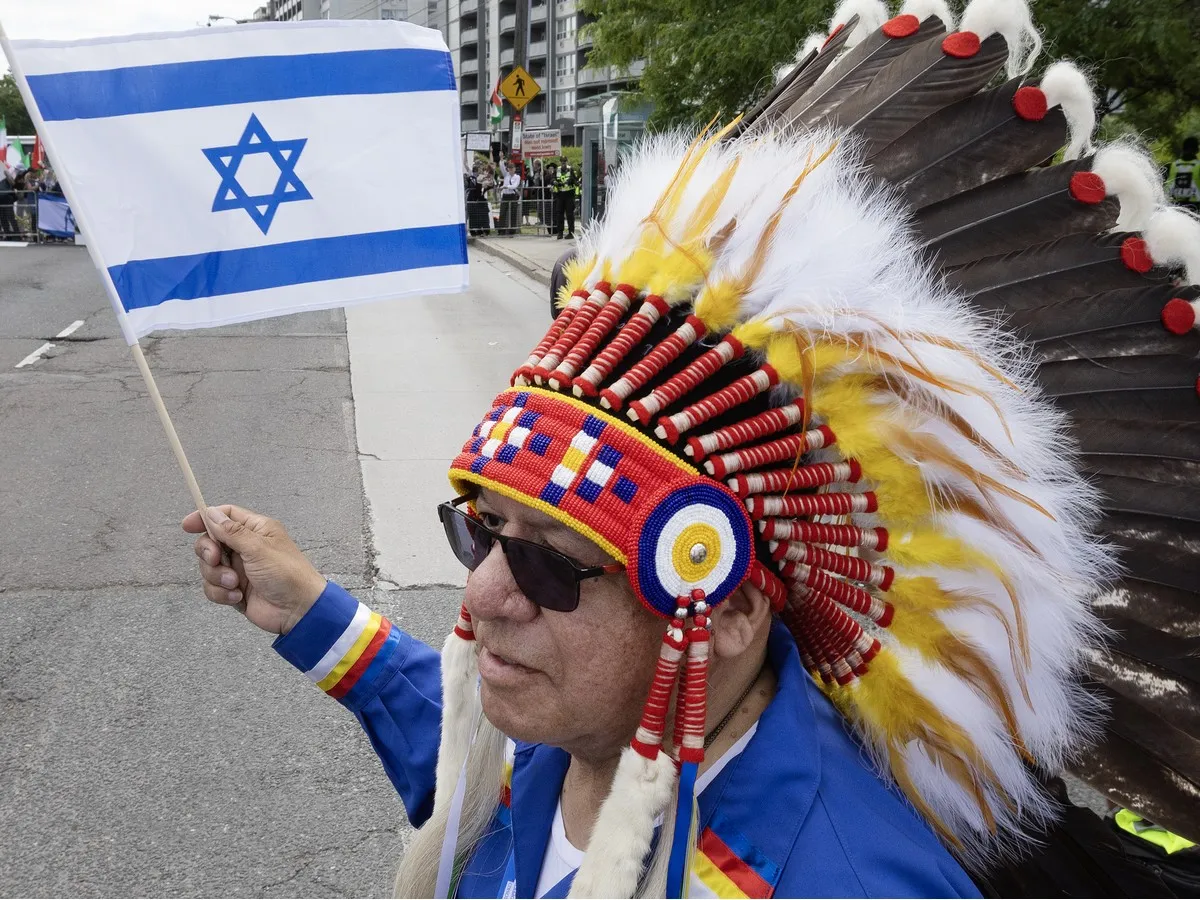
The state of Israel is “the most successful land‑back project, the greatest decolonization project,” a New Zealand Māori activist told the first-of-its-kind Building Indigenous‑Jewish Friendship conference in Toronto.
“From my Māori perspective, a key point is that there was always a continuous Jewish presence in the land; they kept the fires burning, and that is what indigeneity looks like to us,” Dr. Sheree Trotter told roughly 70 activists, academics and community figures convened at Toronto’s Beth Torah synagogue on Monday.
The conference was the culmination of a weekend of local Indigenous-Jewish programming that included nearly 40 Indigenous people marching in the UJA Federation of Greater Toronto’s Walk with Israel, a Sunday dinner-talk with Concordia University professor Csaba Nikolenyi on early 20th-century Zionism, and a Sabbath lecture by Justice Harry S. LaForme at Temple Sinai.
“Indigeneity is demonstrated by historical, collective continuity with a distinct ethnic identity, language, culture, rituals or traditions, economic, social, legal, and religious and spiritual belief systems that predate subsequent invaders or colonizers,” LaForme told Temple Sinai congregants.
“In my view, Israel is the product of the greatest decolonization project in modern history, and this fact does not make it a colonial entity.”
LaForme is Anishibaabe, and a member of the Mississauga of the Credit First Nation. In 1994 he was appointed a judge of the Superior Court of Justice, and in 2004 was appointed to the Ontario Court of Appeal and is the first Indigenous lawyer to be appointed to an appellate court in Canada.
“The Islamist strategists correctly believe that their ideology-driven false narratives appropriating indigenous social justice language would resonate, and given traction with the academically ignorant and the academically sinister in Canada,” he continued in his synagogue speech.
Karen Restoule, an Ojibwe from Dokis First Nation and director of Indigenous affairs at the Macdonald-Laurier Institute, told attendees at Beth Torah that “political movements” have co-opted “Indigenous identity” and the term is “increasingly being treated as a universal political language, borrowed when convenient and deployed in conflicts that arise from very different histories.”
“Increasingly, indigenous identity is being treated as a metaphor, a branding exercise, a political strategy. Indigeneity isn’t any of that; it is a lived reality rooted in specific people and place.”
Trotter said in her talk that “settler colonialism has become a totalizing dogma: it over‑generalizes, homogenizes, and divides the world into saints and sinners, oppressed and oppressor.”
Related Stories
 Canada
AP top stories August 21
39 minutes ago
 Canada
B.C. booze ban on the chopping block as Canada
39 minutes ago
 Canada
PM Carney says Canada intends to match U.S. tariffs ‘dollar for dollar,’ after suspending trade negotiations
39 minutes ago
 Canada
US imposes 50% tariffs on $20bn worth of Canadian goods after talks fail
40 minutes ago
 Canada
BREAKING NEWS: Canada walks away from trade talks; U.S. expected to impose 50% tariffs on Canadian goods including cement, hardwood
1 hour ago
 Canada
Conservationists sue City of Regina over proposed Prince of Wales road extension
1 hour ago
 Canada
Canada, U.S. fail to strike last
1 hour ago
 Canada
Statement by Prime Minister Carney on Canada
1 hour ago