
Grossi: IAEA will inspect Iran's nuclear facilities
Grossi: IAEA will inspect Iran's nuclear facilities
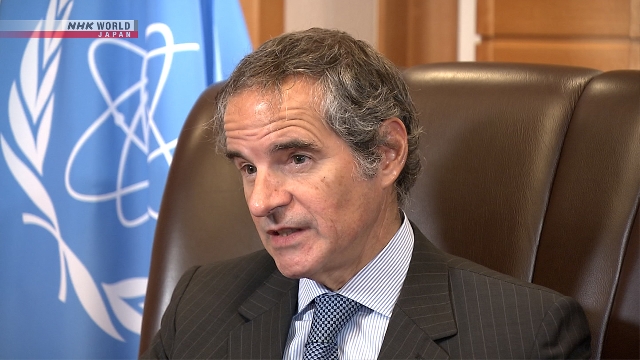
The head of the International Atomic Energy Agency says it will conduct inspections of nuclear facilities in Iran.
IAEA Director General Rafael Grossi made the remark in an exclusive interview with NHK in Tokyo on Tuesday.
The United States said Iran agreed to accept IAEA inspectors back into the country, after high-level talks between the US and Iran based on a memorandum of understanding to end their fighting.
Grossi said there will be inspections. He added, "We think that the sooner the better, especially since this agreement has a time frame of 60 days, so we will have to be working without losing much time."
He said the top priority is confirming the location of highly enriched uranium. He noted the IAEA has an idea of where the material could be, but that it is important for Iran to tell the agency the location.
Grossi added that as some storage facilities were attacked and partially destroyed, the agency may need to study how to get to the material.
He indicated the IAEA will soon talk with the Iranian side to decide on the dates and other details of inspections.
Grossi also said the IAEA is an independent organization and will carry out the inspections on its own. But he said that "if Iran wishes to invite the United States or other observers, this is another matter," adding that "we do not foresee that somebody needs to help us or control us."
The IAEA has been unable to conduct inspections in Iran since the US and Israel attacked nuclear sites there in June last year.
Earlier this month, the IAEA Board of Governors adopted a resolution calling on Iran to disclose information on its enriched uranium and accept the agency's inspections.
Grossi is scheduled to stay in Japan through Friday. He will inspect the damaged Fukushima Daiichi nuclear power plant on Wednesday. He will also conduct additional monitoring of the discharge of treated and diluted water from the plant.
Water used to cool molten fuel at the plant, mixed with rain and groundwater, is being treated to remove most radioactive substances, but it still contains tritium.
Before releasing the treated water into the ocean, the plant's operator dilutes it to reduce tritium levels to about one-seventh of the World Health Organization's guidance level for drinking water.
Related Stories
 AI News
SoFi deepens AI
35 seconds ago
 AI News
Keeping teens safe in a world with artificial intelligence
41 seconds ago
 AI News
Oracle Admits Artificial Intelligence Has Cost 21,000 Jobs
45 seconds ago
 AI News
World Cup 2026: England v Ghana
23 minutes ago
 AI News
Forty drown across France in heatwave and parts of Spain above 30C at night
23 minutes ago
 AI News
The Latest: Pentagon asks Congress for roughly $80 billion to cover cost of Iran war
24 minutes ago
 AI News
Global crises persist in Europe, Africa and Middle East
24 minutes ago
 AI News
Iran denies Vance claim on IAEA inspectors' return
24 minutes ago