
Indonesian tech entrepreneur jailed over Chromebooks purchase
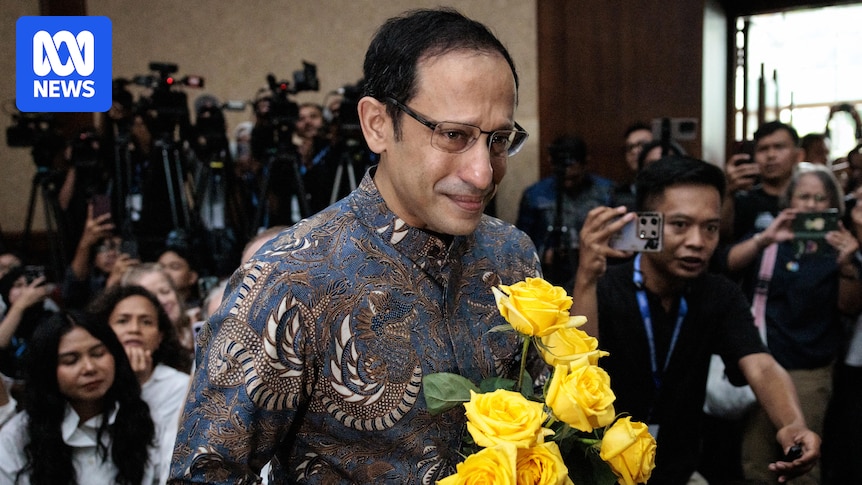
Prominent tech entrepreneur and former minister sentenced to jail in Indonesian corruption case
Nadiem Makarim and his wife Franka Franklin during court proceedings as judges heard a corruption case related to the procurement of Google Chromebooks. (Reuters: Ajeng Dinar Ulfiana)
An Indonesian court has sentenced tech entrepreneur and former education minister Nadiem Makarim to 10 years' jail in a case linked to the procurement of Google Chromebooks for schools.
Some legal experts said prosecutors failed to provide conclusive evidence to prove him guilty, while one judge dissented from the court's majority decision and called for Makarim's acquittal.
Makarim's legal team has vowed to appeal the ruling.
A prominent tech entrepreneur in Indonesia has been sentenced to 10 years' imprisonment in a corruption case linked to the procurement of Google Chromebooks for schools.
Nadiem Makarim, a co-founder of tech firm Gojek and a former education minister under the previous administration of Joko Widodo, was accused of profiting from the government's decision to purchase Chromebook laptops and software for schools during the COVID-19 pandemic.
In Indonesia's Corruption Court yesterday, Chief Judge Purwanto Abdullah said a panel of judges had found Makarim guilty of abuse of authority and of causing state losses.
However, the court found him not guilty of directly seeking to enrich himself.
Gojek drivers gathered at the court wearing green uniforms and brought flowers to show support for Makarim, who is regarded by many as an innovation pioneer. (Reuters: Ajeng Dinar Ulfiana)
Prosecutors alleged the procurement decision was made because of Google's investment in Gojek's parent company.
Google said its investments in Gojek came before Makarim was appointed as minister and that it "never offered, promised or provided any benefits to Indonesian government officials in exchange for their decision to adopt Chromebooks or related products", according to news agency Reuters.
Nadiem Makarim was co-founder of ride hailing company Gojek. (AFP: Yasuyoshi Chiba)
Makarim was also fined 1 billion rupiah ($81,000) and ordered to return more than 800 billion rupiah ($65 million) that the judges said was an amount he personally gained from the deal.
Failing to return the money would add five years to his prison sentence, the judges said.
Makarim's legal team, as well as many legal experts, argued that the prosecutors failed to provide conclusive evidence to prove him guilty.
His lawyers previously said the Chromebooks program saved money and that the state-loss calculations were flawed.
Why is the legal case controversial?
Makarim's legal case has received support from academics both in Indonesia and abroad, who said the charges against him appeared to be politically motivated. (Reuters: Ajeng Dinar Ulfiana)
Makarim's legal case is one of the biggest corruption cases involving a senior Indonesian official in recent years.
It gained attention, particularly from tech and start-up communities, because Gojek was Indonesia's first "unicorn" or start-up business to reach more than $US1 billion in value.
Gojek is a ride-hailing app and Indonesia's equivalent of Uber, operating in several South-East Asian countries when it first launched.
On its official website, the business also claims it has created jobs across the region with more than 3 million drivers.
In 2019, Makarim became the youngest person from Asia to receive the Nikkei Asia Prize for business innovation.
Millions of Indonesians, including tourists, rely on the Gojek ride-hailing app for commuting, food delivery, and courier services. (Reuters: Willy Kurniawan)
He left Gojek to become Indonesia's Minister of Education, Culture, Research, and Technology when he was 35 years old, making him the youngest minister in the country's history.
Support for Makarim has been pouring in since the beginning of the trial, with academics and civil society groups alleging the prosecution was "politically motivated" and warning the case may prevent aspiring young professionals from entering public service to make contributions to the country.
Asyifa Isvari, an Indonesian student at Harvard University, told the ABC she worried Makarim's prosecution would deter tech innovation in Indonesia.
"I still have a strong intention to return to Indonesia and contribute to Indonesia or work for Indonesia," she said.
"But with the criminalisation of [Mr Makarim] and also several other technocrats, it's clearly becoming more worrying to innovate. If our country punishes innovation, how are we supposed to advance beyond other countries?" she said.
Asyifa Isvari says she was disappointed with the verdict and concerned that it sent the wrong signal to those who wanted to innovate. (Supplied: Asyifa Isvari)
Gojek drivers told the ABC after the verdict they regretted that Makarim had left the firm to join the government, a decision they believed ultimately led to his imprisonment.
"As online motorcycle taxi drivers, we've been greatly helped by [Mr Makarim] for creating this public app. So, if he ends up being put in prison like that, it really weighs heavily on my heart," said driver Chairul Anwar.
"He should be shown some leniency."
Gojek drivers attended several rallies before the trial to show support for Makarim. (Reuters: Willy Kurniawan)
Tim Lindsey, a law professor at the University of Melbourne and an expert on Indonesia's legal system, told Reuters that the verdict "has the potential to cause more damage to the country's image with investors and aggravate existing concerns about the integrity of the legal system".
Gojek motorcycle taxi drivers wearing green jacket uniforms gathered outside the court carrying banners that read "Free him … No other option".
One of five judges provided a dissenting opinion in the decision and called for Makarim's acquittal.
The judge said the case offered no proof of malicious intent, wrongdoing or any indication of a conflict of interest.
Speaking to Indonesian media outlets, Makarim said the verdict "did not make sense" because while nothing in the conviction said he was self-enriching, he was still fined and ordered to return money to the state.
"I don't have that amount of money, and my total wealth at the end of my term as minister was far below that figure," he told reporters after the court decision.
Four of the five judges on the panel found Makarim guilty of abuse of authority, while one voted for a full acquittal. (Reuters: Ajeng Dinar Ulfiana)
On his Instagram account, Makarim said his only hope to seek justice was now the Indonesian people.
"There has never been a case where millions of people have followed every fact of a trial so closely," he wrote.
"It is very rare to see a case where anti-corruption experts unanimously say that there was no element of corruption involved.
Makarim's legal team said it would appeal the court's ruling.
Related Stories
 AI News
World Cup 2026: Mexico rampant at Azteca
24 minutes ago
 AI News
In Mideast and around the world, everyone's talking 'ceasefire.' But what does it really mean?
24 minutes ago
 AI News
Morning 4: What to know ahead of tonight’s World Cup watch party in Campus Martius
24 minutes ago
 AI News
Trump's crypto businesses took in about $1.2B US last year, federal filing shows
25 minutes ago
 AI News
How extreme heat is exposing extreme inequality
25 minutes ago
 AI News
News Live: Watch Times Now Live Streaming | Live News India, World, Politics, Sports News
25 minutes ago
 AI News
Canada Day a moment of pride, patriotism and melanchony in Alberta
25 minutes ago
 AI News
Vancouver restaurants’ see prolonged boost from Canada’s historic World Cup run
26 minutes ago