
Indiaspora’s 250 at 250 Highlights the Indian Americans that Built America
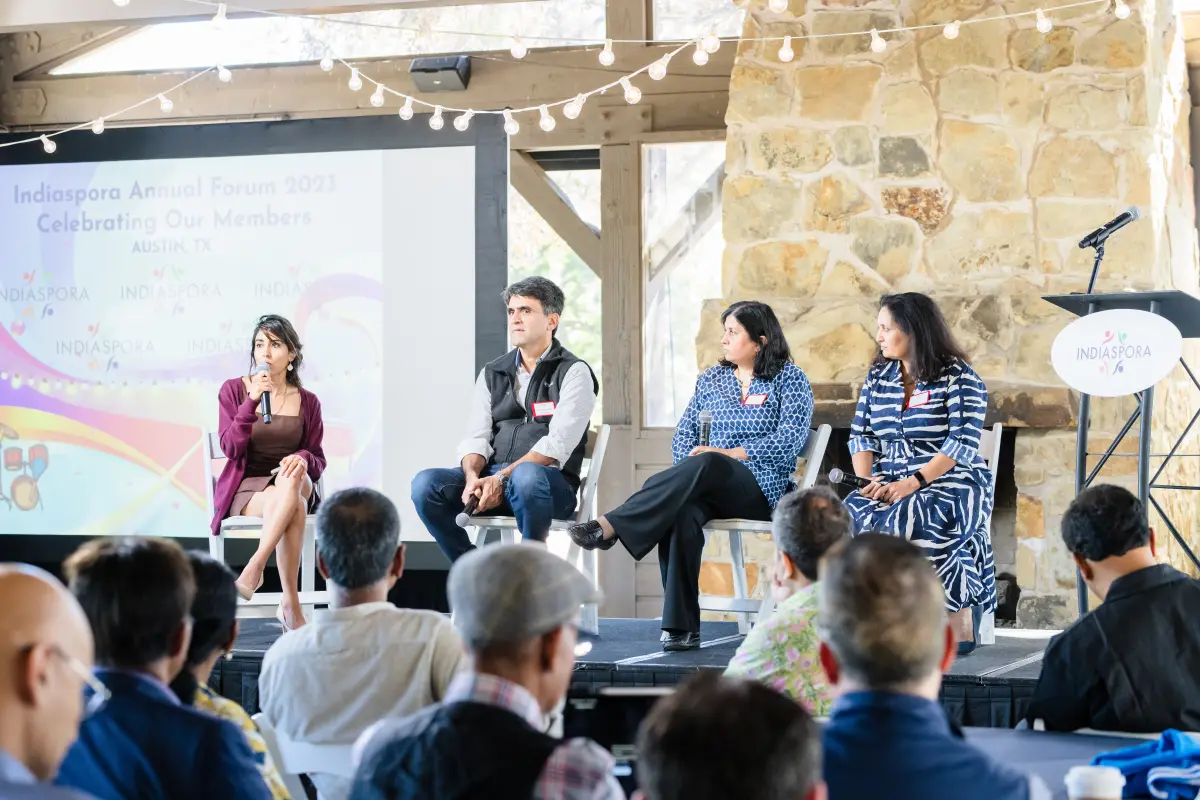
From physicist Narinder Singh Kapany, who brought fiber optics to the world, to director M. Night Shyamalan, who crafted some of the most jaw-dropping plot twists in cinema, Indian Americans have made incredible contributions to American life.
To honor America’s 250th birthday, Indiaspora, a nonprofit and global network of members of the Indian diaspora, is highlighting the contributions people of Indian origin have made to the United States with 250 at 250: Moments of the Indian American Story.
This collection features important figures part of the Indian diaspora who made an impact – whether well-known or underrated – in areas like business, technology, entertainment and science.
Indiaspora was founded 14 years ago with the mission to bring together the estimated 35 million people who make up the global Indian Diaspora to be a “force for good,” founder and chairman MR Rangaswami told Newsweek.
“What the organization is doing is bringing the global diaspora together,” Rangaswami said. “Leaders across diverse professions, so doctors, lawyers, CEO, VCs, artists, academics, all together to do good. It's not a business group, it's not an ethnic group, but rather somewhere we all get together and become a network."
Leaders from all around the world, across every profession, come together with the mission to transform the success of the Indian diaspora into meaningful impact worldwide by amplifying and acting on causes that people of Indian heritage care most about.
Indiaspora has funded several political campaigns for Indian-American politicians and led an effort to legitimize Diwali in America with a petition to the postmaster general to make an official Diwali stamp in 2016 and make Diwali an official holiday in three states (Connecticut, California and Pennsylvania). The community also helped support food banks in the U.S. and raised over $5 million in one day for India Giving Day.
Sejal Hathi is an assistant professor of medicine at Stanford University, the director of the Oregon Health Authority and a board member at Indiaspora. She views her Indian American identity as both an inheritance and an instruction.
“It has taught me that belonging is something each generation helps build, and that achievement carries responsibility,” she told Newsweek. “I grew up with the expectation that whatever gifts we are given should be put to use — for family, for community and for people whose names we may never know.”
Indian Americans are one of the fastest-growing major immigrant groups in the United States. According to Indiaspora, there are 5.1 million people who were born in the U.S. or who emigrated to this country. Indian American households contributed over $1.5 billion in philanthropy in the U.S. in 2023 and over 150 were nominated to senior public service positions in 2023.
The online gallery for 250 at 250 guides readers through 250 years of American history told by the accomplishments of members of the Indian diaspora members, including Newsweek CEO Dev Pragad. Each moment featured in this project was chosen due to its historical significance, with special attention to representing all sectors, time periods, gender and communities.
This list is not a ranking and is limited in its ability to represent everyone who has made an impact across business, arts, science and technology, athletics, law, culture and entertainment, environmentalism, faith, immigrants and civil rights, education, philanthropy, politics, media, health care and culinary arts.
It categorizes the 250 leaders into four categories: Pioneers (the first to do it), Luminaries (those at the pinnacle of success), Catalysts (those who sparked movement or change) and Builders (those creating institutions).
The stories of standouts like Taraknath Das, a prominent figure in the Indian Independence movement and minority rights advocate, Payal Kadakia Pujji, the founder of ClassPass, former Top Chef host Padma Lakshmi and former CEO of PepsiCo Indra Nooyi, the first Indian American woman to lead a Fortune 500 company, will inspire the next generation of leaders.
Tentpole moments include Slumdog Millionaire winning Best Picture at the 2009 Academy Awards, Nina Davuluri’s crowning as Miss America in 2013, Bobby Jindal, the first Indian American elected governor (Louisiana in 2007) and Vice President Kamala Harris’ time in the White House and demonstrate how this community is integral to American life and culture.
Stars like Mindy Kaling, Priyanka Chopra and Dr. Sanjay Gupta and media outlets like India Currents and Brown Girl Magazine, are sharing stories of the Indian diaspora and bolstering representation on screen.
From achievements in sports — with Mohini Bhardwaj, the captain of the U.S. women's gymnastics team at the 2004 Olympics in Athens — to advancements in medicine and technology, like Mani Lal Bhaumik’s development of the first efficient excimer laser that laid the groundwork for LASIK surgery, this project shows how Indian Americans have always been an essential part of America's history.
Beyond the great contributions of celebrities, CEOs and Nobel Prize winners, Indian Americans have also made their mark on everyday American life, from the Patel Motel dynasty to the expansion of Indian restaurants and yoga studios around the country.
Hathi’s career spans medicine, public health and academia, leading her to the White House as a senior policy advisor for the Biden administration and at the state level as the deputy commissioner and state health officer for the New Jersey Department of Health.
While Indian Americans like her have achieved great success and public notoriety, she said some of the most important contributions are often quieter.
“They are the doctors sitting at bedsides, the researchers pushing the frontier of knowledge, the teachers expanding young minds, the small-business owners anchoring neighborhoods, the public servants trying to make government work better and the families who insisted that their children could inherit both India and America without diminishing either,” Hathi said.
The 250 at 250 list doesn’t just aim to highlight the individual successes, but the widespread and lasting impact each individual had on the country and the Indian American community.
It examines how this demographic has influenced institutions, expanded opportunities, advanced knowledge, transformed industries, enriched culture and strengthened everyday life. The goal is to go beyond the stereotypical representation of Indian Americans as doctors or engineers, Indiaspora said, to provide a holistic view on their influence on American life that reaches far wider and further back than people realize.
“There is a tendency to view the community through stereotypes—sometimes positive, sometimes negative—that fail to capture its diversity,” Dr. Balu Natarajan, chief medical officer at AccentCare and the first Indian American winner of the Scripps National Spelling Bee in 1985, told Newsweek. “One of our ongoing challenges is ensuring that future generations can embrace both their American identity and their cultural heritage without feeling they need to choose between them.”
Natarajan hopes this project reinforces the notion that when given the opportunity, anyone can succeed and make contributions that outlive them. Because, ultimately, the Indian American story is one of opportunity meeting preparation.
“Many Indian families place a strong emphasis on education, personal accountability and service,” he said. “At the same time, America provides an environment where talent, innovation and hard work can flourish.”
Amid a time of rising anti-immigrant rhetoric in America, bolstered by policies from the Trump administration to limit immigration and deport legal residents, this list aims to bring people together and remind everyone that America’s story is, and always has been, an immigrant story.
For Hathi, each generation of immigrants has “stretched the American imagination,” building and creating to expand what the country believes is possible.
“Too often, though, immigrant communities are treated as footnotes — useful when they succeed, suspect when they struggle and invisible when they serve quietly,” she said. “What resonates with me about the 250 at 250 project is that it refuses that flattening. It says Indian Americans are part of the architecture of America.”
Related Stories
 Global Indians
MoS Margherita meets members of Indian diaspora in New Zealand’s Auckland
2 days ago
 Global Indians
‘Jantar Mantar is everywhere’: Indian diaspora holds global solidarity protests
2 days ago
 Global Indians
NRI: NRI news today. NRI updates, immigration news
2 days ago
 Global Indians
Fear Grips Indian Diaspora After US Temple Attack
4 days ago
 Global Indians
Indian diaspora in UK, Ireland protest against SIR
4 days ago
 Global Indians
NRI investors in Indian equities rise threefold since FY19, shows data
6 days ago
 Global Indians
Indian diaspora in Saudi Arabia remains connected to its roots
1 week ago
 Global Indians
Collecting the stories of the Indian diaspora in Australia
1 week ago