
How Artificial Intelligence is Transforming Conflict And Peace
While AI is compressing the kill chain, lowering the cost of lethality, and embedding private industry into states’ military architecture, it also has the potential to enhance peace, widening participation in peace processes, offering anticipatory indicators on conflict escalation, and accelerating the recording, sharing and verification of war crimes. Yet of these two trajectories, AI-enabled warfare is evolving faster than the legal and governance framework designed to regulate it, leaving the infrastructure for AI-enabled peace fragmented and underfunded, and leaving behind significant concerns as to accountability, responsibility, and compatibility with international law.
So far, three conflicts have served as the operational tests bed for AI in war. Ukraine has operated as the world’s foremost testing ground for drone innovation and the race towards fully autonomous weapons systems. Gaza has demonstrated how AI has moved to the core of military targeting, and the 2026 Iran war has offered an insight into how AI-integrated infrastructures are facilitating military campaigns ran at machine speed.
A report by Israeli Publications +972 and Local Call disclosed that the IDF had integrated two AI systems, Lavender and Habsora (The Gospel), in Gaza. While the Gospel was employed to select physical strike targets, Lavender generated human targets, at one point flagging as many as 37,000 potential targets, predominantly ‘military-aged males’ who were classified as potential junior Palestinian Islamic Jihad (PIJ) or Hamas militants. The systems were integrated to provide targeting reports to analysts. If the analysts determined the object satisfied the requirements of a target, this judgement would be passed to a higher-level intelligence officer to confirm the strike. Human operators admitted their role as rubber stamps of approval, often only checking that marked targets were male and investing only 20 seconds of oversight before authorising a strike.
Iran: Operational Planning and Strike Intensity
The US-Israeli Operation Epic Fury campaign has served as the first large-scale field test of the US’s new AI-integrated military architecture. The Maven Smart System (MSS), a Pentagon program that employs computer vision algorithms to analyse satellite imagery and radar to identify strike targets, lies at the centre of the military’s AI strategy. The MSS, designated as a formal program of record in 2023, integrates the mapping data in a mission control platform that gives commanders a live, synchronised view of the battlefield, recommending targets and ranking courses of action before a human officer is presented the intelligence to decide whether to authorise a strike. By May 2025, the Pentagon’s contract with Palantir, who own the platform, totalled roughly US$1.3 billion, a 165 per cent expansion in 12 months.
Head of US Central Command, Brad Cooper, disclosed that AI systems were being used to compress “processes that used to take hours and sometimes days” into seconds. The US military conducted 900 strikes in the first 12 hours of the war, further confirming how AI’s integration into operational planning had compressed the kill chain and established a new operational baseline in which military campaigns ran at machine speed see humans approving rather than originating most targeting decisions. Operation Epic Fury can thus be seen as an inflection point in AI-integrated kill-chain compression, raising significant questions as to the meaningful oversight humans will maintain over weapon systems.
Ukraine: Drone Warfare at Scale
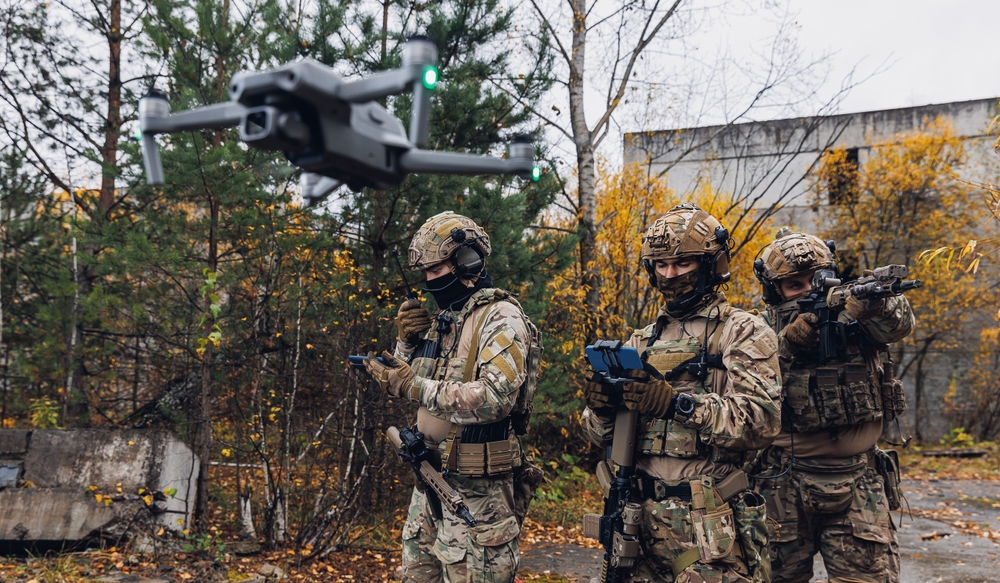
The Ukraine-Russia conflict has become the world’s preeminent testing ground for autonomous and AI-enabled weapons systems. Ukraine have reorganised their entire war effort around drone technology, with Ukraine’s production capacity reportedly reaching nearly five million drones in 2025. Ukraine accounts for almost 50 per cent of drone strike events between 2018-2015, with drone strike events worldwide climbing from 364 in 2018 to over 42,000 in 2025. Russia accounts for 30.6 per cent of drone strike events in this period, with the Russia-Ukraine war accounting for approximately four out of every five events worldwide since 2018.
Related Stories
 AI News
AI in your oven? Anthropic warns models ‘months away’ from self
41 minutes ago
 AI News
London firm's AI
41 minutes ago
 AI News
Saudi man charged with planting 'sophisticated' recording device in OpenAI office
1 hour ago
 AI News
One-year
1 hour ago
 AI News
Kroger to lay off 3,000 employees as it leans into artificial intelligence
1 hour ago
 AI News
Why British
1 hour ago
 AI News
Building agents that transact with Anchor Browser and AgentCore payments
1 hour ago
 AI News
Disney strikes $20
1 hour ago