
India’s Gen
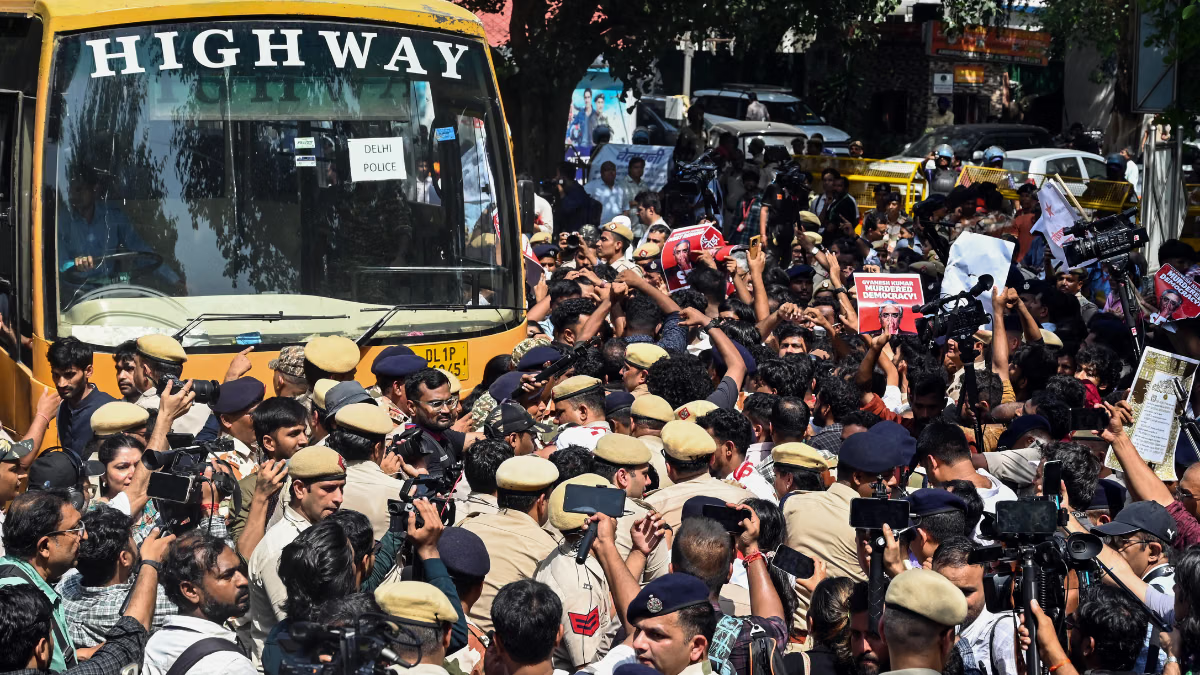
It would be myopic to present the current student protests only in light of short-term politics. What the younger generation of India is doing is profoundly important, both for India and the world.
In light of the excesses perpetrated by the rulers, Gen-Z is trying to reverse what must be viewed as the greatest attack on India’s democracy since the Emergency (1975-77). It should be recognised for what it is. It should not be reduced to whether we like Abhijit Dipke and his background, or whether we like Rahul Gandhi, the “party-political” beneficiary of this moment, who is currently riding a rising political wave.
Whether this political moment will last and create big changes, or whether the Modi regime will hit back with greater repression, is an inherently speculative question, though not a bad one for that reason. Some columnists are certain that it will lead to greater repression. I am not so sure. I don’t believe definitive predictions can be made in moments of tumultuous politics. During critical political episodes, the future tends to be unpredictable.
To my mind, it is hard to imagine how the Modi regime will be able to contain the progressively negative decline of what used to be called its deepening hegemony, especially after the Ram Temple construction and then after its massive election victory in Bengal. Can it really come back now? If so, in what ways? We frankly don’t know.
But the present moment can certainly be analysed in a conceptually relevant manner. Such analysis is not just a purely theoretical matter. There are times when theory can be of great empirical significance.
Democracy theorists have long recognised that India’s democracy was historically exceptional. The biggest issue was income and industrialisation. Only rich and industrialised countries tended to be lastingly democratic. With the exception of oil-rich Middle Eastern countries, democracy has basically been a rich-country game, as it were. Singapore is the only non-oil-rich undemocratic country, now even richer than the US in per capita income.
For decades after independence, India was poor and minimally industrialised, yet it was democratic. The odds against India’s democratic longevity were incredibly high. Hence its great significance for democracy scholars.
As early as 1966, Barrington Moore Jr, the author of a truly seminal book, Social Origins of Dictatorship and Democracy, wrote:
“..as a political species, (India) does belong to the modern world. At the time of Nehru’s death in 1964, political democracy had existed for seventeen years. If imperfect, the democracy was no mere sham. . . . Political democracy may seem strange both in an Asian setting and one without an industrial revolution.”
Then, in 1989, Robert Dahl, the well-known founder of modern democratic theory, wrote that India was “a leading contemporary exception” to democratic theory. Finally, in 2001, Adam Przeworski, the most statistically sophisticated democracy theorist of the last several decades, wrote: “The odds against democracy in India were extremely high.”
But this claim applies mostly to India as an electoral democracy. India has functioned less well as a liberal democracy. Liberal democracy and electoral democracy are two different concepts, with the latter being broader in the sense that elections alone do not exhaust what democracy entails.
Without freely contested elections and universal franchise, no modern democracy is possible. It is a necessary condition. But elections are not all there is to democracy.
Liberal democracy, as a concept, covers not only elections, but also how elected governments behave between elections. A liberal democracy always protects civil liberties, especially freedom of speech and freedom of association, which in contemporary times is termed “civil society”.
Equally important, a liberal democracy protects minority rights. The argument is that majorities can protect themselves by their numerical weight, but minorities don’t have the numbers. Without minority protections, therefore, democracy can become a brute majoritarian force.
And without protection of individual rights to free speech and the ability of citizens to freely form non-governmental associations, an electoral democracy can also become a brute authoritarian force in general, even if electoral freedoms are available.
In India, after 2014, the electoral and liberal aspects of democracy developed a deep conflict. India’s electoral democracy on the whole remained quite vibrant. But the liberalism of its polity went into a serious decline, as freedom of speech, civil society and minority rights were attacked. There was liberal erosion first.
After the 2024 elections, an electoral erosion also began, culminating in the Special Intensive Revision (SIR), which is for all practical purposes an attack on the voting rights of citizens.
There are two conceptual ideas at work in SIR:
(a) the idea of documentary adequacy for vote eligibility; and
(b) the onus of registering voters being placed on citizens, when it had traditionally been the responsibility of the government.
The assumption of India’s founding figures was that the poor citizenry would not have the literacy or capability to step forward and register for voting. The government should, therefore, reach out to the poor and include them in the electoral rolls. And it did.
Now, the Election Commission wants adequate documents, which citizens must provide. A very large number of citizens, especially the poor, are unlikely to have the documents required to prove eligibility or citizenship. Many of the rich will also be affected, but they can rectify the problem in a way that the poor will find extremely difficult. The odds are against them.
In the United States, where the concept of documentary adequacy for vote eligibility was born, the idea behind SIR would, in principle, be described as “voter suppression”. Historically Black voters, and today poor Hispanic voters as well, are among those who have primarily been affected by such requirements. V-Dem has described the US as experiencing democratic backsliding. India is not the only country on the backsliding list.
The reversal of democracy’s darkening is what Gen-Z is endeavouring to achieve. It is not strictly about benefiting the CJP or the opposition parties. It is about the principle of citizens as voters. The Election Commission is weaponizing the principle, in effect reducing it to depriving millions from voting.
Related Stories
 India
India
Cabinet passes resolution hailing PM Modi for nation first over family first politics
2 hours ago
 India
India
Bypolls 2026: Voting begins in 6 seats across Tamil Nadu, West Bengal, Assam, Puducherry
3 hours ago
 India
India
Security heightened around ECI headquarters ahead of INDIA bloc’s planned march against SIR
3 hours ago
 India
India
Why India is getting serious about ending the Ukraine war
3 hours ago
 India
India
INDIA Bloc March in Delhi | BJD Changes Strategy | Students Election | 12 Noon Headlines
5 hours ago
 India
India
"Politics of lies, deceit and corruption": Dilip Ghosh tears into INDIA bloc over march to EC
6 hours ago
 India
India
'Hanuman Ansh' box office collection day 60: Vishal Chaturvedi film earns Rs 75 lakhs on Monday; worldwid
6 hours ago
 India
India
BJP slams INDIA bloc’s EC march, says Congress trying to ‘relaunch’ Rahul Gandhi
7 hours ago