
Indian Right Has Not Built The Power That Will Outlast The Government
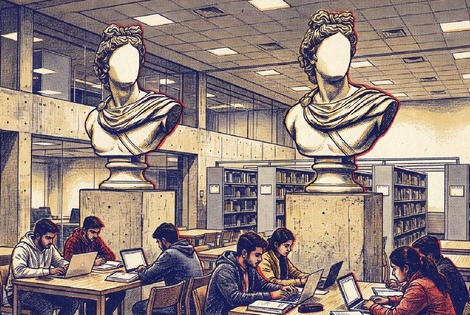
Somewhere in a Delhi drawing room this evening, a professionally successful Indian in his forties will explain with real conviction why Narendra Modi has been the best thing to happen to the republic in decades. He voted for the BJP in 2014, 2019 and 2024.
His bookshelf holds the Iliad, Middlemarch, perhaps some Rawls. The Ramayana is there too, in the Penguin Classics edition he has been meaning to read.
Twelve years in, he is the political right's real problem.
The right won political power in 2014. But the reference points of the Anglophone Indian mind, its aesthetic defaults, the literature it reaches for when it wants seriousness, were all set by others, and nobody has reset them. What 1947 won was political independence. Cultural sovereignty was left as unfinished business.
The instinct so far has been to answer this with cleansing: rewrite the NCERT chapters, remake the Indian Council of Historical Research (ICHR), replace vice-chancellors, rename the boulevards. All of this will do some work. None of it will do enough.
You can capture every institution and still lose the ecosystem. The publishers, film schools, prize juries, literary festivals, design ateliers and essay magazines are not things you can take over. They have to be built, and the right has not built them.
The other reflex has been to preach a 'Hindu reawakening'. This is the wrong message, delivered to the wrong audience, at the wrong volume. A great many Hindus, including devout ones, hear in it a summons they did not ask for, and resent being told what to feel about their own inheritance. A reawakening announced as a slogan is coercive. What the moment needs is not exhortation but a steady supply of things worth reaching for.
The Ram Mandir and the abrogation of Article 370 were, whatever one's view of them, closures of past accounts. They settled something. They do not compound.
A grievance stops paying out the moment it is answered. What remains is the memory of the answering, and memory fades faster than partisans expect. A movement that lives off historical wounds has a ceiling set by how vividly it can keep re-enacting them, and that ceiling lowers with time.
Every generation past the wound is a generation less invested in it. The eighteen-year-old voting in 2029 has no memory of 1992 and only a schoolbook memory of 2019. Her children will have less. A politics of correction has a natural half-life. A politics of creation does not.
The problem is sharper because Indian political geography will not hold still. Consider the Cockroach Janta Party, which did not exist in April 2026, was founded in May in response to an intemperate remark by the Chief Justice, and by late July had extracted the resignation of the Union Education Minister.
Whether it lasts is beside the point. The pattern is the point. The Aam Aadmi Party, unthinkable in 2011 and governing Delhi within two years, was the earlier version. Regional formations rise and fade on shorter cycles still.
Indian politics does not decay in a straight line. It fragments sideways, with new actors appearing at unpredictable intervals and rearranging the arithmetic before anyone has finished analysing the last election.
For a dispensation that has staked its cultural project on the state, this is a serious problem. The state is the least stable platform in Indian public life on which to build something meant to last a century. A movement embedded in publishing houses, cinema, prize juries and law faculties need not worry about which coalition holds Raisina Hill in 2034. A movement that lives inside the ministries must.
The Medici understood this first. They were bankers in a fiercely republican Florence with no hereditary claim to anything, and they found that the durable way to convert money into legitimacy was not to seize institutions but to build them.
They built the Platonic Academy, the Laurentian Library, San Lorenzo, an ecosystem of ateliers where a teenage Michelangelo could eat at the family table. They did not commission propaganda. They commissioned excellence, and the excellence became theirs by association. Five hundred years later, the Uffizi is still their argument.
The American conservative movement learned the same lesson more recently. The Federalist Society was founded in 1982 by law students and young professors who believed the legal academy's monopoly should be broken. It took four decades to reshape the American bench, and throughout it looked like a society of talent rather than a wing of the Republican Party.
That distinction was the source of its authority and of its survival across Democratic administrations. India's right should read this carefully. An institution recognisable as a BJP franchise dies with the next anti-incumbency wave. An institution recognisable as a home for serious Indian scholarship outlasts every dispensation.
The Indian right's own central complaint, the 'Nehruvian consensus', is a monument to precisely this strategy. In the decade and a half after 1947, Nehru and his heirs built the Sangeet Natak Akademi, the Sahitya Akademi, the Lalit Kala Akademi, the National Book Trust, the Films Division and NCERT.
None of these looked like party organs. All of them, taken together, set the reference frame for Indian elite culture for two generations. Nehru died in 1964. His institutional inheritance was still framing the argument in 2014, and to a considerable extent still is. That is compound interest, and the right, of all people, should recognise it, having spent fifty years complaining about the returns.
The strategy has a name. Antonio Gramsci called it cultural hegemony. Rudi Dutschke, more memorably, called it the long march through the institutions. The Western left executed it with discipline for a century.
The Fabian Society, founded in 1884, produced the London School of Economics eleven years later, and British Labour was still legislating from that inheritance in the 1970s. Hayek's Mont Pelerin Society, launched in 1947 with a few dozen economists at a Swiss hotel, took three decades to become Thatcher and Reagan.
In every case the shape is the same: build durable homes for ideas before the political weather is ready for them, and let the weather come to the ideas.
The project will have worked when an Indian teenager reaches for the Mahabharata as naturally as she reaches for Marvel; when a director's visual reference is a Chola bronze rather than a Nolan frame; when a school debate team reaches for Chanakya's arguments as naturally as it reaches for Cicero's. That is what organic cultural reinvention actually looks like.
The Ram Mandir was closure. The question now is what produces more. The right won the state. It has yet to build the century.
Related Stories
 India
India
DUSU election 2026 | From Arun Jaitley to Rekha Gupta: Ex
4 hours ago
 India
India
'Black chapter in Indian democracy': KC Venugopal on Milan Pradhan's arrest ahead of Nandigram bypoll
5 hours ago
 India
India
Cabinet recommends ambassadors to 13 countries including India, China and US
8 hours ago
 India
India
Delhi University freshers get their first taste of campus politics
11 hours ago
 India
India
Woman killed in Summerside remembered as doting mom and friend
11 hours ago
 India
India
The politics of leverage
17 hours ago
 India
India
Spotify launches Haryanvi 101 as listening in the language doubles in a year
18 hours ago
 India
India
‘But why now?’ Mamata questions arrest of Congress’ Nandigram bypoll candidate, calls it ‘BJP's vendetta politics’ | India News
20 hours ago