
In Ohio, Canada
In Ohio, Canada-U.S. trade war sparks anger and uncertainty
Youngstown sits in congressional district that exports more than $820 million US in goods to Canada each year
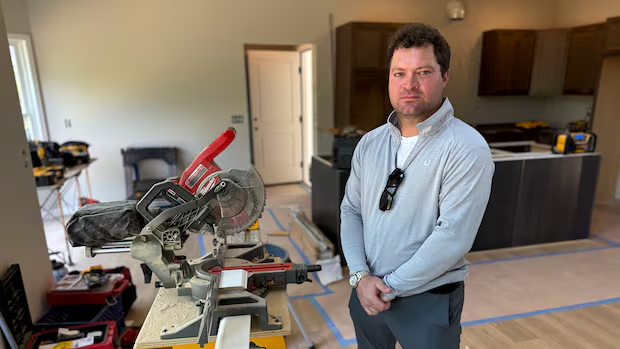
The rat-a-tat-tat of a nail gun and high-pitched whine of a buzz saw echo through the two-storey home as Joe Koch’s carpentry crew completes the final touches.
Koch, the vice-president of operations for his decades-old family business, had hoped there would be three or four other new builds going up in this Ohio subdivision about now, but the U.S. trade war with Canada and many other countries has scuttled that plan.
"People are just going to not build that house this year. They're going to wait 'til interest rates lower. They're going to wait 'til the tariffs subside or the political landscape changes," Koch said.
He sees his business challenges as a microcosm of what’s happening across Ohio. President Donald Trump's tariffs on Canadian and other nations' goods have not only raised the prices he pays but costs for consumers more broadly.
One of Trump's top deputies has been unsatisfied with trade deal on the table for Canada, sources say
Carney says trade deal became untenable when U.S. 'asked too much and offered too little'
Koch used to buy Canadian shingles. Now he buys from a local company.
"If there's any benefit [to the trade turmoil], it's that you get that much more resourceful," he said.
The uncertainty and instability of the trade war has made financial planning and supply management difficult. Koch believes when it comes to trade, building relationships and making compromises is important.
"When it comes to the real volatile landscape of the globe, you need partners within your backyard that you're able to go to," he said. "I think it may be great to be able to have everything homegrown — but is that the reality of the world? I'm not so sure."
Koch feels caught in the middle of a trade storm but he’s determined to tough it out.
"It's a game of chess," he said. "There's no victory. It's just battle after battle and you win where you can. You try to minimize the damage wherever there is damage. And then you live to fight another day."
"But we're used to it," he said. "We're Youngstown, Ohio."
Youngstown/Warren, which has a population of around 425,000, has faced economic challenges before. It was once known as the heart of U.S. steel country, until the closure of Youngstown Sheet and Tube in September 1977 put 5,000 workers out of work overnight.
While Youngstown diversified its economy in the decades that followed, more than 20,000 jobs are still tied to manufacturing, according to the Bureau of Labor Statistics. That's across numerous sectors, including steel tubes and pipes, plastics and advanced materials.
‘Nonsensical’: We asked Americans what they think about the trade war
Last year, Ohio exported $17.5 billion US in goods to Canada — roughly a third of its total exports. Ohio’s top exports to Canada included $2.7 billion US in engines and turbines, $1.8 billion in auto parts, $1 billion in plastics and $692 million in iron and steel alloys and semi-finished products, according to data from the Embassy of Canada in Washington, D.C.
Conversely, Ohio imported $3.2 billion US in Canadian crude oil, $1.1 billion in vehicle parts, $1 billion in plastics, $915 million in steel and semi-finished products, and $672 million in aluminum and aluminum materials.
Youngstown sits in a wider congressional district known as OH-6 with a population of more than 775,00.
It exports more than $820 million US in goods to Canada every year, including coal and petroleum, iron steel and ferroalloys, resins and synthetic fibres, aluminum products and plastics.
While not all of these imports and exports are caught in the crosshairs of the escalating tariffs, a prolonged trade war could threaten some businesses in those sectors.
What Canadian goods is Trump targeting with his latest 50% tariffs?
At a local ballpark recently, players were hanging out for a post-game beer in the parking lot under the glow of a warm sunset. But there were also heated words about the Trump administration's trade war with Canada.
“It makes me angry. Why is that? Because, first of all, Canada and us have been very good allies forever, and to do something like this makes no sense at all," said Pam Hall. "It's just ridiculous.”
Next to her, Patricia Vandervoort chimed in: “We don't want Canada to hold it against us citizens — it's not us.”
Hall said the administration’s trade war with Canada and other countries is hitting Ohioans in the pocketbook.
“Everything you buy is more expensive, no matter where it comes from, because of these tariffs. Groceries, basic day-to-day items that you need,” she said. “The tariffs have … done a lot to destroy the economy.”
Their friend Cindy Burns fears Canada may permanently take its business elsewhere.
“I'm sure you're going to strengthen trade with other countries to supplement what we're not giving you or trading with you. You'll go elsewhere and maybe it'll be better and you'll never come back,” Burns said.
“It'll affect our factories, because there won't be a demand that there has been. People will lose their jobs. I mean, it's gonna spiral,” said Vandervoort, a Pennsylvania native.
Not far away, Larry Kelly believes the tariff war could flip seats blue in this red state in the November midterms.
Some polling in the Buckeye state has shown Democrats competitive and even ahead in some key races, including for a Senate seat currently held by Republican John Husted, who was appointed by the Republican governor to replace now Vice-President JD Vance.
“I think it's going to have a dramatic effect on the midterms," said Kelly.
His teammate Mike Glinatsis says the trade war hasn’t affected him that much.
“I mean, I can afford to eat,” he said. “I think Canada had … high tariffs on our stuff. And then Trump made it equal. And that's when people started getting all pissy.”
Others in the business community share Glinatsis’s more positive view of the tariff war.
“There's a mixed bag — it hurts some, it helps some. And there's some companies where it hurts on one side, it helps on the other," said Guy Caviello, president and CEO of the Youngstown/Warren Regional Chamber.
One of the major steel companies in town is in favour of Trump’s tariffs on Canadian steel, Caviello said.
“Sometimes in those meetings, I've got a chamber member that is trying to argue against tariffs sitting across the table from a chamber member that's embracing the tariffs, and it is interesting to hear them talk it out.”
Companies and agriculture producers in Ohio are still trying to figure out how the Canadian counter-tariffs, set to begin on Sept. 8, will affect them.
Caviello said data from Youngstown State University’s Export Assistance Network suggests overall, the trade war has been a “net negative.”
Americans 'rethinking who truly has their back'
The trade war has stymied growth potential for some Ohio businesses, such as Shapes Unlimited, which fabricates aluminum gates, fences and other materials. It employs roughly 40 people in the Youngstown/Warren area and has just moved into a new facility with major investments in technology.
"We'd like to further extend our reach into the provinces, but it isn't cost-effective right now,” said CEO Doug Rende, who has been eyeing markets in Ontario and Quebec, given their proximity to northeastern Ohio.
“The issues associated with transportation surcharges, rising fuel costs and obviously the 50 per cent issues associated with tariffs make it untenable.”
Rende’s business has had to work hard to source aluminum amid the tariff war, with levies ranging from 25 to 50 per cent on imported aluminum and an elevated demand for domestic and scrap supply.
“You can't cut off your nose to spite your face until such time as you're finding ways to more aggressively invest in the capacity,” Rende said.
CBC speaks with steel-making company owner Rahim Moloo on the impact of tariffs
The U.S. did once make more of its own raw materials, he said.
“This country abandoned investments in aluminum manufacturing in the 1980s, where there were 30 smelters. Now there's four. So again, [the government's] fire-ready-aim approach is unnecessarily raising costs to the end consumer, making housing costs less [affordable], and certainly negatively impacting by millions of dollars our ability to be more profitable in utilizing this material on an ongoing basis.”
Rende said he’d like to buy Canadian aluminum because of its quality and its proximity to Ohio, which would help significantly shorten the lag time in its supply chain.
Rende’s patience with the trade war is growing thin.
“Regardless of the political affiliations and points of view of your prime minister and our president, the bottom line is it's affecting us as individuals, as consumers, it's affecting us as businesses and business owners, and it's driving up issues that can be easily averted,” he said.
He believes this spat and its knock-on effects will play a role in how Americans vote in November.
“I think the U.S. population is now rethinking who truly has their back — and we'll see.”
Katie Nicholson covers the U.S. for CBC News. An investigative journalist who loves being in the field, Katie has covered everything from wildfires, flash floods, and hurricanes to January 6th. Before joining the DC bureau, Katie reported extensively in Canada on intimate partner violence, sexual harassment, MMIWG and child welfare. Get in touch: Katie.Nicholson@cbc.ca
Related Stories
 Canada
Riley Laychuk's weekend forecast: slightly unsettled
20 minutes ago
 Canada
Alberta pulp mill under pressure from Trump’s tariffs gets $20M in federal support
21 minutes ago
 Canada
NP View: Fortress North America isn't what Canada needs
21 minutes ago
 Canada
Number of Canadians missing in Nepal
1 hour ago
 Canada
Kazakhstan’s new ruling party projected to win Sunday elections
1 hour ago
 Canada
Frequent T.C.H. closures caused by accidents this summer becoming alarming, says RCMP
1 hour ago
 Canada
This drive
1 hour ago
 Canada
Strong support for Canada axing U.S. trade talks, retaliatory tariffs: poll
2 hours ago