
NP View: Fortress North America isn't what Canada needs

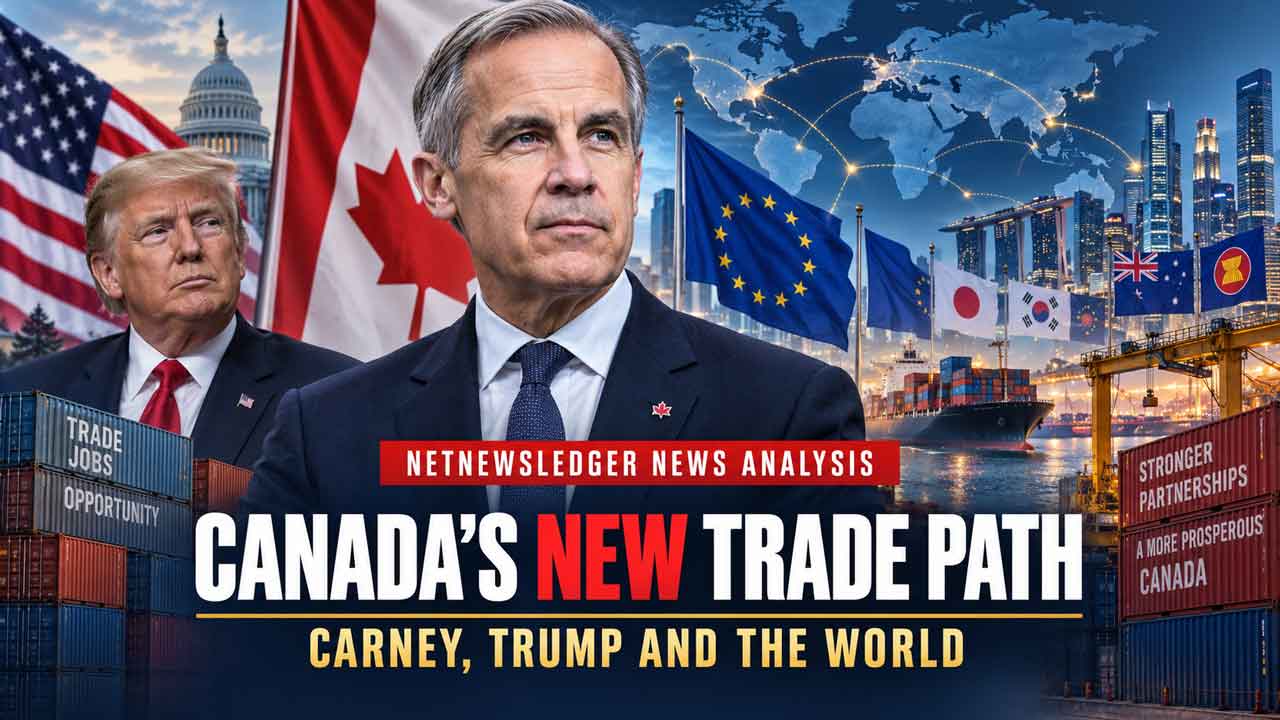
It is objectionable that Prime Minister Mark Carney will address the European Parliament before he faces the House of Commons over why trade talks broke down with the Trump administration. There is much to discuss and, so far, Carney has been cagey about what transpired, while American officials are challenging his version of events.
In particular, Carney needs to explain exactly what he meant when he claimed last Saturday that the Americans wanted to insert language that would restrict Canada's freedom to sign trade agreements with other countries. "One thing we were not going to accept was any restriction on those deals," he said.
It is this argument that made it easy for Carney to persuade Canadians across the political spectrum to rally around the flag. However, the specific proposals at play appear to be more complicated than what has been debated in the media. To start with, Carney even suggested in that same Saturday speech that the government was open to aligning trade policy with the U.S. under the right circumstances. "We would be prepared to do that," he said.
On Tuesday, the New York Times reported that this idea didn't even come from the Americans, but from Ottawa. "Canadian negotiators had gone into the talks suggesting the ultimate goal should be to create a 'Fortress North America.'" And within this so-called fortress, the Times continued, there would be "ultralow or nonexistent tariffs inside its walls, namely between Canada and the United States, and aligned tariffs for outsiders."
U.S. Trade Representative Jamieson Greer then told CBC on Wednesday that, yes, it was the Canadians who were the ones pushing for Fortress North America. He explained why the U.S. likes the idea. "We can't have Canada be a place where you can get flooded with steel and aluminum from other countries and be used as a back door into the U.S.," he said.
Based on what can be gleaned from these partial explanations and anonymous leaks to media, both the Carney government and the Trump administration are aligned on co-ordinating trade policies with third parties, at least when it comes to certain sectors from certain countries.
The difference is that Canada expected that in exchange for matching U.S. tariffs on others, there would be zero or close to zero tariffs on all goods trading back and forth. The Americans liked the concession, but wanted to keep harsh, if a bit lower, tariffs on autos and steel.
We believe that Canada was right to reject that agreement. Canada would be giving up far too much and receiving far too little, and this would have been before entering talks to renegotiate the Canada-U.S.-Mexico Agreement (CUSMA), making our hand much weaker. If the U.S. wants to stop steel flooding into Canada from, say, China, which could then enter the U.S. market, keeping high tariffs on Canadian steel and autos is an obvious non-starter.
But the prime minister should spare Canadians the posturing that walking away from the deal was some kind of high-minded stand for Canadian sovereignty. If what we are hearing is true, Carney is ready and willing to give up that very sovereignty for the right deal.
To be clear, any trade deal involves conceding some sovereignty, as it limits a country's ability to set its own tariff rates. As for limiting trade with parties outside a deal, this isn't a new feature. The 1965 Canada-U.S. Auto Pact required agreement between the two countries before either could enter a free trade deal on autos with another country.
Most relevant for today, CUSMA, which Trump wanted and agreed to, permits either the U.S., Canada or Mexico to terminate the entire treaty if a "free trade agreement" is entered into with a "non-market economy."
The wisdom of Canada agreeing to the so-called "China clause" can be debated, but the difference between then and now, is that CUSMA is a comprehensive agreement encompassing free trade on nearly all goods that cross the border. Countries are expected to make concessions, even far-reaching ones, in such deals, but the other side is also supposed to make concessions. Right now the U.S. is offering very little.
It might be reasoned that the tradeoff of accepting lowered, but still high, tariffs in certain sectors, and some restrictions on Canadian foreign policy, in exchange for continued tariff-free trade in most sectors is worth it, so long as it provides certainty. But certainty wasn't even on the table as, according to the Times, the Americans wanted to reserve the right to change any tariff at will at any time.
We'd advise the government to tread carefully here.
The European Union provides an appropriate warning. No members are permitted to sign trade deals with non members; instead, deals are negotiated by the bloc as a whole. The EU also forces member states to align on a host of regulatory measures, including on labour and environmental policy.
With 27 members of varying economic size though, it is difficult for any one country to dominate, even if larger members like France and Germany hold greater influence.
If Canada were to similarly align with the U.S., as Carney seems open to, we wouldn't even be submitting to some faceless North American bureaucracy, which would be bad enough, but to Washington.
Michael Higgins: And just like that, the French language is protected ...
Colby Cosh: Will Ottawa rename Trump Avenue as revenge for 'Lake America'?
Related Stories
 Canada
Canada, Singapore Reaffirm China Trade Ties as World Pushes for Self
7 minutes ago
 Canada
Police say at least 2 were hospitalized after shooting at elementary school, and the shooter is dead
7 minutes ago
 Canada
Canada’s largest helium purification facility now operating in Sask.
7 minutes ago
 Canada
How the $90M Lotto Max jackpot stacks up against other big Canadian lottery prizes
7 minutes ago
 Canada
Canada’s EV sales are growing, but not fast enough: expert
7 minutes ago
 Canada
3 dead, at least 10 injured in Calgary transit bus fire
8 minutes ago
 Canada
Sophie Grégoire Trudeau didn't see Justin Trudeau as a PM: 'I knew it was his job, but come on'
1 hour ago
 Canada
Living in Calgary showed me Albertans don't realize how good they have it, but their grievances are real
1 hour ago