
I walked across Canada and it changed what I thought I knew about it
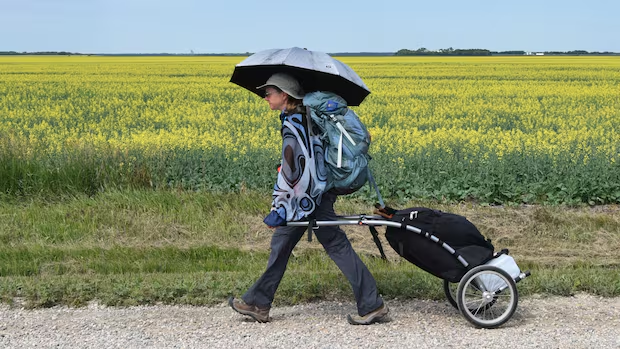
I walked across Canada and it changed what I thought I knew about it
Regions I had dismissed as flyover areas revealed hidden beauty at walking speed
This First Person column is written by Sonya Richmond, who lives in London, Ont. For more information about CBC's First Person stories, please see the FAQ.
It was 42 C outside Emerson, Man., and my partner and I were running low on water. We had been walking for hours along an exposed stretch of gravel road, rationing what little we had left. The last drops in our bottles were so hot they burned our throats.
When a pickup truck slowed beside us, I expected a quick question about two backpackers in the middle of nowhere. Instead, the driver asked where we were headed. When we told him we were walking across Canada, he nodded as if this were completely reasonable.
Noticing our nearly empty water bottles, he stepped out, opened a cooler and started refilling them with cold drinking water without being asked.
He mentioned, almost in passing, that in his region the tap water wasn’t safe to drink and that he had just bought the water on his way home. He didn’t offer the information as a complaint or for recognition. He simply stated it as a fact, wished us well and drove off.
That small act — water freely given, time freely shared — reminded me that much of Canada is held together by people who do not announce their generosity. They simply practise it.
Canada Day 2026: Celebrate from coast-to-coast | CBC News Special
Snowbirds perform in Ottawa on Canada Day for the last time before being grounded
Over four years, my partner and I hiked more than 14,000 kilometres of the Trans Canada Trail from Cape Spear, N.L., to Victoria. Our goal was to experience Canada for ourselves at human speed — rather than through headlines, social media feeds or an airplane window. To do this, we put our careers on hold, sold our home and donated most of our possessions to charity.
Before I set out, I thought I understood Canada. My sense of it came from maps, headlines and travel between major cities. I knew where the mountains rose and the coasts curved, which places were destinations and which were passed through.
Then I began walking and I began to see how much of what I thought I knew was shaped by distance and speed. There is a wide gap between map-Canada and lived-Canada, and most of us live almost entirely on the map.
At walking speed, that distance becomes something you feel in your legs and plan your days around. Towns are no longer anonymous dots, but places where you arrive tired, visible and dependent on the kindness of strangers.
In rural Newfoundland, a man named John invited us to a lobster boil-up on the beach as though we were family. In Nairn Centre, Ont., a retired couple who had seen our hike in the news stopped to wish us well in a roadside diner. When we went to leave, we discovered they had quietly paid for our meals.
Outside Maskwacis, Alta., an Indigenous couple pulled over and gave us a braid of sweetgrass for protection. By the time we reached Vancouver Island, local naturalists joined us for the final steps of our cross-country journey.
None of these moments made headlines. But together they reshaped how I understood kindness to be what holds this country together.
And then there was the geography. Some of the most profound lessons came in regions often dismissed as “flyover.”
In Atlantic Canada, we found coastal communities held together by distance, weather and resilience, where neighbours still checked on one another after storms. In Quebec and Ontario, we began to grasp the sheer scale of the country itself. In British Columbia, we saw what it means to work and live in a landscape shaped by forces beyond human control, where wildfires and floods can sweep across areas larger than some European countries.
Saskatchewan, in particular, challenged everything I thought I knew. I had expected flat emptiness. Instead, the land rose and fell in long, rolling hills. The Qu’Appelle Valley cut deep into the landscape, wide and unexpectedly beautiful. We crossed more rivers by ferry there than in any other province.
At first, much of it appeared as expected: gravel roads running straight to the horizon, grain fields on either side, limitless sky above. I remember feeling impatient, scanning for something more dramatic.
Gradually I started to notice what I had been missing.
Meadowlarks sang from fence posts. I felt the layers of history as I walked through former railway corridors that stitched together Confederation and through Indigenous territories whose histories stretch far beyond them.
At 100 km/h, the Prairies are flat. At five km/h, I noticed wind patterns move differently across canola than wheat.
What I had dismissed as empty was, in fact, full of life, but only if you paid attention.
That shift changed how I understood scale. I had always associated grandeur with mountainous landscapes. But the Prairies revealed something different: just as vast and complex, but expansive rather than towering. The Rockies and Niagara Falls demand your attention, but the Prairies invite it.
Walking through them, I also came to understand that some of the most important things in this country don’t announce themselves. They emerge slowly and only if you’re willing to notice.
At that pace, it becomes much harder to dismiss entire regions as “in between” or reduce communities to simple narratives. I began to see how the places I overlooked are essential to the fabric of this country — growing food, sustaining ecosystems and maintaining ways of life that rarely make it into national conversations.
What changed for me was not just how I see Canada, but how I think about it. I’m now more cautious about simple descriptions, about calling a place flat or empty. Slowing down has made me less hasty in my judgments and more humble in how I speak about this country. I place more value on lived experiences than generalizations.
I don’t expect most people to walk across Canada. But there is value in slowing down and recognizing how much exists beyond the main routes we take and the stories we repeat.
Do you have a compelling personal story that can bring understanding or help others? We want to hear from you. Here's more info on how to pitch to us.
Sonya Richmond is a travel writer, research ornithologist and Royal Canadian Geographical Society fellow who has hiked the Trans Canada Trail. Through her #Hike4Birds project and website Come Walk With Us, she explores slow travel, conservation and the human need to reconnect with the natural world.
Related Stories
 Canada
Thieves steal 4 Renoir paintings from French Riviera museum, 2 of them still missing
28 minutes ago
 Canada
Canada strikes back with tariffs on about $20 billion worth of US goods
28 minutes ago
 Canada
Canada retaliates against Trump with counter
28 minutes ago
 Canada
Toronto condo developer launches $10M lawsuit against online critics, alleging a 'malicious campaign'
28 minutes ago
 Canada
Canada’s counter
29 minutes ago
 Canada
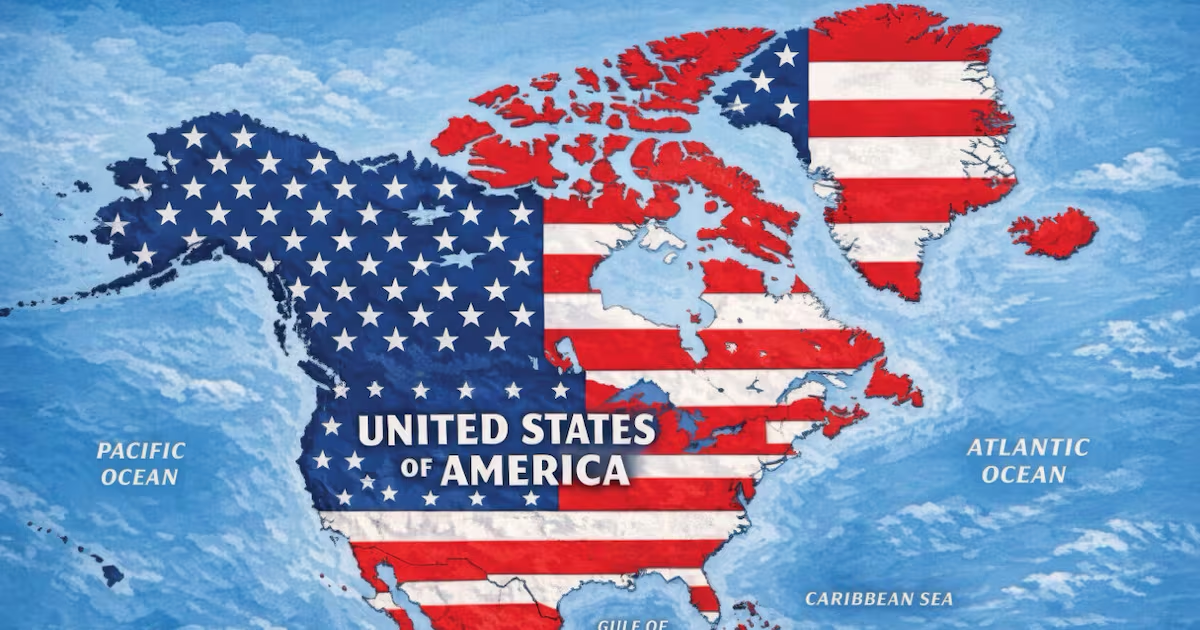
Trump sparks fury with post of map with Canada, Iceland as part of U.S.
29 minutes ago
 Canada
Alberta separatist leader Rath faces $109M debt claim from US investors
1 hour ago
 Canada
Back to school: Everything you need to know about Ontario's education policy changes
1 hour ago