
Hundreds arrested, tear gas deployed in chaotic protests across France over cost of living concerns
Hundreds arrested, tear gas deployed in chaotic protests across France over cost of living concerns
‘It’s utter chaos': Protests in France evolve into anger over broader economy
Several groups are converging today to take part in the protests across France, including a group known as the gilets jaunes — or yellow vests.
The yellow vests first emerged in 2018 during protests against rising fuel prices and other socio-economic issues in France.
The activists got their name from the fluorescent vests they wore during the demonstrations, which were met with a harsh crackdown by the authorities, human rights groups said.
Jérôme Rodrigues, a prominent yellow vest leader, said in a Facebook video last Saturday that the group "can't look away" as student protesters are being hit in the streets "while expressing their anger."
"The yellow vests know that anger, we know that feeling of not being listened to, of being ignored, of always having to work harder while our living conditions deteriorate," he said. "We know what it means to have to take to the streets because words are no longer enough to express our daily struggles."
He called on yellow vest activists and others across France to join today’s demonstrations.
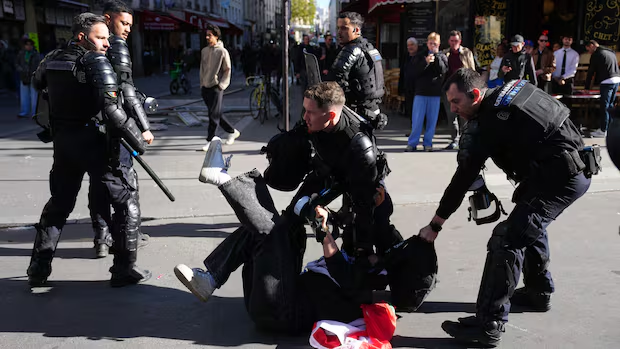
French gendarmes, or military police officers, face off with protesters during a demonstration at Place de la République in Paris.
A person falls on the ground during clashes between protesters and police today in Strasbourg, France.
A protester dressed as Jesus Christ and holding a mock gas station dispenser walks past a burning car at the Place de République in Paris.
Multiple children have been harmed over the last few weeks. We've already talked about the teenager whose hand was reportedly blown off by a police stun grenade. But reports have found four instances of minors suffering irreversible injuries. There is also a fourteen-year-old who has a broken jaw and several smashed teeth after a tear gas canister, reportedly thrown by a police officer at close range, struck him. In two other cases, a person's eye has either been lost or damaged by rubber bullets.
The news has sparked international concern, with human rights group Amnesty International releasing a statement calling for France to permanently ban the use of stun grenades — calling the move a "first step."
France suspended the use of stun grenades for the student demonstrations, but Interior Minister Laurent Nuñez said they could be used on Saturday. "If there were to be clashes, all types of intermediate weapons can be used," he told Télématin TV on Friday.
-With files from Reuters and The Associated Press
French media outlets are reporting that government representatives will meet in a few minutes at the Interior Ministry headquarters in Paris to discuss what’s been happening today.
BFMTV said representatives from the offices of the prime minister, interior minister and justice minister would take part.
With tear gas filling the streets of Paris and vandalized vehicles smouldering around the Place de la République, France is facing yet another moment of reckoning.
Many of those occupying the streets today belong to La France Insoumise (France Unbowed), the country's hard-left coalition that openly supports direct confrontation with the government of President Emmanuel Macron.
On the other side, opponents of the unrest from the political centre and right are pushing back. Jordan Bardella, president of the far-right National Rally, blamed what he called "anti-cop militias" for the violence and declared his solid backing of the security forces.
I spoke to a prominent civic leader about the extreme polarization gripping the nation, and he offered few clear solutions for how the country moves forward.
"France is coming to a major turning point," said Bally Bagayoko, the left-wing mayor of the working-class Paris suburb of Saint-Denis.
Bagayoko has become a central figure in this crisis. He is a fierce advocate for French high schoolers who have spent weeks blockading schools to demand more government education funding. Earlier this month, a video went viral showing Bagayoko physically wedging himself between a line of riot police and young students in Paris to dial down the threat of violence.
"Today, unfortunately, this France is in sadness," Bagayoko told me. "It is unable to provide concrete answers to the legitimate demands of high schoolers.”
Triggered by severe gridlock over national budget and austerity measures, France has faced a rapid succession of hung parliaments and short-lived governments. With a high-stakes presidential election looming next spring, today’s chaotic scenes appear destined to entrench the country's political paralysis even deeper.
You may have seen the viral phrase "Bismillah, c'est les ténèbres" on posters, spraypainted on walls or shared in memes as France's student protest movement has grown in recent weeks.
But where exactly does the slogan — which translates to, "In the name of God, it's the darkness" — come from?
It goes back to what the students say was an alleged attempt by French police to infiltrate the protests.
A message was apparently posted to Snapchat by someone calling themselves "Mamadou." The message opened with the phrase "Bismillah, c'est les ténèbres," and went on to ask for more information about the planning of the protests.
The message was widely shared — and mocked — online, and then it started to appear at the demonstrations, too.
Greta Thunberg, the Swedish activist who joined the French protests earlier this week, also poked fun at the phrase in an Instagram video expressing support for French activist collective Œil au Beurre Noire.
As the unrest unfolds in France, arrests are happening in response. According to police, there have now been at least 272 arrests nationwide so far today.
Thousands of demonstrators have been arrested in recent weeks — most of whom are under the age of 18. Critics have voiced concern over police action against young people. In one of the worst examples so far, one teenager lost his hand and part of his lower arm, reportedly while reaching for a police stun grenade that detonated.
Benoît Payan, the mayor of Marseille in southern France, says he spoke with Prime Minister Sébastien Lecornu and Interior Minister Laurent Nuñez to get more support in response to "the out-of-control situation in downtown Marseille this morning."
Payan said in a social media post that a police station was vandalized, the doors to city hall were forced open and several businesses also were damaged.
"Additional resources will be deployed to protect residents and to allow the demonstration this afternoon to unfold calmly and with respect for people and property," he said.
Related Stories
 Business
World News | CNN Business
2 hours ago
 Business
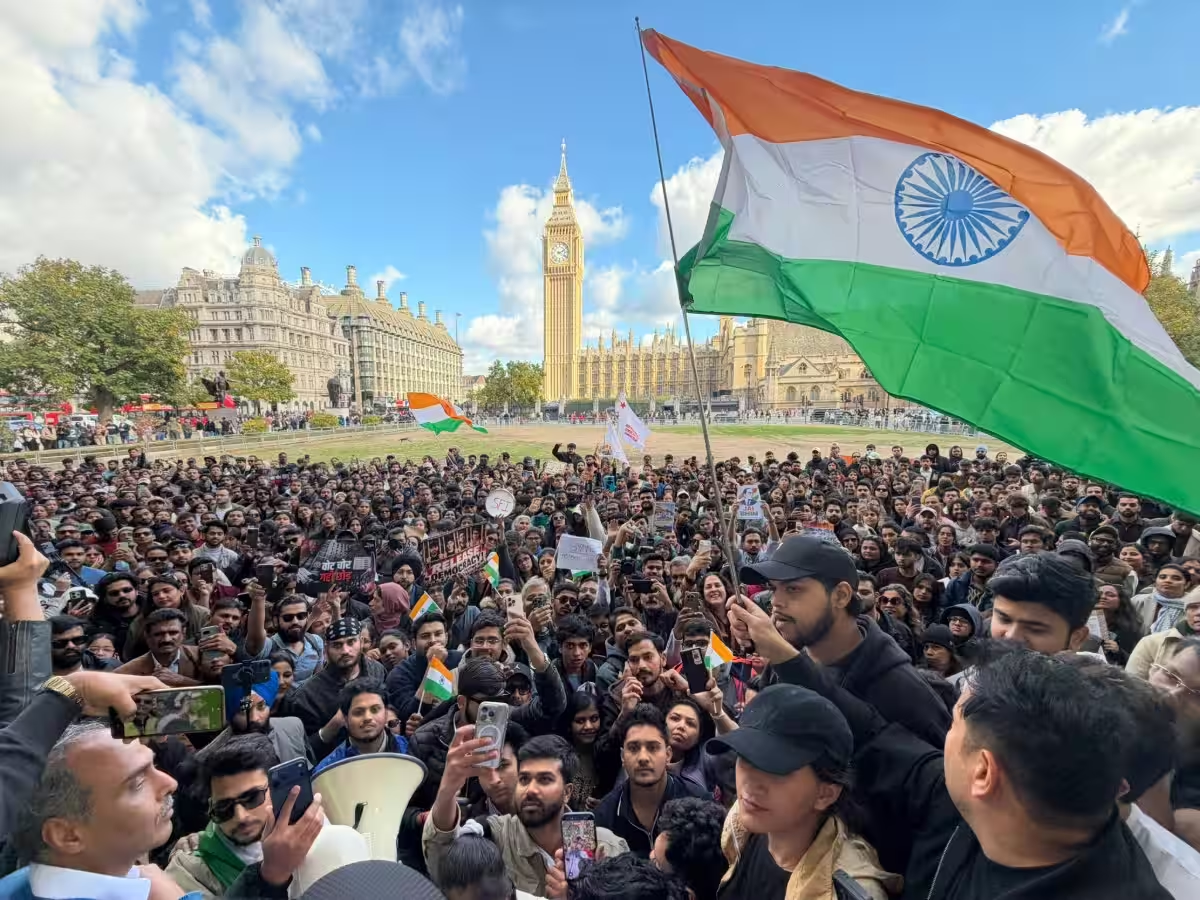
Indian student groups protest against CEC, SIR in London; Govt supporters hold counter
2 hours ago
 Business
Startup Wrap: Mega
3 hours ago
 Business
Weekly funding roundup: The startup deals you may have missed in week of October 18
6 hours ago
 Business
'No route to funding' for closed pool
8 hours ago
 Business
Amazon deforestation hits lowest level since 1988
12 hours ago
 Business
Mark Wahlberg wants to take on the longevity
12 hours ago
 Business
Winnipeg health meetings end with federal commitment to extend funding for rare disease research
13 hours ago