
How the separatist Parti Québécois took back power in Quebec
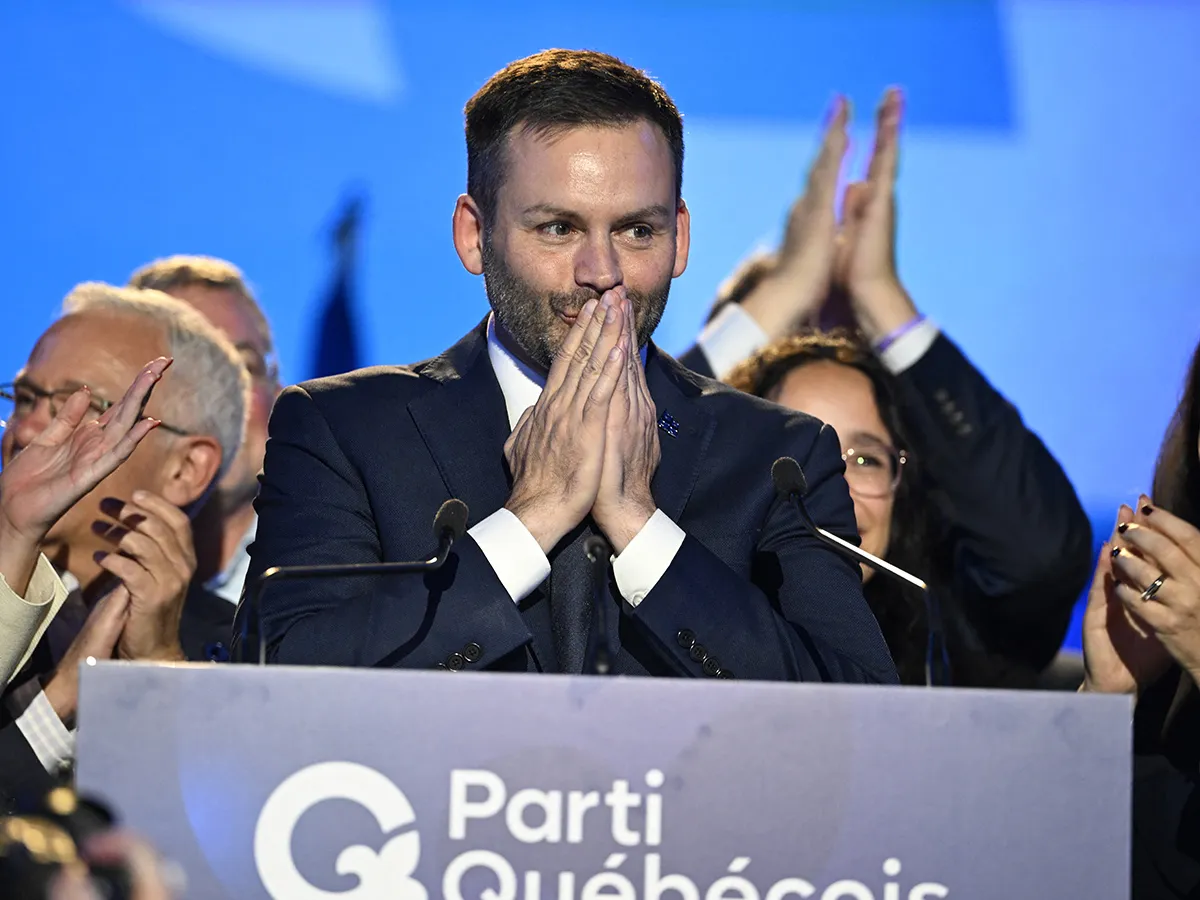
MONTRÉAL, QC — The rest of Canada will be waking up on Tuesday to a slightly less painful hangover than expected after Quebec elected a minority Parti Québécois government led by leader Paul St-Pierre Plamondon.
The separatist party, which was nearly wiped off the electoral map four years ago, came roaring back just a few seats shy from a majority. However, the party underestimated support for Éric Duhaime’s Conservatives that stopped the PQ from getting to the magic number of 64 seats.
St-Pierre Plamondon promised to collaborate with other parties in a minority situation, including working with Québec Solidaire — which is also vying for the independence of Quebec — to hold another referendum.
He also had a message for the rest of the country that is apprehending the return of his party in power.
“I want to reiterate the following: the independence project we are championing is not directed against you. Quebec will always be a partner acting in good faith and open to collaboration — as we have always been,” he said.
National Post spoke to over a dozen people in the PQ’s orbit — candidates, political staff and people who know the leader well — in an attempt to understand just how the PQ pulled off the feat of winning government with 28 per cent.
St-Pierre Plamondon’s party had been first in the polls, almost without interruption for nearly three years. And he was facing a new incumbent premier in Christine Fréchette who, many would agree, was performing well in the role.
It was easy for political adversaries to point out that, in that sense, the situation could become similar to Pierre Poilievre’s Conservative Party of Canada who lost against Mark Carney’s Liberals last year despite dominating poll numbers for years.
But with a fixed election date set for Oct. 5 and with five main political parties at play — including three splitting the federalist vote — the situation was entirely different.
Louis Lyonnais, one of St-Pierre Plamondon’s closest aides, said the PQ was well aware that Fréchette’s Coalition Avenir Québec was going to use the ongoing trade war between Canada and the U.S. to scare voters into re-electing her government.
“We knew the CAQ would play that card. That was all they had left,” he said.
That is why on Aug. 18, days before the election, St-Pierre Plamondon made the formal announcement that a PQ government would only hold a referendum on the separation of Quebec after U.S. President Donald Trump leaves office in January 2029.
It wasn’t exactly a new promise, as the PQ was already planning to hold the referendum near the end of a first mandate in government. But making that announcement would lessen the attacks that the PQ would destabilize Quebec in already unstable times.
“We took away their strongest argument,” Lyonnais said of the PQ’s main adversaries.
The days that followed saw the collapse of trade talks between Canada and the U.S. which caused the “rally ‘round the flag” even in Quebec. Trump imposed further tariffs on Canadian exports and Canada shot back with counter-tariffs on U.S. imports.
The sequence of events benefitted Fréchette, who was presenting herself as the person best placed to face Trump. Her party was creeping up in the polls, in second place, and many were wondering if the “Trump effect” could push her just over the edge.
Lucas Medernach, director of communications for the PQ, said the party was expecting the CAQ to slightly go up in the polls, but he wasn’t anticipating the counter-tariffs which helped the incumbent party go up a bit higher than anticipated.
However, the CAQ never saw a “stratospheric” rise in the polls either, he said.
The only party that was able to rise to the PQ’s levels was the Liberal party which, back in the spring, was toe-to-toe with the separatist party. But leader Charles Milliard’s perceived ambiguity on the question of the French language and religious signs in recent months set him back.
The PQ was especially keeping a close eye on the vote of people aged 55 and up, which were heavily leaning towards the CAQ because of the trade war with the U.S. Medernach admitted that trend was a little “worrisome” at the start of the campaign.
What also irked the Péquistes was the fact that Carney and Fréchette were often seen together for major announcements in the days leading up to the campaign, whether it was for the Churchill Falls energy deal or Davie Shipyard’s icebreakers contract.
“Let’s be honest: Mark Carney had chosen his winner,” Medernach said.
Carney’s team has denied that was the case, and that they were simply working with the team in place to land some major deals. If anything, the federal government was more concerned about its own results in the Chicoutimi byelection on Aug. 31.
Fréchette would use every opportunity to tout just how in sync she was with Carney’s team, saying that she had influenced Canada’s counter-tariffs. That was promptly denied by Ottawa, in a move seen by the PQ to create a distance between the two.
In the weeks that followed, the CAQ leader was forced to admit she was not consulted about some of Ottawa’s major initiatives before they were announced.
That was the case about the plan to privatize operations at the Montreal airport and the productivity mega deduction that would deprive Quebec from an estimated 1 billion annually in corporate tax revenue as it would need to harmonize its rules.
Fréchette also struggled to say early on whether she was a federalist or a sovereigntist — she worked for the PQ during the Pauline Marois government — and eventually settled on being an “autonomist” vying for more powers for Quebec within Canada.
Medernach said the electorate took notice of these contradictions and it reinforced the need to have someone who is authentic and straightforward with voters.
Before the debates, St-Pierre Plamondon and his team seemed tense. The CAQ was still too close for comfort in many critical ridings around the Montreal area, and his small team was struggling to keep up with the daily flow of announcements.
“How could we not be stressed? We were the target of all the attacks,” said Medernach.
Furthermore, the PQ had much less financial resources than its competitors, having elected only three members of the National Assembly (MNAs) back in 2022. The caucus eventually grew to seven members after the PQ elected four more in byelections.
Overall, the campaign was too crowded with too many promises from all five parties.
One PQ staffer admitted it was a boring campaign, where parties were proposing different nuances of the same thing because there is no money in government coffers.
Lyonnais said there is simply nothing to spend: “You can’t invent money.”
For instance, the PQ, the Quebec Conservatives and Québec Solidaire said they would abolish the provincial tax on used goods, such as cars, electronics and clothes. The PQ and the Conservatives also vowed to cut taxes on gas at various degrees.
St-Pierre Plamondon’s team decided to put a lot of energy into preparing for the debates, even keeping him from making public events in the days preceding the first one. The leader was even absent from presenting his party’s financial framework.
“Paul is a sprinter,” said one former PQ staffer. He said the leader is at his best when he is able to focus on a few things at a time. Working with him, the staffer said St-Pierre Plamondon would often have three intense days and three with a lighter schedule.
Lyonnais said the strategy was for the leader to arrive at the debates in good shape.
“Our job is to turn him into a marathon runner too,” he said.
By all accounts, St-Pierre Plamondon performed relatively well in the debates. But even his team acknowledges that he got off easily and wasn’t the target of many attacks.
“We had braced ourselves for many, many, many attacks,” Lyonnais said. “But indeed, yes —perhaps we weren’t attacked as much as we thought we would be.”
Fréchette, on the other hand, was forced to defend eight years of the CAQ’s record.
She made the bizarre choice, some PQ officials remarked privately, to distance herself from the founder of the party in the first debate. “I am not François Legault. I am Christine Fréchette, and I bring my own way of doing things,” she said.
That statement would come to bite her at the end of the campaign when La Presse revealed that Legault joked in a private group chat: “I am not Christine Fréchette.”
“I think Quebecers saw right through the CAQ’s strategies, which tried to claim it was a brand-new team with a new vision. It was the same old CAQ,” said Pascal Paradis, former PQ MNA for Jean-Talon in the Quebec City area.
St-Pierre Plamondon has the reputation of looking angry or having a short fuse. So, his team had to keep him “grounded” to make sure he would stay calm and collected.
As the father of three young children, he would spend a half-day each week with his family. And during the debates, he had a picture of his children in front of him — a way for him to remember that not every shot at him is worth getting worked up about.
Former PQ MNA Alex Boissonneault, who lost his seat on Monday night to the Conservatives, said there already was an understanding at the onset of the campaign that Quebecers were ready for change after eight years of a CAQ government and that the PQ could embody that change.
While he felt around the mid-campaign mark that people’s impressions of the different leaders had “crystallized” and that voters were ready to make their choice, it did not quite benefit him in this election.
Medernach said that, after the third debate, seeing that the leader had not made mistakes and that the polls were still good, that the PQ thought this could be it.
“Our stress was replaced by the question: will we win a minority or a majority?”
The fatal blow for the CAQ was without a doubt the allegations of foreign interference, 48 hours away from the opening of advance polls. A report claimed that an obscure U.S. think tank was attempting to help the PQ get elected to divide the country.
Fréchette, after claiming she would ask for a meeting with Carney on the matter, was forced to admit that her own officials had contacted CSIS on the matter days prior. She eventually said there was no proof of interference in the Quebec election.
It eventually came out that the CAQ was shopping around the story to reporters.
Lyonnais said it was at that moment that people told themselves, “Wow, this is getting ridiculous.” And that was 48 hours before the advanced polling. The polls in the final week would show that the CAQ’s numbers had dropped to fourth place.
“I think that when people base their campaign on fear, it often ends up backfiring,” Lyonnais said. “That’s what happened here, because it was too heavy-handed.”
More than a quarter of Quebecers — 1.6 million — opted to vote early.
In the last week, St-Pierre Plamondon picked up the speed in the campaign.
He was, in his own words, putting “the pedal to the metal” to try to win a majority government. And, yes, he was repeating the expression in English.
With the CAQ out of the picture — or almost — the PQ was especially focused on visiting ridings where there would be tight races with the Quebec Conservatives or the Liberals in the Quebec City area, and Quebec Solidaire in the Montreal area.
The Quebec Liberals and the CAQ, meanwhile, were doing their best to try to convince voters not to vote for the PQ because they are promising to hold a referendum.
But for Medernach, that was never the ballot box question — it was change.
St-Pierre Plamondon was smiling again effortlessly.
In a coffee shop in the Quebec City area, the PQ leader even started joking with reporters that he could see a “phoenix rising from the ashes” in his latte art.
In one pit stop in Laval — a Liberal stronghold — St-Pierre Plamondon became teary as he hugged his father, Jacques Plamondon. The nearly 200 people were chanting his name as the PQ leader was swarmed with selfies in a Trudeauesque manner.
“That’s our future premier, right there!” yelled one person.
Medernach said he expected the party to end up with a minority. To have it come so close to a majority was a win, said the director of communications. And seeing the CAQ wiped off the electoral map is a plus.
But the faces of the PQ supporters on election night told another story. While they were happy to finally be back in government, they lost some of their best MNAs in the Conservative wave that swept the Quebec City area. And the perspective of possibly heading into another election in 18 months as a minority is especially daunting.
Jacques Plamondon has other concerns. The day before the election, he candidly said he is “more nervous than proud” about his son becoming the premier of Quebec because of all the headwinds he will face.
“These are the most difficult moments now, because he is championing a specific cause — the cause of Quebec as a sovereign nation. That is the greatest challenge.”
“So, he faces nothing but enemies.”
National Post calevesque@postmedia.com
Our website is the place for the latest breaking news, exclusive scoops, longreads and provocative commentary. Please bookmark nationalpost.com and sign up for our newsletters here.
Related Stories
 Canada
Ontario looks to ease Highway 400 congestion with major expansion. What commuters can expect
13 minutes ago
 Canada
SIU investigating after man dies following arrest in Niagara region
13 minutes ago
 Canada
Ahead of friendly vs. U.S., Canada men's soccer coach Jesse Marsch not shy about speaking his mind
2 hours ago
 Canada
Vermont cheesemaker says Canada, U.S. trade war hitting border state businesses
2 hours ago
 Canada
Secessionist party wins Quebec election in Canada
2 hours ago
 Canada
What to expect from a Parti Québécois government
3 hours ago
 Canada
Separatist party projected to win Quebec election, adding new test to Canada's unity
3 hours ago
 Canada
U.S. Coast Guard names Canadian crew on missing Ontario air ambulance flight
3 hours ago