
How geopolitical fragmentation is reshaping finance for emerging markets
How geopolitical fragmentation is reshaping finance for emerging markets
Global finance flows, as a share of GDP, have steadily declined over the last two decades. Investment patterns are being fundamentally reshaped by geopolitical fragmentation in global finance. This includes the fallout from the Russia–Ukraine war, the imposition of trade barriers for political reasons (such as the US–China trade tensions or around critical minerals and semiconductors), and new investment screening restrictions for national security and other reasons (Figure 1).
Figure 1: The increase in investment screening globally (annual LHS and cumulative RHS over 1996-2024)
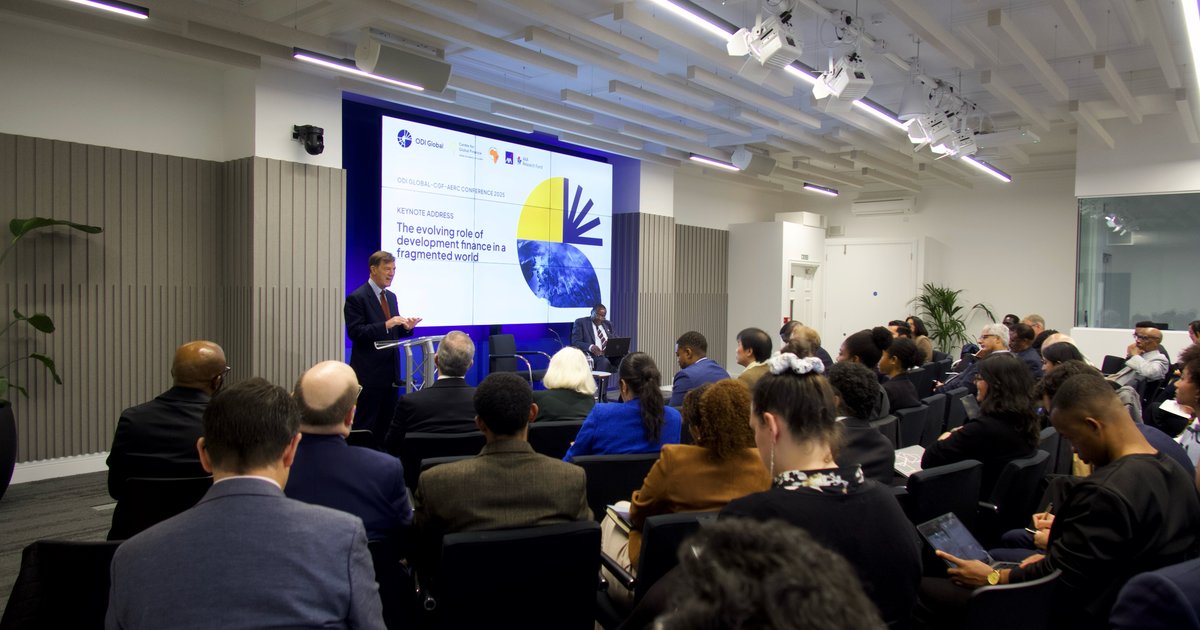
At the recent ODI Global–CGF-AERC annual conference on geopolitical fragmentation, experts emphasised the need to both measure the extent of financial fragmentation globally and identify innovative mechanisms to effectively mobilise finance to low- and middle-income economies (L&MICs), with a view to boosting sustained growth.
A range of recent examples suggests the level and composition of finance, currency use and payment systems are increasingly shifting along geopolitical lines.
Foreign Direct Investment (FDI) flows are now clustering within political alliances, particularly in strategic sectors such as semiconductors and critical minerals value chains. After two consecutive years of decline, data from UNCTAD show a further 3% drop in FDI during the first half of 2025, with a 5% decline forLeast Developed Countries (LDCs), reaching their lowest level since 2025. Greenfield investment in countries politically distant from major powers is at a 20-year low.
Portfolio flows are vulnerable to change. Despite buoyant equity markets, the IMF estimates that a one-standard-deviation increase in geopolitical tensions between an investing and a recipient country – measured by diverging voting behaviour of the US and China at the UN – could reduce bilateral cross-border portfolio and bank capital allocations by 15%.
The cost of remittances to Eastern Europe and Central Asia have increased, while volumes have declined, reflecting the impact of financial sanctions.
Aid and development finance flows are increasingly influenced by domestic interests and national security considerations. After peaking in 2023, Overseas Development Assistance (ODA) has fallen by US$56 billion over two years. On the other hand, a forthcoming G20 report suggests that reforms to the capital adequacy frameworks of multilateral development banks could provide an additional US$60 billion per year in lending capacity over the next decade (so-called ‘other official flows’).
The rise of bilateral lenders such as China have increased fragmentation in the creditor landscape, complicating sovereign debt restructuring efforts in countries like Zambia and Sri Lanka. Geopolitical divisions further hinder debt coordination in multilateral fora. These challenges also revolve around the more complex nature of Africa’s debt landscape – now a composite of multilateral, bilateral and commercial debt.
Currency use is also fragmenting. While China’s renminbi is gaining ground in trade invoicing, according to SWIFT, the US dollar still accounts for approximately 60% of global FX reserves and 90% of FX transactions. Russia, since 2018, has diversified its FX reserves away from the dollar; following its invasion of Ukraine, new sanctions have fuelled its dollar disuse in trade invoicing.
Regional payment systems, and their digitalisation for local use, are expanding rapidly. China's Cross-Border Interbank Payment System (CIPS) continues to grow, while new sanctions have led to a re-patterning of invoicing currencies in the external trade of Russia and its geopolitical allies, to the renminbi and other currencies. The Pan-African Payment and Settlement System (PAPSS), part of the African Continental Free Trade Area (AfCFTA), holds promise for regional financial integration.
The ODI Global-CGF-AERC conference highlighted several innovative pathways to mobilise finance for the poorest countries in this fractured global landscape:
Global finance is entering a new era of geopolitical and regional fragmentation, where capital, trade and currency flows are increasingly shaped by regional and political alliances. This re-configuration marks a retreat from the era of broad global integration. For low- and middle-income economies, success will hinge on leveraging new regional and private-sector partnerships to drive sustainable growth.
Related Stories
 Finance
Women’s role in politics, economy key to Viksit Bharat 2047: Mandaviya
18 hours ago
 Finance
Iran’s top envoy says peace deal with US dependent on Israel’s withdrawal from Lebanon
4 days ago
 Finance
Live updates: Voters await results of Oklahoma, D.C., Georgia and Alabama primary elections
4 days ago
 Finance
B.C. government considering new hydroelectric project as energy demand grows
5 days ago
 Finance
Trump declares US
5 days ago
 Finance
Social care costs leave council in 'fragile' state
5 days ago
 Finance
Anger among Iranian hardliners at terms of deal agreed with US
6 days ago
 Finance
Scaling up our impact investing ambition at the GIIN Impact Forum in Berlin
6 days ago