
GPU Rental Crunch Forces Korean AI Startups to Drop Projects
A data-focused artificial intelligence startup recently prepared a bid for an AI transformation (AX) project run by a government-affiliated organization but abandoned the effort after failing to secure graphics processing units. The company contacted eight domestic GPU-as-a-service (GPUaaS) providers in Korea to ask about available capacity and pricing so it could calculate project costs, but could not even obtain proper quotes. "We could not get the latest GPUs, so we turned to the previous-generation H100, but the situation was no different," a company official said. "We need to calculate GPU costs to submit a bid, but if you cannot commit to a firm usage volume or your usage is small, they will not even give you a quote."
As demand for AI computing surges, rising GPU rental prices and difficulty securing capacity are constraining companies' opportunities to enter new businesses. Even as newer GPUs come to market, demand is also crowding into the previous-generation H100, and suppliers' preference for large, long-term contracts is raising the barrier to entry for smaller customers. With the ability to secure computing resources now determining whether a company can bid at all, concerns are growing that this could also become an obstacle to the government's push to spread AX adoption.
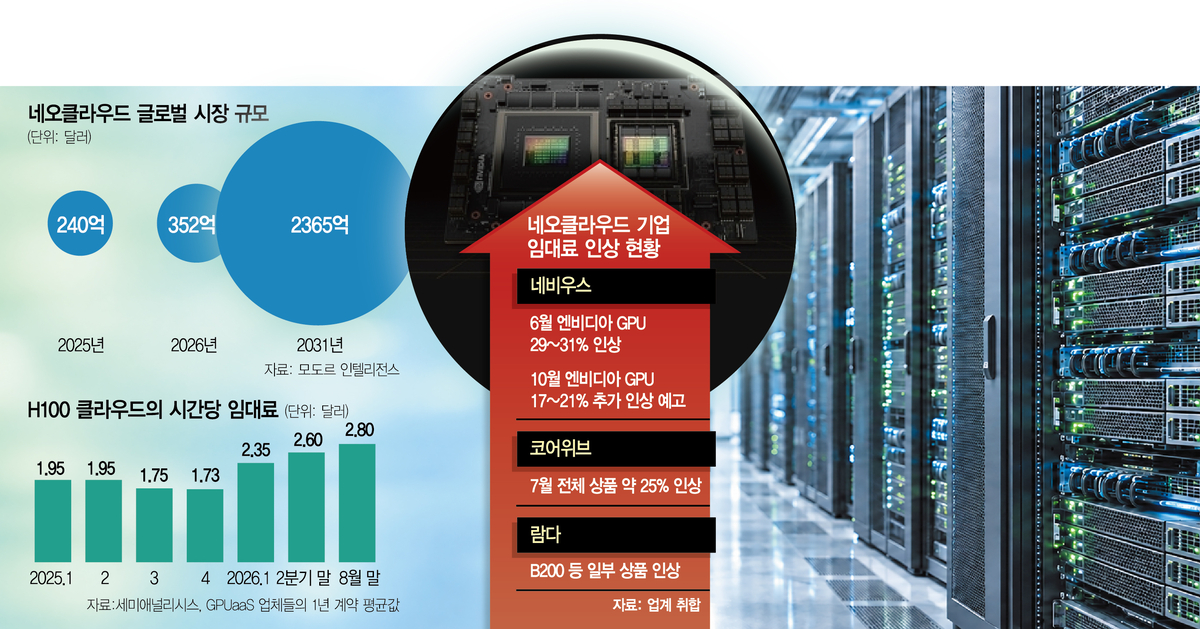
According to market research firm SemiAnalysis on the 21st, the average hourly rental price charged by H100 cloud providers worldwide rose 43.6% to $2.80 at the end of August this year from $1.95 at the end of the first quarter last year. Rental prices for previous-generation products are climbing despite the launch of newer GPUs because demand for AI computing is outpacing the rate at which supply is expanding. As generative AI use spreads to agents and enterprise services, demand for computing resources is growing not only for training but also for inference.
The biggest factor squeezing GPU supply and demand is rising inference demand. In the past, vast computing resources were needed intensively during the training stage of building large-scale AI models. Now, as AI agents and enterprise AI services proliferate, computing is required every time a user accesses a service, generating continuous inference demand.
Securing GPUs is also no guarantee of easy access. AI data centers (AIDCs) with sufficient power and cooling facilities are required, but the number of facilities available for immediate use is limited. "Demand for AI infrastructure is high, but there is a shortage of data centers to accommodate it, so customers in a hurry have no choice but to use expensive AIDCs," an official at a large domestic cloud company said. "It is not just GPUs — the shortage of infrastructure to actually run them is also pushing service prices up."
Large companies, at least, face relatively fewer hurdles in using GPUs. That is because cloud providers prefer large, long-term customers, given that GPU utilization rates translate directly into profitability. If the GPUs that cloud providers acquired at enormous cost sit idle, they absorb the full cost burden. As a result, suppliers seek to secure stable utilization rates through customers that can use a consistent volume over a long period. Large companies, for their part, tend to bet on further increases in GPU rental prices and sign long-term contracts.
Small and mid-sized companies that need to secure computing resources from scratch, by contrast, face a growing burden. Many smaller startups begin their AI businesses by taking on government AX projects. Government AX projects require companies to submit business plans that calculate GPU rental fees, development costs and labor costs within a fixed budget. If volumes and prices cannot be locked in beforehand, companies inevitably run into trouble from the bidding stage.
If this polarization in GPU access persists, business opportunities could ultimately concentrate among companies that have already locked up computing resources. "The AX market has effectively come to revolve around large companies that have already secured plenty of GPUs," an AI industry official said. "Now whoever has the GPUs holds the upper hand."
Against this backdrop, valuations of neocloud companies — GPU rental providers specializing in AI — have been soaring. In the U.S. market, shares of Nebius had jumped 148.52% year to date as of the 18th. Last month, Nebius said in its second-quarter earnings release that revenue reached $582.3 million, up 454% from a year earlier. Four large AI cloud contracts each exceeding $1 billion drove the record results. CoreWeave also reported last month that second-quarter revenue rose 112% from a year earlier to $2.58 billion.
Investor enthusiasm is spreading to unlisted neoclouds as well. Britain-based Nscale has formally begun the process of listing on a U.S. exchange, targeting a valuation of $30 billion, while Lambda is in talks to raise up to $3 billion ahead of a planned listing early next year.
Related Stories
 AI News
Trump Announces a National Force Dedicated to Artificial Intelligence
53 minutes ago
 AI News
Trump Proposes ‘AI Force,’ Says Artificial Intelligence Could Reach 25% of U.S. GDP
53 minutes ago
 AI News
Nvidia boss says there is ‘0% chance’ AI destroys the world by 2030
53 minutes ago
 AI News
Monet masterpiece could sell for record €30 million
1 hour ago
 AI News
Who gets ahead in the enterprise consulting business with AI now in the game?
1 hour ago
 AI News
Xunce Technology Launches TokenCloud, Plans Up To RMB12B AI Capex
1 hour ago
 AI News
AI investors in Asia seen shifting focus to earnings ahead of Xi
1 hour ago
 AI News
Banesh Prabhu on IntellectAI and Artificial Intelligence in Wealth Management
1 hour ago