
GlobalEye gamble: Ottawa chose surveillance plane without knowing it met military needs
GlobalEye gamble: Ottawa chose surveillance plane without knowing it met military needs
'There's gonna be trade-offs everywhere,' says government's point person on defence procurement
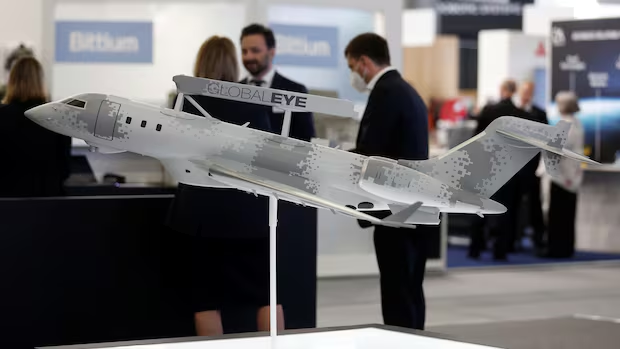
Ottawa had no guarantees that Saab's GlobalEye surveillance plane could meet military requirements when it began negotiations to acquire six of the Swedish manufacturer's early warning and control aircraft last spring, CBC News has learned.
Sources added that the most recent assessment of the GlobalEye came to the conclusion that the aircraft meets only a portion of the military's requirements and that modifications will be needed to achieve operational readiness.
Prime Minister Mark Carney surprised almost everyone in attendance at the country's premiere arms exposition last May in Ottawa, called CANSEC, when he announced plans to acquire the aircraft. He added the deal included a production line in the country for domestic and export markets.
Among those surprised was the commander of the Royal Canadian Air Force, who was in the room, say several defence industry sources.
Stephen Fuhr was mocked for opposing the purchase of F-35s. Now he's in charge of Canada's defence procurement
Air force's 1st new refuelling jet won't be delivered until late 2027
CBC News is not identifying the contractors because they don't want to endanger their relationship with the federal government. Four of them spoke confidentially.
At the time of the announcement, the air force had yet to inform potential bidders of its exact technical and operational needs for a new fleet of airborne surveillance aircraft.
In an interview, Ottawa's point person on military procurement said that the government must also weigh factors such as cost, jobs and geopolitics in major military purchases.
"Are the requirements important? Of course they are," said Stephen Fuhr, secretary of state for defence procurement. "It's not the only thing that needs to be considered here.
"We need to leverage this money to stimulate our own economy. We need to become more independent. We need to think about supply chains and relationships."
Carney's announcement on the GlobalEye forced the Royal Canadian Air Force to scramble to try and match what the aircraft can do with what it needed in terms of a surveillance plane over the Arctic, said several confidential sources.
Canada negotiating to buy Saab's GlobalEye airborne early warning system
It was only in late June — more than three weeks after the announcement — that Canadian military officials met with Saab to go over the specific kinds of features the plane needs.
There was one follow-up session in August where the GlobalEye's shortcomings were confirmed.
Carney has made it a priority to increase the speed of military procurement, but critics say the desire to leverage the economy — through the Canadian jobs the GlobalEye could bring — is trampling on defence needs of the country.
For example, the military is concerned that the plane, under its current design and configuration, doesn't have 360-degree radar coverage. There are also concerns about the range and frequency of the radar.
Saab has proposed modifications, putting additional radar sets in the nose and tail.
There are also concerns about the number of crew stations and connectivity equipment to plug the plane into the NORAD network, which would limit the GlobalEye's ability to offer a "control" function during operations that involve a series of military assets.
The military is also seeking a radar plane that can be refuelled in flight to cover the vast expanses of the Arctic, a feature that is not currently included on the GlobalEye.
Saab says it's responsive to 'customer demands'
In an interview earlier this year, Saab deputy CEO Anders Carp said the company is well aware of the Canadian military's expectations and that the company is ready to meet them.
Overall, the GlobalEye's sensors offer 360-degree coverage, but the main radar on top of the fuselage offers coverage in the 300-degree range, he said.
"We do have a program in place where we can place in a forward-looking and an aft-looking radar, should that be something that the customer demands," said Carp. "And the same will go for air-to-air refuelling."
Also in an interview with CBC News last spring, Saab test pilot Jussi Halmetoja spoke about the flexibility of the company's engineering process.
"We have a spiralling development process on how to improve our systems across the board at Saab, and depending on customer requirements, of course," Halmetoja said.
NATO GlobalEye surveillance aircraft acquisition a 'big step forward' for Canada: McGuinty
Fuhr added that sometimes, the government needs to opt for the "85 per cent solution," saying there is "nothing out there" that checks all possible boxes.
"There's gonna be trade-offs everywhere," he said. "So it's a function of balancing all those things to meet the moment."
Last spring, CBC News reported how Canada will have to ask the Trump administration to share a key piece of technology that allows fighter jets and early warning systems to communicate while maintaining stealth.
Experts doubt the United States will allow a high-tech data link used exclusively on F-35 fighters to be installed on either the early warning aircraft or the Gripen-E — if Canada chooses to buy that warplane.
None of Saab's U.S. competitors — L3 Harris and Boeing — were shown the air force's requirements, according to the confidential sources.
L3 Harris, headquartered in Melbourne, Fla., acknowledged in a recent interview with CBC News that it had not been privy to the Canadian surveillance plane requirements before the announcement.
Canada ready to further distance itself from U.S. on military procurement
Ottawa to spend almost $2B over 4 years to buy 190 Canadian-made armoured vehicles
Boeing, whose leadership is located in Arlington, Va., declined to say whether it has received an advance look, but a spokesperson added the company continues to stand ready to support the Canadian government.
The requirements form the basis of what the military needs to have in the aircraft — or any other piece of kit it is buying.
The process also helps the defence industry decide whether its product is the right fit. And if it is, the process sets the conditions to decide what kind of modifications might be required and eventually what the price will be.
The GlobalEye could end up being an extraordinary — but not unprecedented — end-run around decades-long procurement practice, says former senior defence procurement official Alan Williams.
The process, he said, is in place to prevent "governments making these decisions haphazardly."
Williams said it's important to distinguish between what the military says is absolutely essential in a capability and what is optional.
He also said he doesn't buy the argument that measures such as this are necessary to speed up procurement because there are existing authorities within existing legislation that allow the government to move swiftly.
"You don't have to go to these strange lengths in order to try to do things faster. Go through the front door, do things right and you can get the right result in a timely fashion," Williams said. "I think it really does undermine the process. And it makes us look, I think, very, very amateurish. It goes against the intent of the legislation."
Industrial policy vs. defence needs
Philippe Lagassé, a defence policy and procurement expert at Carleton University, said there is an obvious tension at play between Ottawa's focus on job creation and the military's long-standing alliance with the United States.
"It's important to recognize that military requirements are not handed down from on high in some platonic ideal. They are meant to reflect the government defence policy," he said.
NATO bets on Saab, giving Canada's GlobalEye gamble a major boost
Why is Canada spending tens of billions on new submarines?
"At the end of the day, the governments get to decide what they choose to prioritize and what they'd choose to emphasize."
Ideally, Lagassé said, Canada would have updated its defence policy and articulated "what the government believes the Canadian Armed Forces should be doing and with what kind of equipment."
What Canada’s fighter jet decision could mean for NORAD
Lagasse also said, in an ideal world, there would be no "trade-offs between domestic industrial policy or defence policy."
Requirements don't give the military a veto over what the government intends to buy, he said.
"It means that the government has to come out and accept the operational risk that it's imposing" on the military, said Lagassé.
What happens if the trade-offs cost lives?
"I think that's the challenge, right? Who wears the operational risks that we're asking the Canadian Armed Forces to accept?" Lagassé said.
Senior reporter, defence and security
Murray Brewster is the senior defence writer for CBC News, based in Ottawa. He has covered the Canadian military and foreign policy from Parliament Hill for over a decade. Among other assignments, he spent a total of 15 months on the ground covering the Afghan war for The Canadian Press. Prior to that, he covered defence issues and politics for CP in Nova Scotia for 11 years and was bureau chief for Standard Broadcast News in Ottawa.
Related Stories
 Canada
‘Skyrunner’ describes appeal and peril of sport as Canadian remains missing in Alps
45 minutes ago
 Canada
The Associated Press says it will still refer to Lake Ontario, not Lake America
45 minutes ago
 Canada
'Unhinged' for Canada to call dispute with U.S. a trade war, says Trump's tariff chief
45 minutes ago
 Canada
Oilers sign Formenton after sexual assault acquittal, Hockey Canada suspension
45 minutes ago
 Canada
Trump announces ban on some imports from Canada
1 hour ago
 Canada
Ottawa council to vote to remove Donald Trump’s name from residential street
1 hour ago
 Canada
Canada to blame for Washington's escalation of trade war, says Trump trade czar
1 hour ago
 Canada
Live updates: Trump escalates trade war with product bans, new tariffs on Canada
1 hour ago