
RSS, BJP and the Political Strategy Behind Bhagwat’s Speech
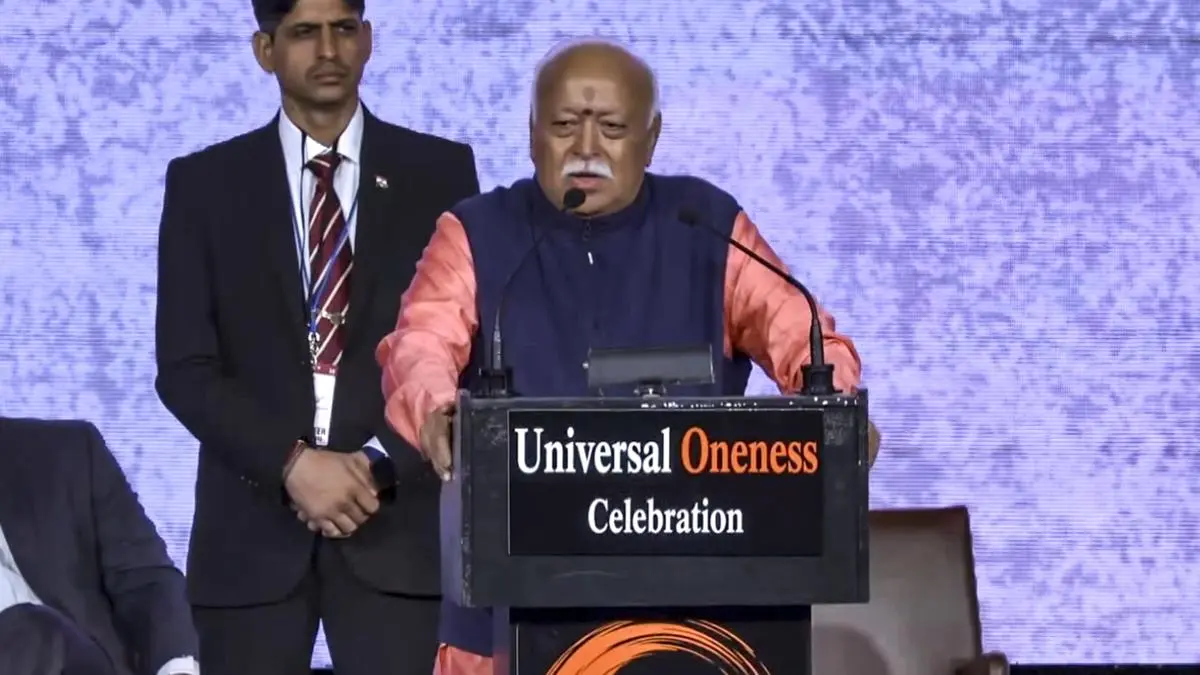
In 2003, when I worked at Outlook magazine and covered the BJP (and thereby the RSS), I had occasion, along with Hindi Outlook, to conduct an interview with V.S. Sudarshan, the fifth sarsangchalak (chief) of the RSS, who held the post from 2000 to 2009 and preceded the current chief, Mohan Bhagwat. That was a coalition era when the jockeying between the then Prime Minister Atal Bihari Vajpayee and Deputy Prime Minister L.K. Advani was frequently in the news as was the RSS’ pressure and its differences with some of Vajpayee’s inner circle.
After Mohan Bhagwat’s speech in New York on August 29, I hunted for the interview online and finally found it on the website of Hindu Vivek Kendra, which calls itself “a resource centre for the promotion of Hindutva”.
To a question about anti-Muslim statements by VHP leaders, Sudarshan had answered then: “They [VHP] have only said that the people who do not consider India their homeland need not live here. If they consider India their own, then there is no cause for worry. Sometimes it happens that some things come out and some things are left out. Some things are said in a certain context. If taken out of that context, the meaning changes. They have never said this. After all, where will the 15 crore Muslims in India go?
“There was this Id Milan function when I met that Imam of ours. I talked to him. I asked him why the Muslims consider themselves a minority. A minority is one which comes from a foreign land and settles down here. The Muslim society needs a leadership to emerge. That leadership has not yet emerged. The kind of social movement required hasn’t happened in the Muslim society. The Muslims need to change themselves.”
The central pillar of the RSS ideology is to preserve and “safeguard” Hindu society as conceived by it. Those who follow Abrahamic religions are seen as entities that can never be included in the project. This includes Muslims, elicited by their presence in large population clusters and their cultural, linguistic, and architectural impact on India over centuries, and Christians, who are seen as people who convert Hindus and others like the Adivasis of central India.
Much has been made of Bhagwat’s statement in New York that “if a Hindu thinks there will be no Muslim in Bharat, he will not remain a Hindu”. It is being interpreted as a sudden secular twist in the thinking of the RSS. It is not.
Over the decades, RSS chiefs have given open-ended statements about Muslims only because they can hardly say that they want to throw them out of the country or purge them from institutions and livelihoods. Indeed, the RSS would not actually want a Muslim-free India, as there would then be no internal enemy to mobilise the majority against and to shape its electoral politics.
Across the country, RSS front organisations continue to mobilise opinion against Muslims even as they have embedded themselves within institutions. The organisation that has been banned three times in independent India has mutated and expanded during the Narendra Modi era since 2014.
The RSS is trained to be pragmatic—be low-key when necessary and up its profile when deemed essential. The interesting aspect of Bhagwat’s recent overseas trip and his address at Madison Square Garden is the high-profile nature of the event. RSS sources said that it was planned as part of the year-long centenary celebrations of the Sangh that will end on Vijayadashami this year, which falls on October 20.
All right-wing organisations, movements, and parties need an enemy to polarise the people against, be it immigrants in Europe and the US or Muslims in India. At a time when we have just seen a popular mass movement run by Gen Z, it is useful to recall that arguably the biggest mass movement in contemporary history that reshaped the political map was the Ram Janmabhoomi agitation run by VHP and then the BJP. The large RSS cadre network made it possible to activate a mass upsurge as Advani took his rath yatra from Somnath to Ayodhya.
Since its founding in 1980, the BJP’s core ideological tenets have been about showing Muslims their place—be it building a temple at Ayodhya (achieved), abolishing Article 370 that gave special status to Jammu and Kashmir (achieved), or imposing a uniform civil code (work in progress).
Bhagwat’s address, meanwhile, is not a signal to foot soldiers to tone down their rhetoric or actions. It is intended merely to position the RSS as ideologically “reasonable” and give itself nuanced publicity so that the sympathisers, loyalists, and individuals who want access and appointments in an ecosystem controlled by the BJP/RSS can speak of the “universalism” displayed by the chief. But to interpret Bhagwat’s address as “emphasising diversity” is entirely inaccurate, if not deliberately false.
RSS workers take part in a march on the occasion of the organisation’s centenary in Sangli, Maharashtra, on October 2, 2025. | Photo Credit: PTI
Long-time Sangh watchers will know that the organisation has been forced to adopt a passive stance in the Modi era because of the sheer rewards it has reaped.
But a significant aspect of the RSS-BJP dynamic is the mothership’s subservience on the issue of the rampant crony capitalism that is afoot, against which the RSS’ frontal organisations such as the Swadeshi Jagran Manch and the Bharatiya Mazdoor Sangh, the organisation’s labour union affiliate once led by individuals such as Dattopant Thengadi, were once active.
Thengadi was one of the stalwarts of the Sangh (he passed away in 2004) who set up organisations that rejected both communism and Western-style capitalism. K.N. Govindacharya, who pushed the BJP towards what he called social engineering among Other Backward Classes (OBCs) and Dalits, was also committed to the swadeshi ideology. Older now, he has been rendered irrelevant.
In an age where select capitalists hold great sway over the Modi establishment, the Sangh no longer has much to say, but it just seeks to get its people into positions of influence. Yet, it is still the Sangh that provides a unique advantage to the BJP, via its cadres.
And regardless of denials about the RSS influence on leadership questions in BJP, it is nevertheless there. The Prime Minister’s image has been dented by the recent Gen Z protests, and at the time of the next general election, Narendra Modi will be 78.
What does the RSS think about the future? Bhagwat has, in the past, made statements about leaders retiring at the age of 75. This rule was applied to figures such as Advani, who was party president multiple times and, in the view of this columnist, the BJP’s most impactful strategic thinker—one who put the party on the political map although he never became Prime Minister. (Bhagwat himself is 75, but there is no retirement age in the Sangh. And in the century since its founding, there have been only six chiefs.)
All the pieces on the BJP-RSS chess board are not yet in place. Will Uttar Pradesh Chief Minister Adityanath, 54, manage to retain power in the State election due next year?
Maharashtra Chief Minister Devendra Fadnavis, 56, is close to the Sangh and a Brahmin from Nagpur, where the RSS headquarters is located. And Home Minister Amit Shah, 61, according to rumour mills, is eyeing the Deputy Prime Minister post in the event of a long-awaited Cabinet reshuffle.
Meanwhile, halfway through the third term of Modi, once a full-time RSS pracharak who was shifted from organisational work to mass politics, one can state with certainty that the RSS is not changing its ideological stripes but jockeying itself into position to take strategic decisions for the future.
Saba Naqvi is a Delhi-based journalist and author of four books who writes on politics and identity issues.
Also Read | From the fringe to the core
Also Read | Editor’s Note: A century of dissimulation
Related Stories
 India
India
Starlink, Ambani’s venture should get equal treatment, let consumers decide: Shashi Tharoor
2 days ago
 India
India
Lawrence Bishnoi’s rise: Student politics, first murder and a sprawling crime network | India News
2 days ago
 India
India
India’s finance minister says market liquidity makes it easier for investors to exit
2 days ago
 India
India
India news: CJP alleges 'deliberate' delay in leaders' release
2 days ago
 India
India
Indian Diaspora Holds Pro-Modi Counter
2 days ago
 India
India
Clashes Erupt in London as Diaspora Divided Over India's Election Chief and Electoral Roll Controversy
2 days ago
 India
India
London: Indian diaspora rallies in support of PM Modi, criticises CJP protesters
2 days ago
 India
India
Cabinet Approves Go
2 days ago