
Getting my Canadian permanent residency should have felt like a win. But I've lost a lot along the way
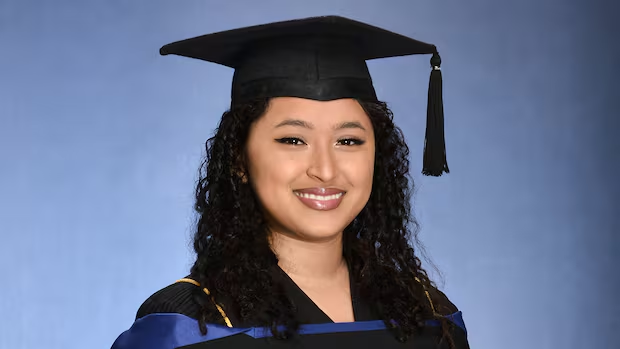
Getting my Canadian permanent residency should have felt like a win. But I've lost a lot along the way
Many of my friends who also applied for PR have left
This First Person is the experience of Areena Shrestha, who lives in Vancouver. For more information about CBC's First Person stories, please see the FAQ.
I was 18 when I moved to Canada as a Nepalese international student, carrying two suitcases and a simple dream: to study, build a career and eventually call this country home. However, I didn't fully understand when I first arrived how uncertain and emotionally exhausting the journey to permanent residency could be.
While I studied psychology and international relations at the University of British Columbia, I interned at the Canadian Cancer Society and worked as a research assistant in a lab. I said yes to opportunities, built connections and slowly started to feel like I belonged here.
By the time I graduated four years later, my path felt clear. I wanted to work in the non-profit sector and give back to the same kind of communities that had supported me. So I began building a career in social services, supporting vulnerable communities as a program assistant, crisis responder and youth worker.
Today, I work as a case manager at a rent bank, helping people facing housing insecurity access financial support to avoid eviction. My job focuses on helping others find stability during times of a crisis.
Yet while I help others find stability, my own future in Canada has often felt uncertain.
For years, my future in Canada depended on my immigration status and the ticking clock of my work permit. I applied for permanent residency in December 2023. I would check my application status late at night, calculate points for Canada's comprehensive ranking system, and refresh the draw page for permanent residents over and over again. I thought about moving to a rural area just to increase points, hoping something would change.
Canadian citizenship certificate applications now facing nearly 3-year delays
As time passed, that uncertainty started to take a toll, especially six months before my permit was due to expire.
My closest friends — the same people I had grown up with and went to UBC with — began to leave. One by one, they packed up their lives and returned to countries they hadn't planned on going back to. They told me it wasn't worth sacrificing their mental health for a system that felt so unpredictable. Before one can even apply for permanent residency, you have to get an invitation to apply (ITA).
One of my friends even received an ITA for permanent residency — something we had all been working toward. But their application was rejected over a small mistake: uploading the wrong document.
Just like that, years of building a life here came to an end as they had to leave Canada within a 60-day period. Watching that happen made everything feel even more sad.
As my own work permit expiration date got closer, the anxiety became harder to ignore. I would wake up in the middle of the night with panic attacks, overwhelmed by the thought of losing everything I had built. Every phone call with my parents ended in tears — not just from stress, but from a growing sense of hopelessness.
I felt I had done everything "right." I had paid international tuition fees, built a career in the non-profit sector and was contributing to my community. And still, it felt like it might not be enough. I was not enough for Canada.
Trump says Canada is 'destroying itself' with immigration. Ministers say that's bogus
Going back to Nepal didn't feel like an option. My dad's job took him to work in many different countries which meant my parents no longer lived in Nepal. I realized how disconnected I had become since I grew up speaking Nepali, but couldn't read or write it.
Canada was the only place that felt like home. Yet I wasn't sure if I would be allowed to stay.
Out of desperation, I started relearning French — not out of passion, but because it felt like one of the only ways to increase my chances of getting an ITA.
After two years and eight months, I received my permanent residency approval through the health-care and social services occupations draw, which is a specific, express entry draw for individuals who are currently working in those fields. On March 22, 2026, my PR card finally arrived.
I expected to feel overwhelming joy. Instead, what I first felt was something quieter: Relief.
Relief that I could finally breathe without checking immigration updates. Relief that my life here was no longer temporary.
But the feeling is complicated.
Because while I stayed, many of the people who were part of my journey did not.
2.1 million temporary residents will have expired or expiring permits this year. But will they leave Canada?
The friends who once made Canada feel like home are now scattered across different countries. The support system I built over the years is no longer here in the same way. And now I find myself starting over again, like when I was 18 and new to Canada: building new friendships, considering moving to a new city, trying to reshape what "home" looks like.
When I think back to the 18-year-old version of me who had just arrived in Canada, I realize she believed that if she worked hard enough, everything would fall into place.
But what I didn't expect was how much waiting, uncertainty and quiet fear would come with it. I am grateful to be here. But I also carry the weight of everything it took to stay. And sometimes, that feeling doesn't disappear overnight.
When I voiced my concerns on TikTok, my videos went viral with more than 900,000 views. I realized that my story is not unique. Across Canada, immigrants like myself are navigating the same uncertainty while continuing to contribute to the country's workforce and communities.
Do you have a compelling personal story that can bring understanding or help others? We want to hear from you. Here's more info on how to pitch to us.
Areena Shrestha is a Vancouver-based case manager and content creator passionate about community, culture and storytelling. She is doing a master's of arts in applied social psychology. She uses her experiences as a young immigrant in Vancouver to explore identity, belonging and life in Canada.
Related Stories
 Immigration
Tensions run high in Northern Ireland after contentious march given go
1 hour ago
 Immigration
Half of Albertans undecided on 9 non
4 hours ago
 Immigration
Bad language: profane Trump brings presidential swearing out into open
9 hours ago
 Immigration
Private colleges around Australia offering last
21 hours ago
 Immigration
German town bans 'stumbling stone' memorials to Nazi victims
1 day ago
 Immigration
Canadian citizen detained at U.S. border crossing, questioned about voting for hours
1 day ago
 Immigration
Inside America's vast expansion of immigration enforcement
1 day ago
 Immigration
Supreme Court allows Trump to use SAVE database to check voter citizenship
1 day ago