
German, U.S. scientists win Nobel in medicine for advancements in optogenetics
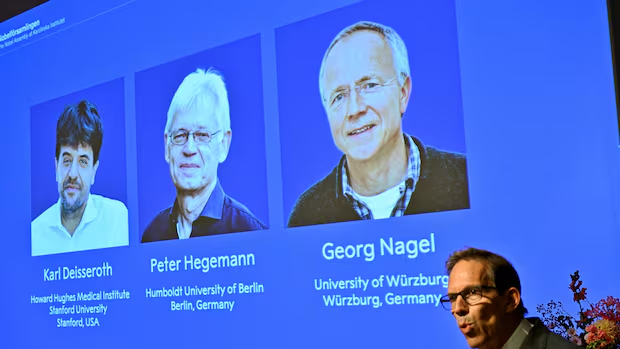
Nobel Prize in Medicine awarded to scientists who pioneered work in optogenetics
Winners lauded for discoveries that enhance understanding of the brain
Scientists Karl Deisseroth, Peter Hegemann and Georg Nagel won the 2026 Nobel Prize in Physiology or Medicine for "discoveries concerning light-gated ion channels and optogenetics," the award-giving body said Monday in Stockholm.
Optogenetics "makes it possible to switch on, or off, the activity of individual nerve cells in a living brain," said Thomas Perlmann, secretary general of the Nobel Assembly at Karolinska Institutet.
"This method is now being used in laboratories around the world to reveal the brain's mysteries," he said.
Deisseroth, a 54-year-old American, Hegemann, a 71-year-old German, and Georg Nagel, a 73-year-old German, were all surprised to learn they had won, Perlmann said.
"All three said the same thing, that they thought it was absolutely wonderful to receive the prize with the other two, and they call them … friends. That it's such an honour to receive them together. So that's something they conveyed," Perlmann said.
The Nobel Prizes come with a prize amount of 12 million Swedish crowns ($1.7 million Cdn), which the three scientists will split. Deisseroth is based at Stanford University in California, with Hegemann at Humboldt University in Berlin and Nagel at Germany's University of Würzburg.
Anna Wedell, a professor in genetics and a member of this Nobel committee, said a new era in neuroscience had opened but it was only the beginning.
"For the first time we can actually start to understand how the brain processes information and how different neurons interact across the brain," she said.
In clinical trials, researchers are restoring vision to people blinded by a condition called retinitis pigmentosa by inserting a light-sensitive protein in the retina.
Researchers also hope optogenetics could improve cochlear implants, allowing more precise stimulation of the auditory nerve than current electrical devices.
"The patients lose their photoreceptors, the rods and cones in the retina. But healthy cells remain. Researchers use optogenetics to stimulate these healthy cells, activating the optic nerve and generating visual perception in the brain," said Per Svenningsson, professor of neurology at Sweden's Karolinska Institute.
In the early 1990s, Hegemann investigated how the alga Chlamydomonas reacts to light in half a millisecond. He hypothesized that a single protein captured light and acted as an ion channel. Nagel tested this by injecting Chlamydomonas genes into frog eggs, discovering channelrhodopsin-2 — an ion channel that opens when exposed to light.
In 2003, they published that this protein could be introduced into human and hamster cells to generate electrical impulses using light. In 2005, Deisseroth demonstrated the technique in rat nerve cells, and the method was named optogenetics a year later.
Mark Carney for Nobel Peace Prize? Probably not, but his name's out there
"We publish papers together. We have had many discoveries together over the years, had meetings, had beers together, so it's just, it's just absolutely perfect to share with these two," Deisseroth said.
Boston-born Deisseroth was initially set on neurosurgery, but shifted to psychiatry after encountering suffering patients — asking why depression steals joy and what causes autism.
Prizes for chemistry and physics will be awarded Tuesday and Wednesday, literature on Thursday and the peace prize on Friday. The economics prize will be announced Oct. 12.
The Nobel Prize was created by wealthy Swedish chemist and entrepreneur Alfred Nobel, who in his will dictated that the bulk of his estate should be used to fund "prizes to those who, during the preceding year, have conferred the greatest benefit to humankind."
Nobel is best known as the inventor of dynamite, but also wrote poetry and drama and could speak Russian, French, English and German by the age of 17. The five original prize categories reflect the interests closest to his heart.
Nobel died in 1896, with the first prizes bearing his name following five years later.
The Nobel prizes are presented to the laureates on Dec. 10, the anniversary of Nobel's death.
Related Stories
 Business
Are You Prepared for Security Incidents? Only 7.6% Have Established Response Systems and Conducted Training, IT Survey Reveals
3 hours ago
 Business
LightSource Wins DPW’s 2026 Startup Growth Award
3 hours ago
 Business
Outcry in Trinidad and Tobago after passing of police bill that could threaten press freedom
4 hours ago
 Business
Lee So
4 hours ago
 Business
Wealthy Chinese couple accused of abusing 21 children born through surrogacy in ‘house of horrors’
5 hours ago
 Business
Lee So-young launches reform to cut red tape, boost Korea SMEs in strategic sectors
5 hours ago
 Business
Small Business Insider: Policy Update, Tips & Intelligence, More
8 hours ago
 Business
Quebec's next premier says he promises to hit the ground running as PQ takes power
9 hours ago