
Garber Endorses Integrating AI Into Harvard Research and Teaching
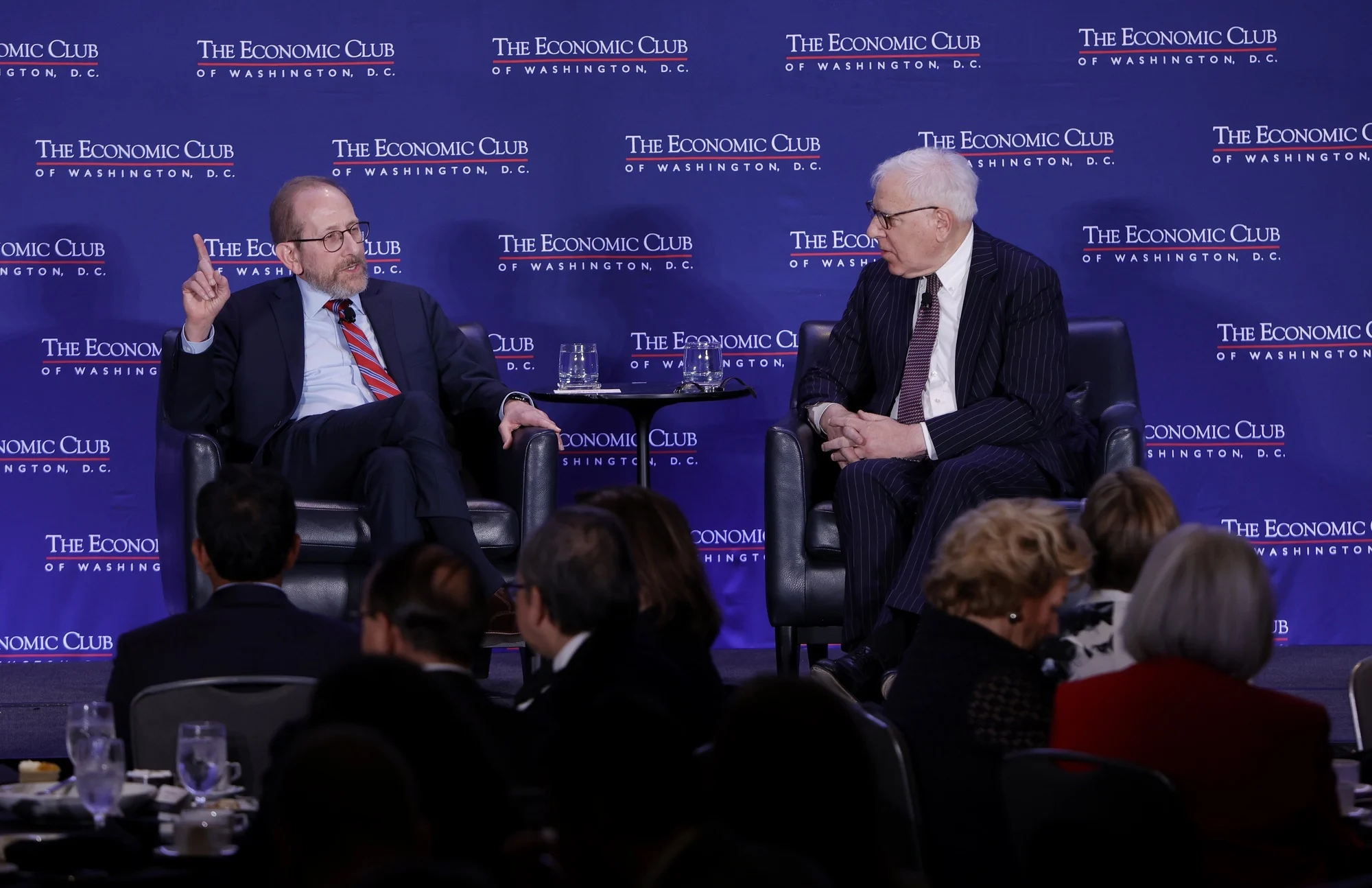
Harvard President Alan M. Garber ’76 offered his clearest endorsement yet of artificial intelligence Thursday, saying researchers in many fields can no longer remain at the forefront without integrating the technology and touting its potential to transform teaching.
“You cannot be in the forefront of many fields anymore — and here I include all of the quantitative social sciences along with science and engineering — if you don’t use AI,” Garber said. “You are unlikely to be in the forefront. So it’s something we need to deal with.”
During an interview with former Harvard Corporation fellow and Carlyle Group co-founder David Rubenstein at the Economic Club of Washington, D.C., Garber made clear that he believed AI will be part of the future of research, teaching, and work.
He even said he wanted to use AI in his own job — once the technology became capable enough.
“You can’t do that, right?” Rubenstein asked.
“Oh yes I can,” Garber responded. “But the problem is, AI isn’t quite there yet.”
The remarks puts Garber squarely in the pro-AI camp as universities around the country — and professors on Harvard’s campus — weigh how to respond to the novel technology.
His optimism comes amid growing concern among faculty and administrators that students are using AI to cut corners and that misuse of technology is difficult to detect.
Harvard College does not impose a uniform AI policy on faculty, who are left to create their own rules as long as they inform students of them. As a result, some courses encourage students to use AI, while others prohibit the technology entirely.
The decentralized approach has left faculty and students navigating a patchwork set of course policies. An inaugural 2024 report commissioned by the Harvard Undergraduate Association found that nearly 90 percent of undergraduates used generative AI.
The Office of Undergraduate Education hosted a summit in January on generative AI where students gave administrators feedback on their use of the technology. A few months later, Harvard College Dean David J. Deming sounded the alarm on AI, warning that “subtle” AI misuse was flying under the radar and decrying the use of AI as a cognitive shortcut.
Deming, a labor economist, has produced several papers studying the rapid adoption of AI and its transformational potential for work. He has said for months that AI will reshape the economy and encouraged students to engage with the technology.
Some of Harvard’s peers have taken more restrictive approaches. The University of California, Berkeley Law School, for instance, recently adopted an across-the-board ban on AI use for academic work, though instructors may authorize exceptions.
By contrast, Garber advocated integrating AI into teaching Thursday, describing himself as an “optimist with some asterisks” about the technology’s role in education. He pointed to Harvard faculty already developing new approaches to teaching that incorporate AI.
One new course offering for the fall — First-Year Seminar 54I: “Letting Claude Cook” — expressly challenges students to consider how AI could be used to answer complex scientific questions, tasking them with using AI tools to investigate their own research question.
“I do believe that when it comes to education, the personalization that it’s possible with AI leads to incredible advances in improving education for each individual student,” Garber said.
The remarks struck a more bullish note than Garber’s baccalaureate address two months ago, when he urged graduating seniors to decide which forms of knowledge they were unwilling to surrender to AI.
In that speech, Garber framed AI as the “backdrop” of their Harvard years. Though he praised its potential to accelerate innovation, he told students there was still “value in toiling laboriously.”
Garber joked again in that speech about using AI himself — but said he had opted not to.
“Claude and I have been working on my remarks for many days,” Garber said in the May address. “Given how Commencement season has been unfolding, we decided it would be better for me to go it alone.”
On Thursday, Garber paired his optimism about AI with a more pragmatic approach to student assessment.
Even as he announced to applause that Harvard was emphasizing in-person exams to prevent AI-assisted cheating, Garber acknowledged that some subjects would need to test how students worked with, not without, AI.
“You actually want to know how well students perform with the aid of artificial intelligence, because that’s how the work is done today,” Garber said in reference to fields such as computer science.
“It’s not a perfect solution to say, ‘Okay, you can’t access a computer or an LLM when you’re doing your programming,’” he added. “That’s going to be part of it, but a realistic set of skills uses AI as part of it.”
Garber also indicated Thursday that Harvard was trying to prepare students for a labor market that would look very different in a world equipped with artificial intelligence.
“The number one question is ‘what is the future of work?’” he said. “And we need to contribute to that.”
—Staff writer Hugo C. Chiasson can be reached at [email protected] or on Signal at hcc.35. Follow him on X @HugoChiassonn.
—Staff writer Elise A. Spenner can be reached at [email protected] or on Signal at elisespenner.82. Follow her on X @EliseSpenner.
Related Stories
The Generalitat activates artificial intelligence to track the 87,906 empty apartments that official records ignore in Tarragona
2 hours ago
 AI News
iAsk AI Launches New Education
2 hours ago
 AI News
The Enterprise Journey, Reimagined with AI Agents
4 hours ago
 AI News
This Is Probably Not the AI
5 hours ago
 AI News
Frontier AI labs still won’t say how they’d contain a rogue model
5 hours ago
 AI News
Ex
5 hours ago
 AI News
Editorial | As Hong Kong boosts governance efficiency with AI, balance is key
6 hours ago
 AI News
Nvidia customers notified of AI
8 hours ago