
From Begumpura to the ballot box: The politics of Bhagat Ravidass
Bhagat Ravidass’s vision of “Begumpura” imagined a society free from social, political and economic hierarchies. Centuries later, his legacy has become central to the assertion of a community whose political significance carries weight in Punjab’s electoral politics. With the state government earmarking Rs 100 crore to mark his 650th birth anniversary, a larger question has emerged over how his spiritual vision of equality is being interpreted within electoral politics.
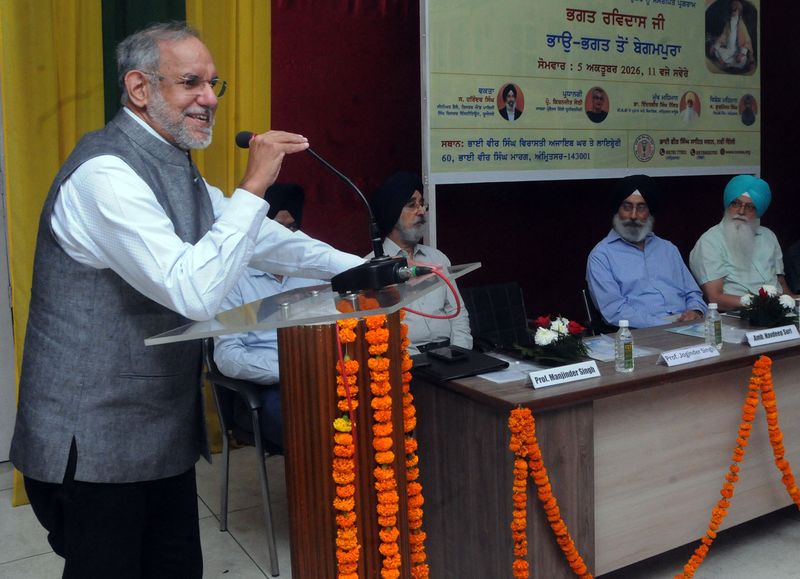
Harinder Singh, scholar and founder of SikhRI, USA, said the problem began with how Ravidass was understood. Delivering a lecture at Bhai Vir Singh Niwas Sthaan as part of the 650th birth anniversary celebrations organised by the Bhai Vir Singh Heritage Museum and Library, he said debates over whether to describe him as Bhagat, Sant or Guru Ravidass had overshadowed his vision of an egalitarian society.
Singh said Ravidass’s message challenged caste hierarchy, inherited status, exclusion and political and religious domination. He noted that although Ravidass lived within a caste order that marginalised his community, his compositions were preserved in the Guru Granth Sahib alongside the bani of the Sikh Gurus.
According to Singh, this demonstrated that spiritual authority was not derived from caste but from the truth and wisdom of the word.
Drawing parallels with the Ravidassia movement of the 1930s, Singh said members of the marginalised community remained largely landless and excluded from social, economic and political resources. He questioned whether political assertion since then had translated into substantive social transformation.
The discussion also examined issues beyond Ravidass and Begumpura, including beadbi, institutional credibility and accountability within the Sikh community. Former ambassador Navdeep Suri, Sikh scholars H.S. Gill and MLA Amritsar South Dr Inderbir Singh Nijjar participated in the discussion.
Singh linked beadbi with the broader concept of adab, or reverence, arguing that justice and reverence must be reflected in thought, word and action. He said contemporary debates should also examine institutional responsibility and whether Sikh authority remains connected to the ethical values of Gurbani.
The lecture ultimately centred on not merely how Punjab remembers Ravidass, but how it engages with his message of equality.
THE TRIBUNE, India’s oldest, daily English-language newspaper, was first published on February 2, 1881, in Lahore (now in Pakistan), and save for 40 days in the immediate aftermath of Partition, has come out every day over the last 145 years. THE TRIBUNE was started by Sardar Dyal Singh Majithia, a public-spirited philanthropist of the time. The newspaper is run by a five-member Trust, which is chaired by Shri N N Vohra, former Governor of J&K State (2008-2018); as well as Justice S S Sodhi, former Chief Justice of the Allahabad High Court; Shri Gurbachan Jagat, former Governor of Manipur; Lt Gen. Shamsher Singh Mehta, former Western Army Commander; Shri Paramjit Singh Patwalia, Senior Advocate in the Supreme Court. THE TRIBUNE is free, objective, and independent. Restraint and moderation, rather than agitational language, are the hallmarks of the paper. The Tribune has two sister publications, Punjabi Tribune (in Punjabi) and Dainik Tribune (in Hindi).
Remembering Sardar Dyal Singh Majithia
Related Stories
 Community
After poll victory, Pradyot announces plan to quit politics
5 hours ago
 Community
From 'vote chori' to 'chita andolan': Street protests return with a new playbook
6 hours ago
 Community
‘All I want to do is cry’: trauma of 7 October survivors three years after the attacks
7 hours ago
 Community
Foam Lake community supporting one another after horrific tragedy
17 hours ago
 Community
Fresh call to reinstate lost rail link
17 hours ago
 Community
Kenya: The beautiful faces of Kibera and room to dream
1 day ago
 Community
Street politics
1 day ago
 Community
U.S. hunter charged in Sask. crash that killed 3 still in hospital as court process begins
2 days ago