
Dyed diesel is now legal on U.S. roads. What are the rules in Canada?
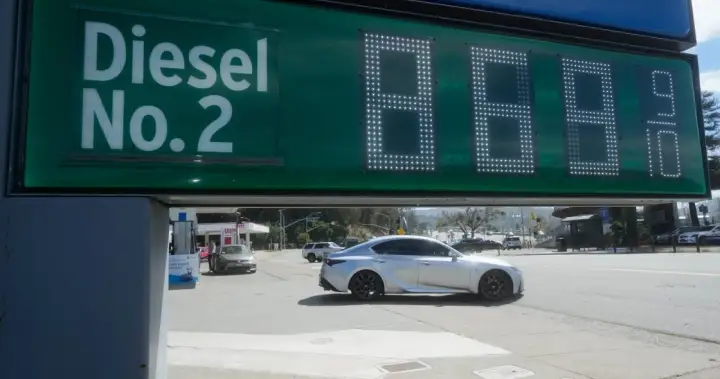
Dyed diesel has now been cleared for general use in the U.S. as gas prices soar, but Canadians could still face fines if caught using it on roads and highways.
Red-dyed diesel is essentially the same as regular diesel fuel, but is coloured a reddish brown in order to identify it for use off-road, like with farming, construction vehicles and other off-road uses.
U.S. President Donald Trump, on Monday, signed an executive order directing secretaries of the U.S. Treasury as well as the departments of transportation and agriculture to waive the off-road requirement for this tax-free diesel.
The move followed similar changes at the state level, including in Texas, as Americans struggle to pay for diesel and other fuels as a result of soaring prices from the U.S. war on Iran.
The changes mean if someone like a U.S. farmer has red-dyed diesel in bulk, which would have been exclusively used for their farming and other equipment, they can now use the same fuel in their trucks to drive on the roads without facing any penalties or taxes.
Canada’s agriculture industry is heavily reliant on diesel to power its equipment and trucks, and at a time when diesel prices have been soaring, industry leaders say similar changes would be welcomed here.
“Canadian farmers have always had access to dyed diesel on-farm for the equipment that runs on diesel engines, combines, tractors, self-propelled vehicles in general that are used on the farm,” says Keith Currie, president of the Canadian Federation of Agriculture.
“There’s constantly additional surcharge put on because of increased diesel prices, and so if they had an opportunity to run dyed diesel and not have the road tax, that would certainly stabilize some of the pricing of diesel fuel, which has gotten extremely expensive now.“
Is the federal government considering changes?
As it stands, using red-dyed diesel to fuel road and highway vehicles is illegal in Canada, and is enforced mostly at the provincial and territorial level through specific fuel tax legislation.
Although the federal government has waived the excise fuel tax on regular and diesel fuel in Canada, certain road taxes are still applied to diesel cleared for use on roads and highways in some provinces and territories.
“Federal fuel excise tax rules do not include special treatment associated with coloured or dyed diesel fuel,” said the Department of Finance in a statement.
“Provinces and territories may have their own tax rules, restrictions and enforcement requirements governing coloured fuel, including its use in on-road vehicles.”
Global News has sent requests to all provincial and territorial finance ministries to ask if any changes to red-dyed diesel laws are being considered, but none confirmed any changes to the laws were being considered.
Saskatchewan said doing so would mean a significant loss in revenue needed to maintain infrastructure.
“100 per cent of Saskatchewan’s fuel tax revenue is legislated to be used to maintain and improve Saskatchewan’s highways and transportation infrastructure,” said a spokesperson for the Saskatchewan Ministry of Finance in a statement.
“Expanding the Farm Fuel Program to allow all on-road uses of diesel fuel would amount to cutting the highways budget. This would impact the safety of motorists as well as the transportation of the exports that our economy relies on.”
Can you cross the border with red-dyed diesel?
The short answer is yes, but there are important distinctions and requirements that must be followed in order to avoid fines.
Rob Kreklewetz is a lawyer and managing director at Millar Kreklewetz LLP, which specializes in tax customs and trade law.
“The dye is what identifies whether it’s tax paid or tax unpaid. So if it’s red dye, no taxes have been paid on that fuel, and the local ministry of finance officials are going to be hunting for that if used on highway,” says Kreklewetz.
“I’m free to go to the U.S., and load that fuel onto my diesel pickup if I want, and Trump is allowing people in the U.S. to do that. The question is, how do I bring it across the border?”
He explains that it is technically legal to bring most types of fuel from the U.S. into Canada, including red-dyed diesel, but it comes down to declaring it if it is in a container, and if it is being used to fuel a road vehicle.
“You’re bringing in a jerry can of red diesel, it’s just like bringing in the Louis Vuitton purse. Do you want to take the chance of not declaring that Louis Vuitton purse? Well, it could be subject to seizure and then a whole bunch of really bad consequences at the border,” says Kreklewetz.
Once the red-dyed fuel is placed in the fuel tank of a road vehicle, that’s where things change.
“I am potentially susceptible there to a bit of a problem. Somebody pulls me over, I go through an administrative finance checkpoint, they put a little dipstick into my fuel tank, it comes out red,” says Kreklewetz.
“Technically, they would say, I have contravened the Fuel Tax Act.”
Kreklewetz says it is not necessarily a criminal offence at this point, but if caught, road users could be subject to fines, which differ depending on the jurisdiction.
In Ontario, motorists can be fined between $200-$1000 per offence, according to the Fuel Tax Act.
“Every operator of a motor vehicle to which a number plate is attached as required under the Highway Traffic Act and that is found to contain coloured fuel in a fuel tank of the motor vehicle is guilty of an offence and on conviction is liable to a fine of not less than $200 and not more than $1,000,” the legislation says.
In Saskatchewan, contravening the Fuel Tax and Road Use Charge Act, which describes the regulated use of red-dyed diesel in the province, carries a fine of up to $10,000 for an individual and $50,000 for a corporation.
Although red-dyed diesel fuel may be comparably cheaper than clear diesel used for regular roads, the cost savings may not be worth the risk.
“It could be tempting to save a few bucks on fuel taxes by filling up with that red-fuel in the states and using it in Canada, but it’s a slightly more complicated situation than just your regular gas fuel up,” says Kreklewetz.
“It may not be worth the price that you’re saving in the U.S. to be running with red diesel on the roads in Canada.”
Related Stories
 Canada
Trump speaks at Paxton rally in Texas as Republican midterms woes deepen
8 minutes ago
 Canada
Federal defence minister McGuinty delivers pro
9 minutes ago
 Canada
Confederation ‘not an accident’: McGuinty delivers pro
9 minutes ago
 Canada
Denied Indigenous rights, NunatuKavut council fighting Canada in Federal Court
9 minutes ago
 Canada
John Turturro's red carpet heist
9 minutes ago
 Canada
School in Murray Sinclair's hometown named after him
9 minutes ago
 Canada
The only person to survive a U.S. lethal injection attempt is awake and confused
1 hour ago
 Canada
Canada yanks sponsorship of disinformation conference discussing U.S. as a threat
1 hour ago