
First came the blockade. Then came separatism. Old tensions revived in Coutts
First came the blockade. Then came separatism. Old tensions revived in Coutts
Many supporters of border blockade are now separatists. 'They just changed flags,' says former mayor
The protest arrived loudly, if slowly. Riding mowers don’t go very fast.
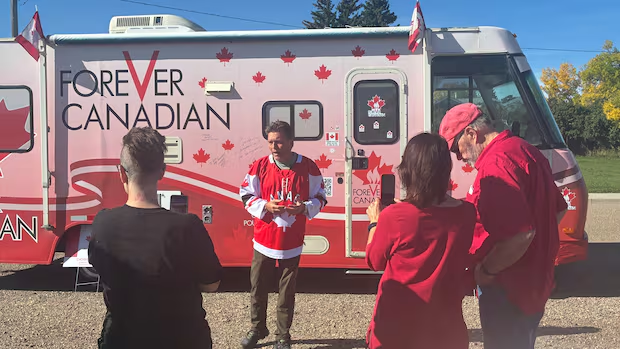
A small group of people supporting the Canadian side in Alberta’s upcoming referendum had gathered in a gravel lot in the town of Coutts, putting up signs and waving flags, and as a woman on a yellow mower rolled toward them, they parted to let her pass.
She came to a halt in front of Thomas Lukaszuk, founder of Forever Canadian, perhaps the best known of the federalist campaigns, who had just pulled into town in his signature RV. First she had demanded the group remove their signs on village property, then she had returned with the mower and, as the event got underway, began doing noisy passes on the grass across the street. But now she’s right in front of him.
The woman wanted to know, she said, where Lukaszuk’s financial disclosures were. It’s a common bone of contention for separatist leaders, frustrated that the federalist group hadn’t told the public how much money it had raised until recently being required to by Elections Alberta. (Lukaszuk referred her to the official website.) He then attempted to put an arm around her shoulders, when she shouted at him and rolled away. She also declined to speak to CBC News.
Follow all of our Alberta referendum coverage
The moment was short but tense. It was also not surprising to Jim Willett, the town’s former mayor, who watched the interaction unfold.
“There are always those people in the crowd that decide they want to be a little more vocal,” he said.
That’s not a theoretical prospect in Coutts, a border town of 200 people where many people can, quite literally, see America from their house. It made international headlines four years ago as the epicentre of a protest that began over COVID-19 vaccine mandates and culminated in a group of truckers blocking the border crossing, snarling travel and trade for two chilly weeks. The legal battles are still playing out in court.
Willett was mayor during the blockade, and spoke afterward about the way it had cleaved his community into those who supported the truckers and those who did not.
Coutts mayor emotional while speaking of blockade's impact on Alberta community
Now, the separatism debate is inflaming that old scar tissue. The woman on the mower, for example, was well known in town as a supporter of the convoy who hosted protesters on her property. Before she arrived, the operator of a café known as a gathering spot for convoy supporters also stopped by to put up a separatist sign before climbing back in his truck.
“I feel like it’s the same people,” Willett said. “They just changed flags.”
A few years ago, the Canadian flag was synonymous with convoy protests, to the point where critics of the movement were reluctant to fly it, he says. Now, separatists have rejected the maple leaf in favour of an Alberta flag.
As Alberta separatism referendum looms, flags become symbol of voting intention — and tension
The roots of Alberta’s discontent go back decades, but much of the current independence movement found its voice opposing public health measures during the pandemic. Polling has consistently found that separatism and convoy supporters are a minority, but a passionate one.
'I sensed after I put my [Canadian] signs up, one of the fellows treating me a bit differently, a bit colder,' says Colynn Kerr, a resident of Coutts. (Alex Boyd/CBC)
Writing in 2022, political scientist Jared Wesley, who is now a member of the pro-federalist group Lead Not Leave, found that both movements were driven by similar forces, including a sense of loss of status, an insular sense of community, and low levels of trust when it comes to mainstream sources of authority and information, such as government or the media.
A survey done last April by Common Ground, the group of researchers Wesley leads at the University of Alberta, found that 73 per cent of separatists said they sympathized and shared the views of the convoy. A further 20 per cent sympathized but did not share views.
The failure of the convoy to achieve its goals of ending pandemic health measures led to an “open wound,” says Max Cameron, a political scientist at the University of British Columbia and the author of a new book on the evolution of polarization in Canada.
“This referendum has provided the perfect vehicle for people who remain frustrated about how the convoy turned out and, in particular, are angry about how it was resolved,” Cameron told CBC News.
In any small town, but in Coutts in particular, putting a sign on your lawn means taking a public stance, since everyone knows where you live.
“I sensed after I put my [Canadian] signs up, one of the fellows treating me a bit differently, a bit colder,” says Colynn Kerr, a resident of Coutts who was in the process of handing out paper flags to neighbours who’d turned up to welcome the Forever Canadian RV.
A Forever Canadian sign pictured at an event in Warner, Alta., 35 kilometres north of Coutts. Polling suggests separatism is more popular in rural communities than in the big cities, but a small and passionate group of federalists turned out to greet Thomas Lukaszuk. (Alex Boyd/CBC)
Home to sprawling cattle ranches and a Bible Belt reputation, southern Alberta has long been viewed as a bastion of conservatism, and polling suggests separatism is more popular here than in the big cities. The proximity to the border, where Montana’s Sweet Grass Hills look within walking distance, also means the separatism debate has taken on a particularly American flavour.
“The border is ground zero in terms of some of the threats people feel [from] south of the border,” Kerr said.
We hit the road with separatists as they meet supporters in rural Alberta
Those who say they will vote to go forward with a separation referendum have a much warmer view of the United States than the rest of Alberta, according to a poll released by Abacus Data in September. Almost half view both America and Trump positively, compared to just 14 per cent of Albertans as a whole.
Many people in southern Alberta claim deep ties to their southern neighbours, often visiting or doing business in Montana.
“I love America,” says Keith Dangerfield, the café owner who stopped by the event to plant his sign.
During the border protest, Dangerfield’s café, the Hills of Home, became known as a gathering spot for the movement’s supporters.
In his mind, the Canadian Constitution prevents Alberta from doing things like electing judges without the permission of the other provinces, so he welcomed the idea of joining a country where he felt like individual regions would have more say.
“We would be, in principle, the 51st state,” he said. “I’m pro, because they have a constitution that works.”
Past Alberta separatist meetings in U.S. don't fall under foreign influence registry: watchdog
But for those in opposition to separation, the border can make the threat of American interference feel visceral. If Alberta were to separate, it might not be independent for long, says Jennifer Stuckey, a carpenter from Vauxhall, Alta., who had made the drive to Coutts to attend the Forever Canadian event and continued on to Lukaszuk’s next few stops in southern Alberta.
“I might be overreacting, but I think they’d probably just sweep in and scoop us up,” she said. “We have no military.”
Lukaszuk says he was told by a lot of people not to take his Forever Canadian campaign to Coutts because they warned it was the “epicentre of separatism,” he said. “But then we go there, and we get an amazingly positive response.”
Campaign leaders on both sides have talked about the threats they say they’ve faced, and Lukaszuk says he is aware of his surroundings, given how heightened emotions have become. He recently replaced a window on the RV after he says a rock was thrown at him while driving down the highway.
He says he tells his volunteers not to debate or argue with those who disagree, but tries to make a point himself of talking to critics — even when, like the woman on the lawnmower, they just drive away.
But for those who live in Coutts, it isn’t always possible to opt out of the debate.
Don Mayne, a Coutts resident who’d come to meet Lukaszuk, pointed out that there was a potluck dinner planned in town for the following day. Many of the people from the Forever Canadian event would be there, he said, and there was a good chance many of the separatists — some of whom had driven by in a truck, honking — would be, too.
That’s just how it works in a town this size and this isolated, where you can’t afford to cut anyone off permanently, he said.
“Twenty minutes later, you might need them to pull you out of a snowbank.”
Alex Boyd is a senior reporter based in Calgary, interested in politics, provincial affairs and misinformation. She is a former national and investigative reporter for the Toronto Star. Reach her at alex.boyd@cbc.ca.
Related Stories
 Canada
Defence minister delivers pro
5 minutes ago
 Canada
Don't support Trump tariffs then blame Stelco job cuts on 'act of God,' minister Joly warns Cleveland
5 minutes ago
 Canada
Elon Musk thinks Quebec should separate from Canada
5 minutes ago
 Canada
Permanent daylight time brings late NHL start times in Western Canada
5 minutes ago
 Canada
McGuinty delivers pro
5 minutes ago
 Canada
Ottawa teacher ‘immediately removed’ after sex assault allegation: board
1 hour ago
 Canada
FBI says it thwarted an attack on the Mall of America by a teen it supplied with an assault rifle
1 hour ago
 Canada
Do Canadians Hold Grudges? 🇨🇦
1 hour ago