
Feds should devise way to reflect on COVID
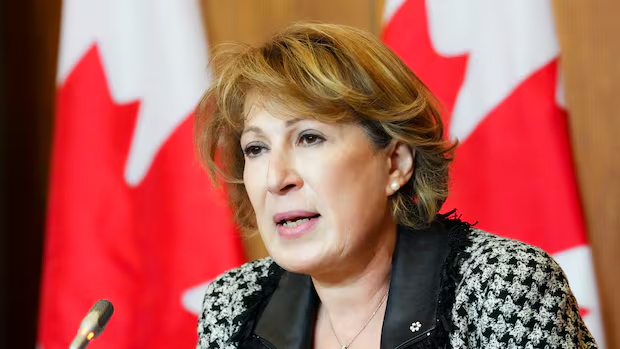
Feds should devise way to reflect on COVID-19 response, says Canada's chief science adviser
Canada must understand where some Canadians' anger comes from: Mona Nemer
Canada's chief science adviser says the federal government should devise a way to reflect on its response to the COVID-19 pandemic to better prepare the country and Canadians for future public health challenges.
"I think we have to respect how people feel, and then we need to meet them and hear them and understand where things stand," Mona Nemer said in an interview with CBC's The House airing Saturday.
"People are angry for different reasons around the COVID measures. Some are angry because they lost their livelihood. Others are angry because they lost loved ones. Others are angry because their kids didn't go to school. I think we need to understand all of this."
Nemer, an independent adviser who does not make government policy, said Ottawa's reflection must be apolitical and cannot be open-ended. In her view, it must tackle specific questions so the process doesn't drag on and people forget.
"Just like now, when people reflect on and are angry about some of the vaccine discussions, people forget that so many folks were dying every day before we had vaccines and how much vaccines saved lives, actually," she said.
The world isn't ready for another pandemic, report warns
"We just need to have the proper context for these kinds of discussions and reflections. And we need to have the proper mindset to do it in a constructive manner, to better prepare the country and the population for future health challenges."
Nemer's comments come as Conservative MP Dean Allison plans to hold his own inquiry in September on the pandemic — specifically "listening to the testimony of Canadians injured by a COVID-19 vaccine."
Manitoba launching review into government's COVID-19 response, but focus will be limited
Last month, Allison said "every Canadian deserves to be treated with dignity, respect and compassion. When people come forward with their concerns about their health, our first response should never be dismissal. It should be listening."
According to the inquiry's website, it will be non-partisan. Plus, other MPs and senators from all parties are eligible to sit as panel members.
When asked about the level of trust Canadians have in authorities when it comes to questions around infectious diseases, Nemer said general trust in government and science is decreasing — a worrisome development, the adviser noted, but not undeserved.
"Nothing was perfect [with COVID], but nothing was horribly badly done either," Nemer said. "I think people distrust when they don't understand, or they have their perspective and it hasn't been confronted or discussed against other things."
World falling behind on Ebola response
During her interview, Nemer also expressed concern about the global response to other infectious diseases, including Ebola.
The outbreak was declared on May 15 by the World Health Organization, and the number of infections has been steadily rising. According to data from the government of the Democratic Republican of Congo, the number of confirmed cases has risen above 4,000.
Ebola is not new, but Nemer said there were no diagnostics ready to detect the virus for several months, which likely worsened the containment of the current outbreak.
Why Nova Scotia was chosen to test a new Ebola vaccine
Congo says death toll in fastest-growing Ebola outbreak has passed 1,500
Nemer said that the global community still has not learned key lessons from COVID. For example, she highlighted that pandemic preparedness should not be viewed as a standalone concept, but instead should be integrated into routine health services.
Furthermore, Nemer said there was an urgent pace to dealing with the COVID-19 pandemic, but that urgency has since subsidied despite other diseases popping up that pose significant threats.
"Since COVID, we've had mpox, we've had Ebola, we've had hantavirus — the list is long. [Bird flu] is still a threat," Nemer said.
"So I don't think that we can declare victory and move on to other things."
Canada approves trial for mRNA Ebola vaccine
Nemer also acknowledged the collective fatigue when it comes to dealing with new viruses in the wake of the COVID-19 pandemic, but pointed out there will always be a need to prepare for future outbreaks — and it's better done now than in a crisis.
"I think the pandemic has also taught us important lessons about public trust [and] about the need to develop this trust during peacetime, meaning between pandemics or prior to pandemics," Nemer said.
"Because it's not during crisis that we're going to start developing the trust that is absolutely critical."
Benjamin Lopez Steven is an associate producer for CBC's The House and a digital writer with CBC Politics. He was also a 2024 Joan Donaldson Scholar and a graduate of Carleton University. You can reach him at benjamin.steven@cbc.ca or find him on X at @bensteven_s.
Related Stories
 Canada
Regimental funerals held for correctional officers who died in crash
54 minutes ago
 Canada
Trump Official Called Out for Claiming Canada Has No Military
54 minutes ago
 Canada
Alberta separation threatening 150 years of Treaty 6
4 hours ago
 Canada
Sextortion and online safety awareness
4 hours ago
 Canada
Kim Mounts Sunday Charge in Canada, Finishes Solo Third
4 hours ago
 Canada
'It won't be easy': Premier Scott Moe braces for tariff impacts to Saskatchewan
4 hours ago
 Canada
‘We’re in this for a while’: Canada
4 hours ago
 Canada
He was waiting for his son to return from the USS Lincoln. Then Border Patrol arrested him.
5 hours ago