
EtherealX takes aim at the one thing SpaceX hasn’t yet achieved: full rocket reusability
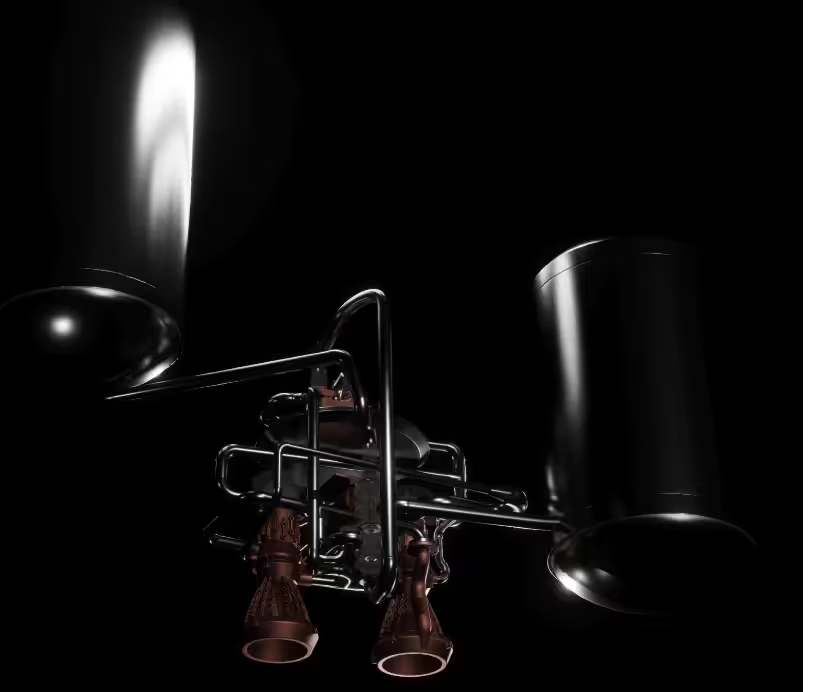
EtherealX takes aim at the one thing SpaceX hasn’t yet achieved: full rocket reusability
Elon Musk-led aerospace giant SpaceX has spent years turning rocket reusability from an engineering marvel into a commercial venture. But there is a small distinction: SpaceX's Falcon 9 is not a fully reusable rocket.
Its first stage (engine) comes back and flies again, while the upper stage is expended. SpaceX's Starship is designed to change that, with both stages intended to be recovered and reused, but that remains under development.
That gap is where Bengaluru-based EtherealX Exploration Guild sees an opportunity. "The toughest challenge to make rockets reusable lies in the thermal management system," CEO and co-founder Manu Nair told Moneycontrol.
The startup, founded in 2022 by Nair, Shubhayu Sardar and Prashanth Sharma, is developing a medium-lift rocket whose central proposition is full reusability.
The company is working on an engine that can effectively deal with the immense heat that space objects encounter when entering Earth's atmosphere.
For that, they have developed a Full-flow Segregated Cooling Cycle (FSCC) — a proprietary engine architecture that the company recently unveiled.
For an upper stage returning from orbit, the problem is heat. Conventional thermal protection works like this: it shields the vehicle during re-entry into Earth's atmosphere but at the same time it also adds mass to the rocket without doing much during liftoff.
FSCC is designed to use the propellants (fuel) as part of the vehicle’s thermal-management system, the company said in a video in which it unveiled the engine architecture.
FSCC uses the heat generated in the engine, transfers enthalpy (a measure of the total heat of a thermodynamic system at a constant pressure) between the fuel and oxidiser streams and uses that energy to drive the turbomachinery, the startup said.
In simpler terms, the propellant that is already on board is made to do another job.
"By utilising residual fuel reserved for reentry burn inside the fuel tank, it can serve as both propellant burn and thermal management medium for the reentry," EtherealX said in the presentation.
The economics of launch costs also make EtherealX’s approach relevant. A recent study by researchers from Cambridge University found India's average launch cost was $13,302 a kg in 2025, more than four times the US figure of $3,225.
If the startup succeeds in making its larger rocket fully reusable and achieves its targeted launch cadence, it could significantly lower the cost per kilogram.
But there is a catch and EtherealX is open about it.
The FSCC engine has not yet flown. In fact, it has not yet been hot-fired. The company has scheduled its first firing for November, when it expects to begin generating the real-world performance data that will determine whether the architecture works.
That makes the next few months important.
"We're humble enough to know that an engine like this hasn't been fired before," Nair says. "That’s exactly why we haven’t just designed one cycle but an entire family of them."
The technology also reflects a broader difference in how EtherealX views India's emerging private launch market.
Skyroot Aerospace and Agnikul Cosmos have both spoken about reusability.
Skyroot, which a few months back became the first Indian private entity to launch an orbital rocket, is developing larger vehicles beyond its Vikram-1 small-launcher programme. Agnikul has outlined plans to attempt recovery of its orbital-class vehicle.
Agnikul’s approach involves attempting a controlled return and landing of its booster, while Skyroot has been working towards reusable launch architecture.
EtherealX, however, argues that the starting point matters.
"We never built subscale stuff — not a single one," Nair says. "If you fail, you fail big, because at least when you fail big, that data is more useful."
The company says it went directly towards a flight-level engine and a vehicle designed around reusability, rather than developing a smaller rocket first.
The company envisages a fleet of four or five rockets capable of collectively supporting 60 to 80 launches a year. Instead of manufacturing a new upper stage for every mission, the idea is to reuse that stage across its life cycle.
EtherealX has ground testing ahead, followed by testing of its larger 1.2-meganewton semi-cryogenic engine and eventually a launch campaign.
Nair says the company expects its first launch towards the end of next year if the testing programme stays on track.
The real test, therefore, is not whether FSCC sounds different from the engines being developed elsewhere. It is whether the engine can survive the transition from an engineering thesis to hardware that can fire, fly, reenter and fire again.
Discover the latest Business News, Sensex, and Nifty updates. Obtain Personal Finance insights, tax queries, and expert opinions on Moneycontrol or download the Moneycontrol App to stay updated!
Find the best of Al News in one place, specially curated for you every weekend.
Stay on top of the latest tech trends and biggest startup news.
Related Stories
 Business
Belgium’s WAD Capital reaches €67.5 million first close for debut fund following €25 million EIF investment
46 minutes ago
 Business
Tata Chemicals ordered out of Kenya by president
2 hours ago
 Business
Robotics startup Hivebotics raises US$6 million in Series A round led by Vertex Ventures
4 hours ago
 Business
33East backs Cyprus
6 hours ago
 Business
Paul Graham says launching a startup is the 'least efficient' way to look cool
6 hours ago
 Business
Palo Alto’s CEO invested in the startup his company just bought for $500 million
8 hours ago
 Business
Prime Minister, Bryan Adams dishing over doughnuts in Thunder Bay
9 hours ago
 Business
Dolly Parton’s star on Hollywood Walk of Fame replaced after vandalism
10 hours ago