
Edmonton’s reconciliation with Indigenous people includes tangible, symbolic steps
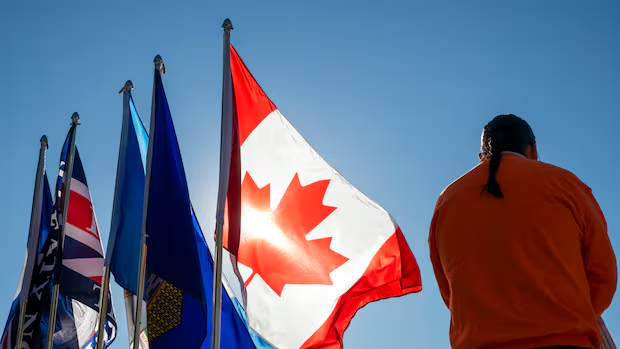
Edmonton’s reconciliation with Indigenous people includes tangible, symbolic steps
City of Edmonton focuses on 28 calls to action in TRC report
For many Edmontonians, the National Day for Truth and Reconciliation is an opportunity to consider what Canada has done and is doing to repair its relationship with Indigenous peoples impacted by the intergenerational trauma caused by the country’s residential school system.
In Alberta’s capital, which is home to the second-largest urban Indigenous population in the country, some steps aimed at reconciliation have and are being taken to implement some of the 94 calls to action outlined in the Truth and Reconciliation Commission’s (TRC) final 2015 report.
The City of Edmonton, under its Indigenous framework, focuses on 28 commitments that respond to or were inspired by the TRC’s calls to action, covering areas of child welfare, language and culture, justice, employment, health and professional development.
Some actions are complete and others are ongoing.
One example is when the city helped to establish a special outdoor space for Indigenous people. In fall 2023, the kihcihkaw askî-Sacred Land site opened at 14141 Fox Dr. in Whitemud Park.
It’s a natural area within an urban setting where groups can hold spiritual ceremonies, sweat lodges, cultural camps and talking circles, grow medicinal herbs and facilitate intergenerational learning within city limits.
'A gift from Mother Earth:' Man behind Indigenous site in Edmonton recounts discovery of sacred spring
Coun. Aaron Paquette, a Métis artist who’s serving his third term on Edmonton city council, said he believes another important step towards reconciliation is providing Indigenous awareness training for all the city’s employees. In the TRC report, it’s call 57: “professional development and training for public servants.”
As of 2025, over 9,200 City of Edmonton employees have taken the training, representing about 65 per cent of the corporation’s staff, the city’s website says.
The training, with an elder present, walks through the history of residential schools, explains the Indian Act and events that led to present circumstances, Paquette noted.
“There was a theft of culture,” he said. “There was a theft of identity, there was a theft of peace and well-being and there was a theft of the family unit from the federal government.”
The training sessions are meant to help people understand Canada’s history, he said.
“No one here is to blame for what happened, but we all carry a responsibility for how we move forward,” Paquette said.
In 2020, Edmonton approved a plan to replace the numbers that had represented the municipality’s 12 wards with Indigenous names. The names chosen were based on recommendations from a 17-member committee of women representing Anishinaabe, Blackfoot, Cree, Dene, Inuit, Iroquois, Métis and Sioux nations.
Janice Makokis, an assistant law professor at the University of Windsor, is from Saddle Lake Cree Nation, about 130 kilometres northeast of Edmonton. She said she thinks renaming the wards was a progressive idea and an act of reconciliation.
“It just has more meaning and significance when you understand the lands that you live on have attachment to an Indigenous language, laws and there's responsibilities that come with — whether you're Indigenous or non-Indigenous — what that treaty relationship looks like,” Makokis said in an interview with CBC News on Wednesday.
Troy Courtoreille, the lead for Edmonton’s Indigenous Relations Office, said the city has made progress on 14 of the 28 actions it is focusing on but there is still a lot of work to do.
“Reconciliation is going to be a real lifetime journey for us, and probably something we might not see the end of in my lifetime,” he said in an interview with CBC News.
A tangible step that has made a difference, Courtoreille noted, was subsidizing transit passes to students at amiskwaciy Academy, a school in the Blatchford neighbourhood whose students are mostly First Nations, Métis or Inuit.
For the first two years that discounted passes were provided, attendance at the school increased by 40 per cent and it had its two highest graduating classes, he said.
Courtoreille said the action, which continues this year, removed barriers to “make it to school without having to worry about, you know, how you're going to get there, or do we have enough money for the bus?”
Paquette said one step the city hasn’t yet taken but should is to repudiate the “Doctrine of Discovery,” a 15th-century Christian directive that encouraged Europeans to take over land and have sovereignty over it.
Paquette noted the Vatican repudiated it in 2023 after the late Pope Francis visited Alberta the year before.
Pope Francis apologized for residential schools during historic Canadian visit
“It costs us nothing,” Paquette said. “But it also is incredibly meaningful, symbolically.”
In other areas, there’s a long way to go, Paquette said.
Residential schools and colonization resulted in intergenerational trauma and a disproportionate number of Indigenous people experiencing homelessness.
“The problem is that people in the public might look at that and say, ‘Well, that's who those people are,’” Paquette said. “‘Obviously it's a racial issue,’ which it is not.
“It is a policy issue. The policies of the past have created the reality in the present.”
Paquette said he would like the next step on the path to reconciliation be for Canada to implement a national strategy to tackle homelessness, housing and mental health.
In June, the Federation of Canadian Municipalities (FCM) passed a resolution during a conference held in Edmonton to develop a multilateral strategy among all levels of government and Indigenous groups to address those issues.
Paquette said the FCM is drafting a framework and policy on the proposed national strategy for the federal government to review, which he hopes will be debated and adopted in the coming months.
Natasha Riebe landed at CBC News in Edmonton after radio, TV and print journalism gigs in Halifax, Seoul, Yellowknife and on Vancouver Island. Please send tips in confidence to natasha.riebe@cbc.ca.
Related Stories
 Canada
Carney speaks in Edmonton as ceremonies held across Canada for Truth and Reconciliation Day
31 minutes ago
 Canada
Housing protests gather pace in Spain
31 minutes ago
 Canada
Tennessee unable to carry out the execution by lethal injection of Christa Gail Pike
1 hour ago
 Canada
How will the 'Super El Niño' impact fall colours in Ontario?
2 hours ago
 Canada
BC marks National Day for Truth and Reconciliation
2 hours ago
 Canada
Ontario ministers defend secret payout to Elon Musk's SpaceX over nixed Starlink deal
2 hours ago
 Canada
Ontario completes latest push to raise highway speed limits
2 hours ago
 Canada
Craig Rowe soars to new heights
2 hours ago