
Durham police warn of online predator network 'The Com' manipulating children into criminal acts
Durham police warn of online predator network 'The Com' manipulating children into criminal acts
Police currently investigating swatting incident at Oshawa school linked to group
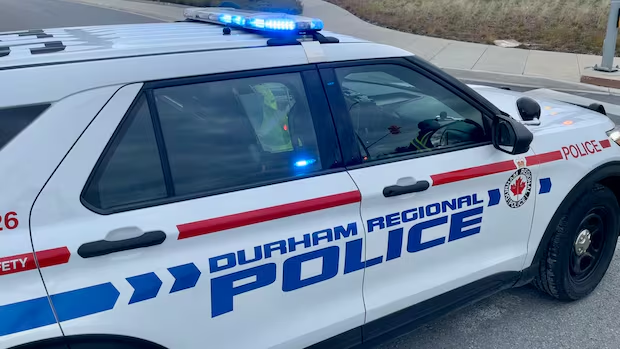
Durham police are warning the public about an online network of predators who target children online and manipulate them into criminal acts.
Police have been responding to a number of incidents believed to be linked to this network, known as "The Com," short for "The Community," Sgt. Janalyn Dowdle said in a video posted on X, formerly known as Twitter, on Tuesday.
Police said the network targets children and teens aged 8 to 17 using grooming, manipulation, coercion and intimidation.
The offenders "often build trust, create secrecy through fear or shame, and pressure victims into harmful or unsafe activities," according to a statement from Durham Regional Police Service (DRPS).
Those activities include coercing children into participating in crimes, such as online attacks and hoax 911 calls — which is known as swatting.
Online network of 'predators' linked to threats at Pickering elementary school, police say
DRPS is currently investigating a swatting incident that led to a lockdown at Monsignor Paul Dwyer Catholic High School in Oshawa on Friday, and "are looking at links" to the network, acting Sgt. Nicholas Gluckstein said in an email.
In February this year, police said they’d linked a series of threats at a Pickering elementary school to this network.
"The Com" may also manipulate victims into sharing inappropriate and exploitative images or videos, and engage in self-harm or harm towards others or animals, police said in the post on X.
"They’re asking some pretty horrific things from our youth in the area," said Det.-Const. Taryn Snow, with the Durham police cyber crime unit
Children may be forced to comply through threats such as exposing private information, doxing or swatting, police said.
York Regional Police spokesperson Sgt. James Dickson said the service is not aware of any incidents directly connected to ‘The Com.’
CBC News also reached out to Toronto police to inquire whether its investigating the network.
Gaming platforms among ways children targeted
The network targets children across various online platforms, including Discord, Telegram, Snapchat, Roblox, Minecraft, Twitch and Steam, according to police.
Parents are encouraged to watch for patterns of behaviors in their children, including whether they're using encrypted apps — such as Discord and Telegram — without parental knowledge.
Other potential warning signs could be if a child has increased or secretive use of electronic devices or is having mood changes or declining academic performance.
"While one of these signs may not be of concern, multiple indicators together may warrant attention," read the statement.
Parents are advised to talk to them about the risks of sharing personal images and information online.
"Ensure you have access to your child’s online platforms and regularly review their activity," the post read. "Pay close attention to platforms with chat or group features."
If a parent believes something is wrong, they are advised to contact the Durham police non-emergency line and save screenshots of all relative information — including messages, usernames and links.
Some 3,000 groups make up network: expert
“The Com” is a “decentralized online ecosystem of different groups,” said Amarnath Amarasingam, an associate professor at Queen’s University who researches extremism and radicalization.
Roughly 3,000 different groups make up what can be called 'The Com,' said Amarnath Amarasingam, an associate professor at Queen’s University who researches extremism and radicalization. (CBC)
Some of those groups may be linked to cybercrimes, while others may be linked to exploitation and extortion of children, or violence-oriented subcultures, he said.
In total, he said roughly 3,000 different groups make up what can be called “The Com."
Amarasingam said police may be issuing the alert to increase awareness of warning signs — not just for parents, but also for teachers, pediatricians and even veterinarians.
“If an animal comes into the veterinary clinic with bizarre bite marks or cut marks, that might be a sign that there’s something else going on, as opposed to just a routine injury of some kind,” he said.
Amarasingam said he’s previously interviewed someone he called a “former perpetrator” involved in one of these groups. That person said he received “a lot of clout and status … for what [he] was able to get young people to do to themselves.”
“It’s almost a kind of cruelty for cruelty’s sake, and the cruelty is how you get status and recognition in these online communities,” Amarasingam said.
He said parents should be aware that it’s important to go beyond setting time limits for screen time, and actually monitor what content their children are seeing on social media.
Rochelle Raveendran is a reporter for CBC News in Oshawa. She can be reached at: rochelle.raveendran@cbc.ca.
With files from Thomas Daigle, Michelle Song and Erin Collins
Related Stories
 Technology
Meet the 55 deep tech startups pitching investors at UNSW’s showcase
1 hour ago
 Technology
NVIDIA plans minority investments in four French startups as European tech commitment nears €9 billion
1 hour ago
 Technology
CNTTech launches English edition to spotlight Korean startups abroad
3 hours ago
 Technology
Iran's nuclear tech. potentials amount to developed nations
3 hours ago
 Technology
ZAWYA: UAE eyes deeper industrial, technology links with China
3 hours ago
 Technology
Choo Miae: "Will Not Let Up on 'Jultakdongsi' Efforts to Ensure Business Success"
4 hours ago
 Technology
Cyprus Business Now: fintech, supermarkets, gambling, shipping, startups, IMF
4 hours ago
 Technology
Saudi Arabia strikes oil depots in Yemen and says missiles launched toward location of Saudi Aramco HQ
5 hours ago