
DOST
With the country facing calamities every year, disaster preparedness and response efforts remain crucial in protecting communities and helping them adapt to any eventualities.
However, limited access to water and electricity can make cooking nutritious food difficult.
The Department of Science and Technology – Food and Nutrition Research Institute (DOST-FNRI) on Tuesday showcased ready-to-eat and ready-to-cook meals that are convenient, easy to store, and shelf-stable.
These food technologies aim to address nutritional gaps, limited sensory appeal, lack of variety, and unfamiliarity with emergency food products currently available in the market.
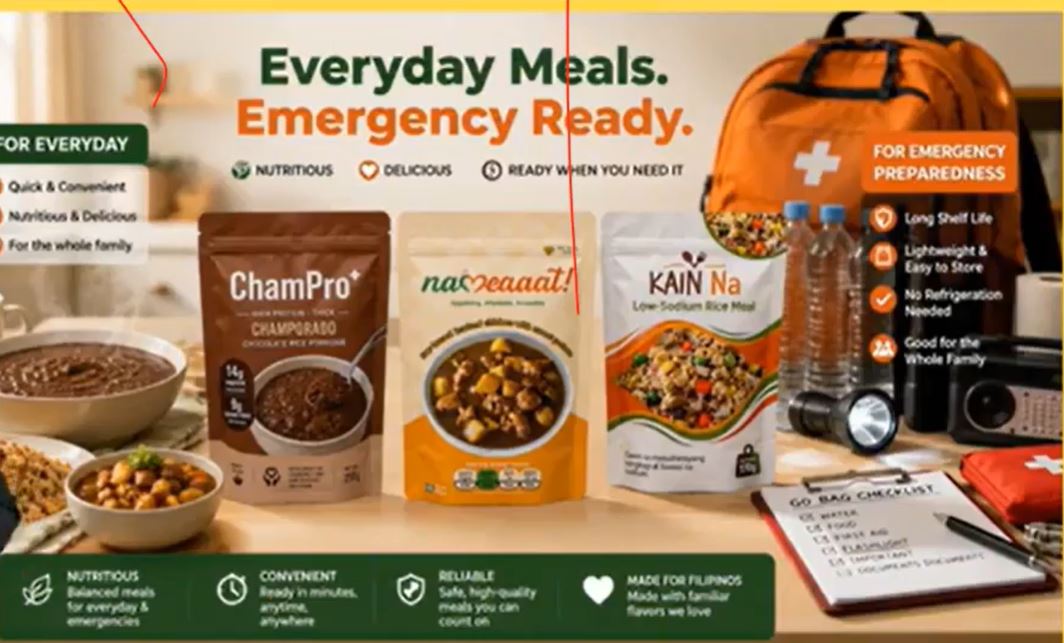
Ready for Everyday and Emergency Situations - Quality Meal (Res-Q Meals) has food products ranging from sweet to savory varieties.
ChamPro+ is a high-protein chocolate porridge made with rice, cocoa, and dairy and plant-based protein.
It contains 14 grams of protein, equivalent to about two eggs, one egg white, and 50 grams of chicken breast, making it higher in protein than similar products currently available in the market.
According to DOST-FNRI, higher protein intake helps promote satiety, sustain fullness, and stretch limited food rations during disasters.
Nameaaat is a ready-to-eat meal made with chicken, sweet potato, and a reduced-sodium soy-based sauce, created to provide the familiar taste of Adobo.
It contains 10 grams of protein, 1 gram of dietary fiber, and 101 milligrams of sodium.
DOST-FNRI pointed out that Nameaaat contains four to five times less sodium than available canned meat and fish products, which can contain up to 495 milligrams of sodium.
This could help lower sodium intake, which increases the risk of non-communicable diseases such as chronic kidney disease.
Data from AstraZeneca showed that CKD prevalence among Filipinos reached 35.94% in 2022. This means one Filipino is diagnosed with CKD every 40 minutes, while one patient progresses to dialysis every 60 minutes.
Also under Res-Q Meals, KAIN Na! is a ready-to-eat meal in a pouch made with rice, chicken, mixed vegetables, and reduced-sodium soy-based sauce.
DOST-FNRI noted that KAIN Na! is not only useful during emergencies but also has market potential.
The Philippines’ ready-to-eat food market is valued at $2 billion and continues to grow.
A DOST-FNRI study further showed strong consumer demand, with 4 in 10 Filipino adults eating meals outside the home.
Meanwhile, Enerbisc is a milk biscuit specially developed to meet the nutritional needs of children.
One serving of Enerbisc provides up to 25% of the recommended energy intake for children aged 6 to 9, based on the 2015 Philippine Dietary Reference Intakes.
It also contains 0 grams of trans fat and cholesterol.
DOST-FNRI also presented ready-to-cook products that are not only quick to prepare but also provide essential nutrients.
Oricea instant rice kernel is an extruded, iron-fortified instant rice that can be prepared in just 5 to 7 minutes by simply adding water.
Each 30-gram serving provides 8% of the recommended iron intake for children aged 6 to 9 years old.
Its estimated retail price is P16.47 per 120-gram pack.
Meanwhile, Maizea is a ready-to-cook, rice-shaped product made primarily from white corn that cooks in just 3 minutes.
With a shelf life of 12 months, it is suitable for storage, emergency supplies, and relief distribution.
Its estimated retail price is P21.50 per 120-gram pack.
Potential adopters may contact DOST-FNRI if they are interested in manufacturing or adopting the developed food technologies.—LDF, GMA News
Related Stories
 Lifestyle
Top News Headlines In Indonesia, Philippines & Singapore: Aug 27, 2026
9 hours ago
 Lifestyle
Food and shelter have driven Canada's affordability crisis. Health care isn't far behind
1 day ago
 Lifestyle
Paddler shoots and kills polar bear along Hudson Bay coast in Manitoba, province says
2 days ago
 Lifestyle
Grim signs the globe is about to run short of food
2 days ago
 Lifestyle
How Trump's tariffs work to redistribute wealth up the food chain
3 days ago
 Lifestyle
Wild beaver kits born in Norfolk for first time in more than 500 years
3 days ago
 Lifestyle
Alberton food bank on the move to nearby grocery store
4 days ago
 Lifestyle
I was burning out as a founder. My summer interns changed everything about the way I work.
4 days ago