
DIY 'bucket of doom' mosquito traps are going viral as bug season begins to bite
Mosquito dunks are selling out as bug season and 'bucket of doom' trend collide
DIY traps are going viral as potentially worse-than-usual season starts to bite
It could be a worse-than-usual mosquito season in some parts of Canada, and if you've scrolled social media for solutions you may have encountered the "bucket of doom."
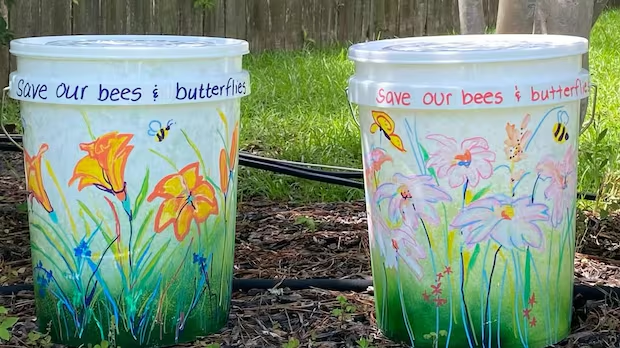
It's a popular at-home mosquito control kit making the rounds online among nature advocates, home-decorating influencers and people who just don't like getting bitten.
How-to videos — some viewed hundreds of thousands of times — show people all over North America adding a bacteria called Bacillus thuringiensis israelensis, or BTI, to large buckets in their yards. As BTI is deadly to mosquito larvae, TikTokers are showing off their traps with jokey names like "skeeter yeeter" and "the no-fly zone."
The online popularity of BTI — sold in pucks as "mosquito dunks" — means some people looking for it at their local hardware store have come up short.
Ranvir Hansbhade, a manager at a Home Hardware on Bank Street in Ottawa, said his store was sold out in mid-June, and so was the company's warehouse.
But as mosquito season nears its peak, some Canadians are wondering whether the "bucket of doom" is actually safe and effective.
Experts say there's a lot more than one trendy fix that goes into controlling the mosquito population.
In Ontario and Quebec, spring mosquitoes are still in the air and summer species that breed in warmer water are just getting started, says Richard Vadeboncoeur, VP of business development for the Quebec-based mosquito control company GDG Environment.
Rain that stays on the ground in late May can sometimes indicate a worse-than-usual mosquito season, he said.
Weather conditions creating perfect storm for mosquito populations, experts say
Vadeboncoeur says the wet weather system that moved through eastern Ontario and southern Quebec on Thursday has likely encouraged further breeding, which could become "a big nuisance" for the rest of the month.
But a longer spell of hot and dry weather can shorten the lifespan of mosquitoes from a month to just one week, he said, potentially changing the population arc for the rest of the summer.
More mosquitoes increase the spread of West Nile virus, which is now endemic across Canada, and rarer viruses like eastern equine encephalitis, or triple E, which can be deadly to humans.
As the climate warms, more mosquito-borne viruses like dengue and zika are expected to find their way further north, said Vadeboncoeur.
Vadeboncoeur's company has been using BTI on a municipal scale for decades, but advocates for the at-home dunks say they're catching on and giving people a sense of control in their communities.
"We see it as a wonderful alternative to spraying and fogging with broad spectrum pesticides," said Krista de Cooke, a spokesperson for the Mosquito Bucket Challenge, an initiative run by the U.S.-based conservation group Homegrown National Park.
Commercial pest control companies tend to use pyrethroid sprays, which also kill bees, butterflies and other pollinators, says de Cooke. "All these fun insects that you want to have on your property — it kills those along with the adult mosquitoes flying around."
An effective bucket contains water and a large handful of organic material like leaves or grass to attract the mosquitoes, says de Cooke.
She recommends breaking the BTI puck into quarters and spreading the bacteria among multiple buckets. Others suggest fixing chicken wire over the top to prevent pets or other animals from getting in — or leaving a branch in the bucket to allow critters to climb out.
BTI targets larvae rather than adults and is only toxic to a narrow number of insect species, de Cooke says — and of those, only mosquitoes would seek out a plastic container for breeding.
When the new larvae ingest BTI, its destroys the lining of their stomachs.
"Basically, they never emerge from the bucket as biting adults," de Cooke said.
The buckets' simplicity and pollinator-friendly selling point have captured the interest of TikTok users across the continent, but de Cooke says the method is not a "one-and-done, silver bullet" solution.
"The main thing I really want people to remember is to refresh their dunk once a month … if you're not refreshing the BTI, then it just turns into another breeding source for the mosquitoes," she said.
Both de Cooke and Vadeboncoeur recommend removing other standing water in the area as part of a broader mosquito control strategy. "Tires, wheelbarrows, poorly draining gutters — the mosquitoes can breed in a puddle of water as small as a cap of a soda bottle," said de Cooke.
The world has a mosquito problem. Here's how scientists are trying to solve it
Concerns have also been raised on some online forums that the pucks, if put in ponds or larger areas of standing water, could harm amphibians.
"There are a couple of studies that are pretty inconclusive right now," says de Cooke. "It's something that I would love to see more research on."
As for a common worry that some birds that rely on mosquitoes as a food source might be affected, Vadeboncoeur says Canadians can safely put that "myth" to rest.
In fact, he says, mosquitoes have a negative impact on bird populations because they spread the West Nile virus. Birds prefer larger insects and even for bats, mosquitoes make up less than four per cent of their diet, he said.
"There's no proof of a negative effect on birds when you are reducing the population of mosquitoes," Vadeboncoeur said.
Mosquitoes can travel anywhere from 500 metres to a kilometre during their lifetimes, so neighbours with ponds, bird baths or other standing water can reduce the effectiveness of a mosquito bucket to "almost nothing," says Vadeboncoeur.
That's why de Cooke recommends getting neighbours involved, "so you can have more coverage and you're controlling more and more of the population on a broader geographic scale."
A healthy garden can also attract species that eat mosquitoes, says de Cooke.
"Planting native and encouraging biodiversity on your property brings in natural predators of the mosquitoes and that very much helps to keep the populations in control as well," she said.
Mosquito wars: Canadian scientist takes on world's deadliest animal
Sarah Berman is an editor with CBC's digital news desk and a reporter covering technology, politics and justice. She is a former senior editor at VICE and past contributor to Reuters, the Guardian, the New York Times, the Globe and Mail, Maclean’s and other publications.
Related Stories
 AI News
Spain vs. Saudi Arabia free live stream: How to watch World Cup game online without cable
32 minutes ago
 AI News
This woman 'managed to not be bored' during the COVID lockdown and planted a vineyard at home
33 minutes ago
 AI News
The Latest: Vance and Iranian negotiators are in Switzerland to work on deal's details
33 minutes ago
 AI News
WORLD CUP DAILY, June 21: Vancouver hosts New Zealand vs. Egypt today at 6 p.m.
33 minutes ago
 AI News
Middle East live: US
33 minutes ago
 AI News
Rahul Gandhi’s politics of resistance needs a credible path to power
33 minutes ago
 AI News
Hundreds watch sunrise at UK's most easterly point
34 minutes ago
 AI News
8 books by B.C. authors to kick off summer
34 minutes ago