
Cross
Cross-party group calls on Canada to block development of superintelligent AI technology
News comes just before federal government releases its national AI strategy
A multipartisan group of Canadian MPs and senators are supporting a campaign calling for Canada to negotiate an international "trust but verify" regime to prohibit the development of AI that far surpasses human intelligence.
The announcement comes just before Canada releases its national AI strategy.
The campaign, which launched Thursday, is being led by Control AI, a non-profit organization that "works to prevent the extinction risk posed by superintelligence and to secure a great future for humanity," according to the organization's website.
A statement from the campaign says "protecting Canadians from the development of superintelligence, at home and abroad, must be a national security priority."
"Nobel Prize winners, leading AI scientists and CEOs of leading AI companies have warned that AI poses an extinction risk on par with nuclear war. Despite this warning, multiple competing efforts to build superintelligent AI are underway," it says.
Supporters of the campaign include Liberal MPs Judy Sgro, Jonathan Wilkinson and Steven Guilbeault — though the last two will soon be stepping down from their roles. Conservative MPs William Stevenson, Cathay Wagantall, Joël Godin and Arnold Viersen have also lent their support.
Canada aims to scale up AI adoption, literacy training: strategy draft
Plus, Independent MP Simon-Pierre Savard-Tremblay is backing the campaign, as is Bloc Québécois MP Martin Champoux — who is described on Control AI's website as a signatory on behalf of the other Bloc MPs.
Three Canadian senators are also listed as supporters: Colin Deacon, Tony Loffreda and Kim Pate.
Artificial superintelligence, also known as ASI, is able to operate far beyond a human level. Some leading AI experts like British-Canadian computer scientist Geoffrey Hinton have said this kind of technology is only a matter of years away, though others are skeptical about that timeline.
Wyatt Tessari L'Allié, founder of AI Governance and Safety Canada, told CBC News the campaign is important because it shows artificial superintelligence is "finally being taken seriously in Ottawa."
L'Allié said U.S. tech companies Anthropic, OpenAI and Google have the biggest leads on developing ASI, and a global regime would be mostly focused on the United States and China — the two superpowers in AI development.
"For Canada to protect its own citizens, its only real option is foreign policy because the most dangerous systems are not coming from Canada," L'Allié said.
L'Allié acknowledged that the U.S. is becoming more aware of the issue at hand.
For example, U.S. President Donald Trump signed an executive order on Wednesday asking tech companies to give the U.S. government a window to review new AI models before releasing them to the public.
Plus, after Trump met with Chinese President Xi Jinping in May, the Chinese government said the two countries need to work together to improve AI governance so that it contributes to the common welfare of the international community.
Canada's national AI strategy imminent
The launch of Control AI's campaign comes just before the federal government releases its national AI strategy. One of the pillars in the strategy is focused on "building trusted partnerships and global alliances."
According to a draft version of the strategy obtained by CBC News, which could still be revised, the federal government aims to build a multilateral alliance so that Canada has sovereign autonomy in key AI capabilities.
That language echoes Canada's Sovereign Technology Alliance, which it launched with Germany in February.
According to the federal government, the alliance is designed as "a platform for practical co-operation on advanced technologies, with a focus on delivering real capability and shared economic benefit."
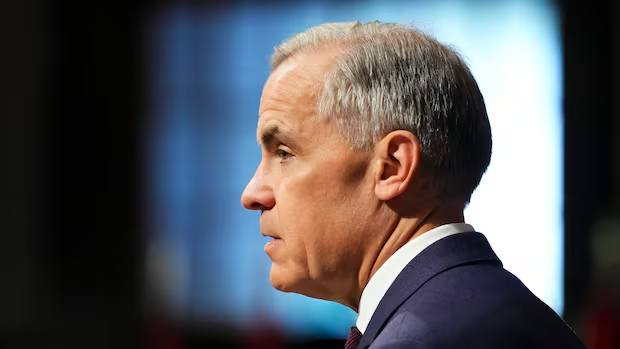
On Friday, Prime Minister Mark Carney spoke with Pope Leo about AI and the "imperative that AI must serve humanity" — a conversation that came soon after the Pope urged governments to slow down the development of AI systems.
The Pope delivered that call in his first encyclical, one of the highest forms of teaching from a pontiff to the Catholic Church's members. He warned AI systems can spread misinformation, prioritize conflict and risk leading the world down a path of unending war.
In a readout distributed to reporters last week, Carney's office said the prime minister, a devout Catholic, is "welcoming the Pope's leadership in this field."
"Prime Minister Carney expressed Canada's desire to lead internationally on responsible AI and tools to benefit the global community," the readout said.
Benjamin Lopez Steven is an associate producer for CBC's The House and a digital writer with CBC Politics. He was also a 2024 Joan Donaldson Scholar and a graduate of Carleton University. You can reach him at benjamin.steven@cbc.ca or find him on X at @bensteven_s.
Related Stories
 AI News
Seattle Times and Newsday sue OpenAI and Microsoft for infringement
40 minutes ago
 AI News
Korea Startup Forum Launches Second Round of 'Claude Credit' Program for Member Companies
1 hour ago
 AI News
Artificial intelligence can't make you a creative artist
1 hour ago
 AI News
ChatGPT Astra is now rolling out to $20 Plus subscription
2 hours ago
 AI News
US and China eye Trump
3 hours ago
 AI News
Artificial Intelligence at AIG
3 hours ago
 AI News
AI becomes the new arms race: China warns US against technological dominance
4 hours ago
 AI News
Who Owns Ukraine’s War? Palantir, battlefield data and the hidden economy of artificial intelligence
6 hours ago