
Cross
Cross-border cocaine: How it’s detected and why it’s such a problem
Cocaine is appealing to criminal networks because of stable supply, established distribution, researcher says
Cocaine is the most seized substance in southwestern Ontario along the Canada-U.S. border, according to data from both countries.
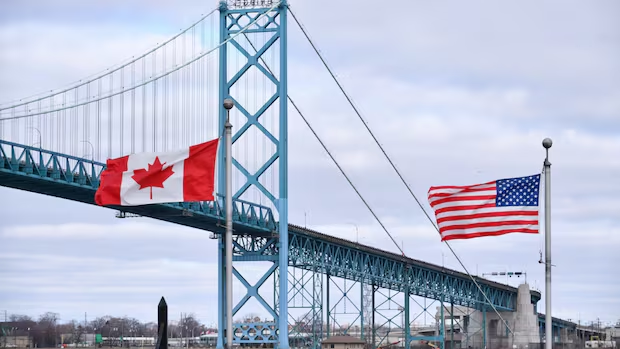
Over the first six months of this year, more than 827,000 grams of cocaine, with a street value of more than $82 million, were seized by the Canada Border Services Agency (CBSA) at the Ambassador Bridge, Detroit-Windsor Tunnel, Blue Water Bridge, Peace Bridge, Queenston Bridge and Rainbow Bridge and at Walpole Island.
Last year, the CBSA seized 1,631,981 grams of cocaine, and in 2024 it confiscated 1,515,369 grams of the substance — amounts worth more than $150 million in each of those years.
“The bulk of our business is the narcotics that are coming from the United States,” said Justin Morgan, chief of operations with the CBSA at the Ambassador Bridge.
Cocaine was also the most seized substance by U.S. Customs and Border Protection (CBP) officials at the same southwestern border crossings, according to CBP data.
They seized 927,142 grams in 2024 and 2,092,875 grams in 2025.
One Customs and Border Protection watch commander told CBC a lot of what's seized at the border in Detroit is on its way to Canada from the U.S., not coming from this country.
“It’s really not that big of a problem for inbound,” said Lavarah Miller. “A lot of the stuff we actually get, we get a lot of it going outbound."
This year, marijuana seizures at the border by the CBP (1,797,133 grams) have outpaced cocaine seizures (242,218 grams) by a significant amount. Those statistics cover the period between Oct. 1, 2025 and July 6, 2026.
Seizure data collected by law enforcement related to illegal substances doesn’t paint a fulsome picture, according to Benoît Gomis, a lecturer at the Munk School of Global Affairs and Public Policy in Toronto.
Ultimately, he said, “we don’t really know” what makes it across the border undetected.
And drug seizure trends lack context because it “might mean a lot of different things," according to Gomis.
“It might mean that law enforcement got lucky with some larger seizures," he said.
"They might mean that there’s a greater political will to go after that particular substance. It might mean that indeed there is an increase in the amount of drugs in circulation."
Why is cocaine so appealing to criminal networks?
There’s a “very stable source” of the plant that’s used to make cocaine, which is primarily found in Columbia and Peru, according to Gomis.
That stability is one of the reasons it makes the drug appealing to criminal networks, he said.
“Cocaine has always been there; there’s a very straightforward playbook that they’re used to. It’s an easy substance to smuggle [because] it’s very small,” Gomis said.
“There’s a stable demand, the distribution networks are there, they’re very well established.”
Based on his research, Gomis also said that cocaine consumption appears to be trending upward, with between two and three per cent of the adult population believed to have used the substance in the past year.
“We also have found some anecdotal evidence that the purity is increasing as well, so in the U.S., Canada, western Europe as well, which is creating all sorts of harms,” said Gomis.
“The toxicity and the potential lethality of the drug has been increasing. It’s also a drug that’s mixed with all sorts of other drugs, including fentanyl and all sorts of other substances."
The United Nations Office on Drugs and Crime publishes data on global drug trafficking, calling it a “clear threat” on the world stage.
It highlights the harm cocaine has caused in Canada, pointing to a 2018 statistic showing the drug was the most reported substance used by people entering treatment in this country.
The latest data from 2020-23 show that cocaine trafficking operations begin in the Andean countries of South America and go north through Mexico into the U.S. and up into Canada.
How does Canada detect drugs at the U.S. border?
The CBSA provided CBC News with rare access to the Ambassador Bridge port of entry to show how it detects drugs at the border.
In some cases, it uses its own intelligence or information provided by other law enforcement agencies to flag incoming, suspicious loads for automatic inspection.
“So that way our officers are able to identify different trends, concealment methods that the transnational organized crime groups are using,” said Morgan.
“Anything you can think of, the transnational organized crime groups have thought of it and have utilized it,” he said.
He said CBSA officers are also trained to look for verbal or non-verbal clues, commercial paperwork issues and other suspicious indicators.
CBSA has tools to assist its officers, including detector dogs, large scale imaging units, a mobile X-ray truck and handheld devices that can detect items such as guns inside vehicles prior to an extensive search.
Canada’s new border crossing has new detection tech
At the new Gordie Howe International Bridge that opened to traffic on July 27, there are 24 inspection lanes — the most at any Canadian port of entry.
The new crossing also allows CBSA officers to do more commercial truck examinations because of X-ray technology on site; they don't have to offload a trailer, which can take several hours, officials say.
There are examination bays at the Gordie Howe bridge that don’t exist at the Ambassador Bridge, as well as smaller scale X-ray capabilities inside.
“We also have a specialized facility within this commercial examination area where we can safely examine packages that may have highly toxic substances, such as fentanyl or methamphetamine in them,” said Sydney Kale, CBSA’s district director for the Gordie Howe International Bridge.
Jason Viau is reporter for CBC News based in Windsor, Ont. He has an interest in telling stories related to accountability, policing, court, crime and municipal affairs. You can email story ideas and tips to jason.viau@cbc.ca.
Related Stories
 Canada
How NATO is prepping in the Baltic skies for a possible confrontation with Russia
22 minutes ago
 Canada
The Democrats are surging as the U.S. midterms near. Here's the data that has Trump's Republicans spooked
22 minutes ago
 Canada
The cost of drugs from Canada is set to soar for millions of Americans because of a U.S. rule
23 minutes ago
 Canada
Man, 59, dies while homeless in Granby, Que.
23 minutes ago
 Canada
Italy’s parliament gives final approval to Meloni’s electoral reform
23 minutes ago
 Canada
Surveillance camera catches moment Montreal boy was run over by school bus
23 minutes ago
 Canada
Bryan Adams, Wyclef Jean and more to headline FIFA kickoff concert in Toronto
24 minutes ago
 Canada
Ravneet Meets Consul General of India in Vancouver to Discuss Women’s Empowerment, Fertility and Diaspora Engagement
25 minutes ago