
How NATO is prepping in the Baltic skies for a possible confrontation with Russia
How NATO is prepping in the Baltic skies for a possible confrontation with Russia
While jets patrol overhead, Canada is tasked with holding the ground below
How NATO is flexing in the face of Russian aggression
When Latvians cast their ballots in a national election this past weekend, many did so without realizing that three countries — Turkey, Spain and Italy — all had fighter jets patrolling the grey skies high above them for any overt Russian attempts to disrupt the vote.
"Nothing flies without authorization in the alliance airspace," said Capt. Antonio Moncebo, a Spanish F-18 pilot whose squadron was operating out of a base in Estonia next door.
So when NATO identifies a possible threat, "we trigger a scramble, and we seek them and shoot them down."
Spanish fighter pilot Antonio Moncebo spoke to CBC News at a NATO airbase in Lithuania. (Jason Ho/CBC)
NATO’s high-altitude vigilance with its "sky shield" is no longer just a routine drill.
While many NATO military planners believe Russia is unlikely to deliberately start a war with the Western alliance, if Russian President Vladimir Putin decides he wants to test NATO’s resolve with a lower-threshold provocation, the Baltic states could be vulnerable.
From suspected Russian arson attacks at high-tech defence facilities in Estonia to a foiled cargo plane bombing plot in Germany, Putin's intelligence services are increasingly pushing past traditional red lines in an effort to weaken Western resolve to aid Ukraine.
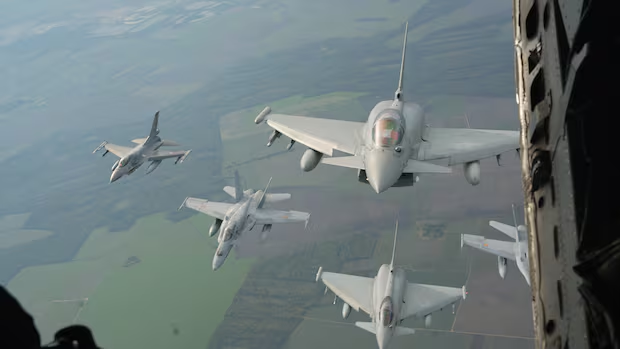
NATO jets from Italy, Spain and Turkey fly in a tight formation above Latvia, as part of a demonstration by the alliance's air command. (Adrian Di Virgilio/CBC News)
Justin Bronk, with the British military think-tank RUSI, says Putin may believe there's an opportunity to exploit U.S President Donald Trump’s often antagonistic relationship with Europe.
"Clearly at the moment, there's a lot of concern about the potential for Russian direct aggression against NATO members in order to presumably try … to demonstrate that the alliance won't come to the military aid of one of its member states," said Bronk.
Members of the media, including a CBC videographer, perch at the edge of the ramp in the back of a Lithuanian military aircraft to photograph NATO jets in the sky. The photographers were tethered with harnesses so they wouldn't fall out. (CBC)
Whether NATO is prepared to counter potential Russian aggression is an existential question.
Lieut.-Gen. Guillaume Thomas, who commands the air operations over the Baltic states, dismisses any talk that a Trump-led U.S. can’t be relied upon.
"I am completely confident in the support of U.S. forces in protecting the alliance. I have no doubt every day I can see the development of the U.S. force and I have no doubt about their support, their continuous support."
To prove its readiness, NATO, which is anchored by the principle of collective defence, recently invited a small group of media, including CBC News, to witness the air shield over the Baltic states first-hand.
High above Lithuania, aircrew lowered the back ramp of a military transport plane in mid-flight, allowing journalists a dizzying, close-up view of Italian Eurofighters, Spanish F-18s and Turkish fighter jets flying wing to wing.
Thomas says such tight formations are a visual manifestation of a deeper, more profound shift in how the alliance secures its eastern flank.
Spanish and Italian fighter jets fly in a tight formation next to a Lithuanian military plane carrying members of the media. (Adrian Di Virgilio/CBC)
"It was a shift in mindset to go from an air policing mission to an air defence mission," he said. "That enabled us to be more reactive, more flexible, more agile, to demonstrate our ability to protect our air spaces."
But NATO’s air shield remains a work in progress.
Russia’s successful and repeated use of highly destructive jet-powered drones in Ukraine has forced Baltic nations to rapidly rethink their own domestic defences.
Latvia is now actively constructing what it calls a "drone wall" along its heavily forested eastern border.
"It consists of integrated radar, interceptors and command-and-control systems so that we're able to detect and intercept, if needed, a hostile drone," explained Airis Rikveilis, state secretary for the Latvian Ministry of Defence.
Police officers stand at the site of a Russian drone strike on the North Bridge in Kyiv, Ukraine, on Oct. 4. (Reuters)
NATO planners admit that building a flawless shield is mathematically impossible.
While heavy fighter jets can intercept larger threats, they represent a severe cost mismatch when deployed against tiny, low-flying surveillance drones.
On the tarmac in Lithuania, crews flew a new Latvian-designed anti-drone system called Blaze. It features a propeller-driven interceptor equipped with cameras and a high explosive warhead that can be used to crash into Russian drones as far as 10 kilometres away.
But Blaze is only just being introduced and its use at the moment isn't widespread.
Rikveilis, the Latvian defence official, acknowledges more work is needed to complete preparations but denies drone defence is a NATO weak spot.
The threat of Russian drones "is a new one, it's an evolving one, but at the same time it is being taken care of."
Holding the vulnerable ground underneath any of NATO's defensive gaps falls squarely on Canada.
Over the last decade, Ottawa’s commitment to the region has quietly scaled up from a localized battle group to full brigade leadership, placing up to 3,000 Canadian troops right on Russia’s doorstep.
As commander of Task Force Latvia (TFL), Canadian Brig.-Gen. Mason Stalker oversees Canada's military presence in the Baltic region. He is also deputy commander of Multinational Division-North (MND-N). (Adrian Di Virgilio/CBC)
For the newly appointed Canadian commander in this theatre, the immediate focus is keeping the multi-nation force integrated and lethal.
"My concern always is making sure that we have the combat power necessary to basically make sure our NATO commitments are adhered to," says Canadian Brig.-Gen. Mason Stalker.
"And we do. We can surge as required."
While military commanders and fighter pilots project absolute confidence in the skies, the reality for Latvians on the ground is more complex.
With its towering stone column, the historic Freedom Monument in Latvia's capital, Riga, is a reminder of a nation that fought hard to break free from foreign rule.
A large poster depicting Russian President Vladimir Putin with a skeletal, skull-like jaw is displayed across the road from the Russian Embassy in Riga, Latvia. (Chris Brown/CBC)
For many people walking past it on cobblestone streets, the memory of Soviet occupation is not ancient history but a lived experience.
With Russia’s brutal war against Ukraine now in its fourth year, this history creates a persistent, low-grade anxiety.
"We just have a history with Russia, so I'm thinking that something similar can happen again," said Leva Rosenberg, a 20-year-old music student in Riga who spoke to CBC News.
"I am scared about it every day, but I'm just living and hoping our government will save us."
That daily fear represents exactly the kind of psychological vulnerability Vladimir Putin’s hybrid campaign aims to exploit.
For others in Riga’s Old Town, the visible presence of NATO and Canadian troops on the ground and allied jets in the sky provides an ironclad sense of security that their grandparents never had.
"Latvia is part of NATO," said Lina Valaine. "So I think if something happens... then NATO will be involved, and I don't think Russia needs that at the moment. So, I don't think anything is going to happen."
Chris Brown is a foreign correspondent based in the CBC’s London bureau. Previously in Moscow, Chris has a passion for great stories and has travelled all over Canada and the world to find them.
Related Stories
 Canada
The Democrats are surging as the U.S. midterms near. Here's the data that has Trump's Republicans spooked
1 hour ago
 Canada
The cost of drugs from Canada is set to soar for millions of Americans because of a U.S. rule
1 hour ago
 Canada
Man, 59, dies while homeless in Granby, Que.
1 hour ago
 Canada
Italy’s parliament gives final approval to Meloni’s electoral reform
1 hour ago
 Canada
Surveillance camera catches moment Montreal boy was run over by school bus
1 hour ago
 Canada
Bryan Adams, Wyclef Jean and more to headline FIFA kickoff concert in Toronto
1 hour ago
 Canada
Ravneet Meets Consul General of India in Vancouver to Discuss Women’s Empowerment, Fertility and Diaspora Engagement
1 hour ago
 Canada
Students worried, devastated after Ontario pauses OSAP for private career colleges
2 hours ago