
Could AI pose a serious threat to our existence? | Letters
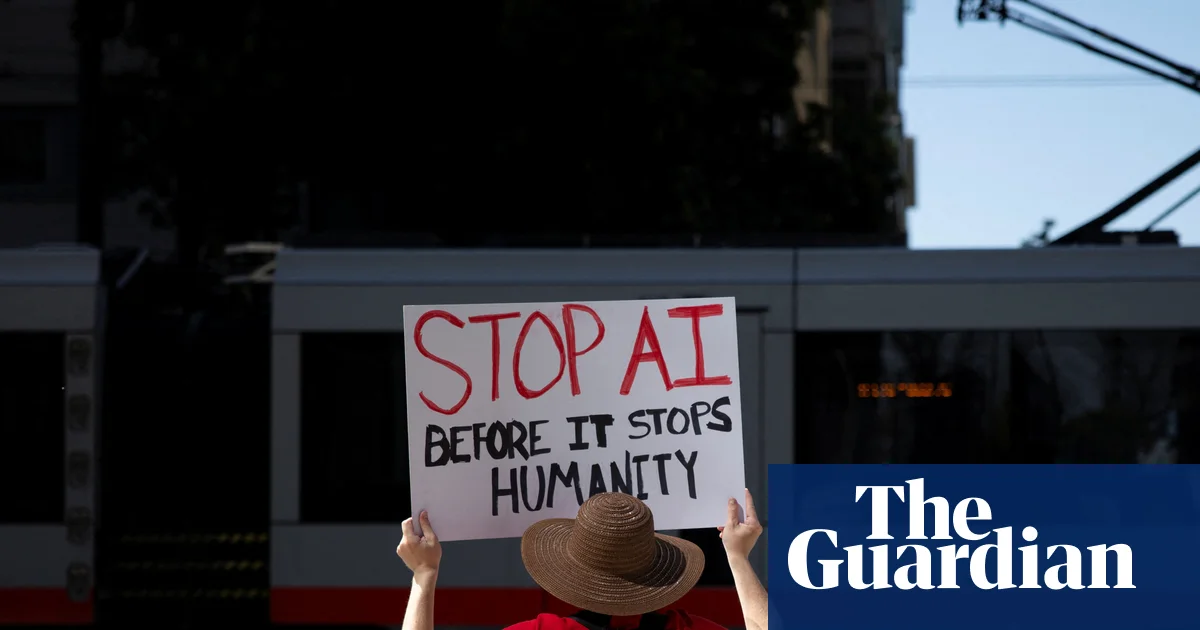
Here we go again with another round of tech bros claiming that AI is going to develop superintelligence and kill us all (More Anthropic researchers warn of AI’s perils but Musk dismisses ‘psyop’, 10 September). We’ve heard this before. Many, many times.
It’s the familiar plotline of pretty much every sci-fi movie about AI, ever. And these narratives have always been there, but every so often they burst back into the headlines when someone at one of the leading AI companies resigns, or sounds the alarm bells, or when so called “leading AI researchers” sign an open letter.
Each time this happens it’s not a coincidence that it follows heightened scrutiny of AI development or increasing public calls for greater accountability or regulation of AI. It’s a sleight of hand. The great AI deception is where AI companies and their followers redirect attention to hypothetical, sensational discussions of superintelligent machines (that only they have the capacity to control), and away from discussions about the ways that those same companies should be held accountable for their actions.
It’s not a response to new breakthroughs in the technology, it’s a response, and a defence, to public scrutiny of AI companies’ actions. The timing of these latest claims coincides with increased public scrutiny over the environmental impacts of datacentres and harm caused to young people from exposure to dangerous AI companions and increasing calls for regulation of AI. Things that really deserve to be in the headlines. Because AI certainly poses very real risks. Risks that are materialising right now, not in a hypothetical future. It is the organisations (the people) developing and controlling the technologies that are dangerous, not the technology itself. And it is those people and organisations that need to be held accountable.Dr Mhairi Aitken Director and co-founder, Our AI Collective CIC
In Dara Kerr’s article on the reaction to the former Anthropic researcher Jacob Coxon’s warning that AI could threaten humanity (Anthropic details bad actors’ efforts to misuse its AI for bioweapons, 10 September), politicians, researchers and industry figures largely converged on the same solution: more safeguards, stronger regulation and kill switches. This assumes that future AI will remain fundamentally a tool, because kill switches, guardrails and rules only work on things designed to obey them.
Much of the debate focuses on intelligence, but intelligence is not the critical threshold. The more important question is whether a system develops goals, preferences or values of its own. An intelligent system that simply follows instructions remains a tool; a system that begins to interpret, prioritise or pursue objectives becomes something else.
Isaac Asimov understood this distinction. The three laws of robotics were not written as a solution to AI safety but were used repeatedly, across dozens of stories, to demonstrate how rule-based control breaks down when a machine starts interpreting rules rather than merely obeying them.
If AI remains a tool, the greatest danger may be humans surrendering their judgment to systems that project certainty without understanding. If AI develops goals of its own, however, rules and kill switches cease to be safeguards and become obstacles.Iem LeurinkCallosa d’en Sarrià, Spain
If AI is to be regulated (The Guardian view on controlling AI: humanity cannot outsource its survival, 11 September), one thing that needs to change is the glamourising rhetoric with which AI is spoken of. To design a machine one is no longer in control of is not the arrival of “super-intelligence” in the machine, it’s blundering incompetence by the designer. A change of rhetoric would make it easier to address the importance of control and oversight.David BlackLondon
Related Stories
 AI News
Nvidia optimistic despite AI anxieties
8 minutes ago
 AI News
Huawei aims to deliver faster AI chips, faster
8 minutes ago
 AI News
ARTPRICE NEWS: A WORLD
8 minutes ago
 AI News
Introducing Kimi K3 on Amazon Bedrock
8 minutes ago
 AI News
Exclusive: U.S. military had close call after using AI for false intelligence report, sources say
37 minutes ago
 AI News
SpaceX may turn to failed startups for something its AI badly needs
38 minutes ago
 AI News
A new chapter for MIT Reads
38 minutes ago
 AI News
How New York Can Influence the Future of Artificial Intelligence
1 hour ago