
Conservation group contesting Kananaskis logging project in court
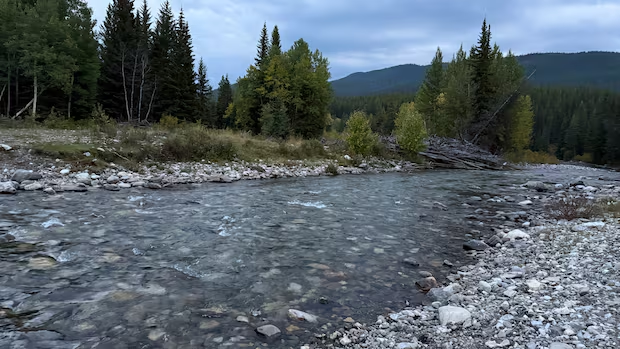
Conservation group contesting Kananaskis logging project in court
'West Fraser undertook a number of actions in response to feedback and to reflect our environmental approach'
A conservation group is asking for a judicial review in federal court after a permit was provided for a logging operation in Kananaskis Country in an area with threatened bull trout.
Timberwolf Wilderness Society launched its legal action after Fisheries and Oceans Canada approved West Fraser Timber to build a bridge over the Highwood River and 13 other temporary river crossings in the Loomis Creek and Upper Highwood area.
The group argues the project southwest of Calgary “may result in harm, harassment or killing of the threatened bull trout … or damage or destruction of the bull trout’s critical habitat.”
Bull trout are listed as a threatened species under the federal Species at Risk Act and Alberta’s Wildlife Act.
The application to the court calls it a “serious justiciable issue,” and says “bull trout is likely to become endangered if nothing is done to reverse the factors leading to their extirpation or extinction.”
The Minister of Fisheries Joanne Thompson signed off on West Fraser’s permit in late 2025 to build 14 temporary bridges.
Timberwolf’s legal filing contests the bridges were "the best solution after considering all reasonable alternatives." The conservation group argues the approvals “do not address watershed-scale effects of logging in the Upper Highwood River” with the temporary bridges since it "assumes that industrial access for logging must occur and does not demonstrate that less harmful alternatives ... were meaningfully assessed."
Timberwolf's filing adds the DFO hasn’t issued its five-year report on a recovery strategy for bull trout, and there’s “no evidence” its population decline has been halted.
None of the allegations have been tested in court.
The office for the Minister of Fisheries was unable to comment due to the matter being before the courts.
Meanwhile, West Fraser has emphasized mitigation measures it has put in place.
Evidence lacking for permit, argues conservation group
Dave Mayhood, a science adviser for Timberwolf, said they are bringing forward the legal action because the written justification for the permit “simply didn’t have evidence to support their explanation for why they issued the permit.”
“In the case of the Upper Highwood, their habitat is perfectly fine the way it is, and it can’t be improved,” he said of the bull trout.
Concerned citizens set up a blockade in an attempt to stop logging in Kananaskis
The Canadian Parks and Wilderness Society Southern Alberta, which has filed as intervenors in the case, completed a study in 2025 that found the area was a critical habitat for bull trout. The legal filing says the Upper Highwood River area is a “major spawning and rearing area for bull trout.”
It added operations such as forestry, mining, transportation infrastructure, and oil and gas development can “degrade water quality and fragment critical habitat, undermining reproductive success.”
Logging company says thorough consultation, studies done
The original project began under Spray Lakes Sawmills and was planned to harvest about 1,100 hectares of forest.
Spray Lakes Sawmills built a bridge over the Highwood River and at eight other creek locations without Fisheries and Oceans Canada’s approval. The federal agency launched a two-year investigation that resulted in no charges or fines.
West Fraser Timber bought Spray Lakes Sawmills and removed the Highwood bridge in 2024.
It also added a 30-metre riparian buffer that’s part of the federal recovery strategy for bull trout.
Joyce Wagenaar, director of communications for West Fraser, said the company couldn't speak to the judicial review since it's before the courts.
She said after the company took over the project, it paused logging plans to further consult with people and groups that could be impacted.
“West Fraser undertook a number of actions in response to feedback and to reflect our environmental approach,” she wrote in a statement. “Among them was a reduction of approximately 428 hectares from the area identified in the proposed forest plan, with water and fish habitat values playing an important role in those decisions."
Greg Colgan is a journalist for CBC in the Bow Valley. He was previously the editor of the Rocky Mountain Outlook in Banff and Canmore. He has also worked for media outlets in Ontario and has experience covering topics such as sports, politics, housing and development, courts and arts and entertainment. He joined CBC in 2025. He can be reached at greg.colgan@cbc.ca.
Related Stories
 Canada
Albertans head to polls in historic referendum on whether they want to stay in Canada
2 days ago
 Canada
In the news today: four soldiers killed, Alberta referendum, AI privacy fears
2 days ago
 Canada
How a grass fire at a Canadian military base killed four soldiers
2 days ago
 Canada
How will household electricity rebate reduction, temporary winter pricing change impact Ontarians?
2 days ago
 Canada
Residents told to boil tap water due to bacteria
2 days ago
 Canada
Oil
2 days ago
 Canada
Albertans vote on path to independence as Carney fights to keep Canada united
2 days ago
 Canada
Two of 4 soldiers killed in fast
2 days ago