
China's leading artificial intelligence (AI) apps, ByteDance's "The Bao" and Alibaba's "Q One," will..
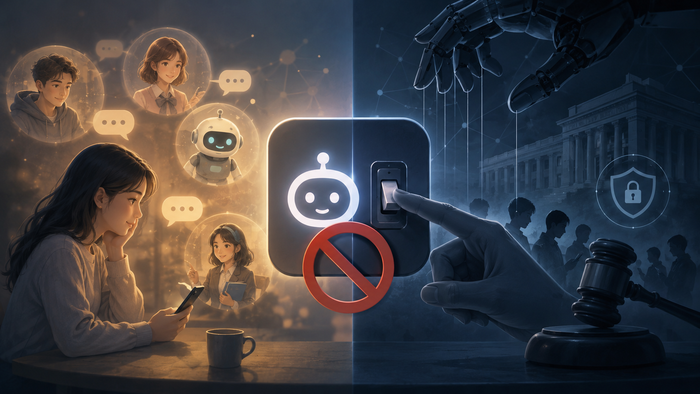
China's leading artificial intelligence (AI) apps, ByteDance's "The Bao" and Alibaba's "Q One," will stop functioning as customized AI agents one after another. The move is interpreted as a result of China's implementation of new regulations on human-like AI interaction services from the 15th.
According to the South China Morning Post (SCMP) in Hong Kong on the 5th, Doubao announced in a recent notice that the agent function will be terminated on the 15th due to product function adjustment. As a result, related data cannot be inquired or recovered within the app after October 15.
Q1 also announced that it will deactivate the "human-like interaction agent and user-generated agent function" on the 10th, and the entire agent function and service will end on the 15th. Earlier in June, Tencent also removed similar functions from its AI assistant app 'Yuan Bao'.
Until now, companies and users have been producing agents equipped with specific speech, work, or technology through the service. The general chatbot could be used as a so-called "customized AI agent" set as a personal assistant, role-playing character, and emotional companion.
However, as Chinese regulators implement 'Temporary Measures for Management of AI-like Interaction Services' from the 15th, the services will also be suspended.
The regulations target AI services that provide continuous emotional interaction by simulating human personalities, thinking patterns, and communication methods. Customer center bots, knowledge Q&A, work assistance, and educational and scientific research tools are excluded from regulation if they are not accompanied by continuous emotional exchange.
Chinese authorities suggested the dissemination of extremist ideas, personal information leakage, physical and mental health damage, and AI addiction as major risk factors.
As AI develops into a system equipped with memory, planning, tool calling, and task performance functions beyond simple chatbots, the intensity of management of the authorities is also increasing. Last month, "National Standards for AI Agent Interconnection" was also announced, including AI identification codes, identity management, agent description, search, and interaction.
"Using an agent requires a certain level of understanding," said Fan He-lin, a member of the expert committee of China's Ministry of Industry and Information. "The current agent is not yet mature."
The SCMP analyzed that the move shows China's willingness to incorporate AI agents into a system that can be identified, empowered, and tracked. It is explained that AI agents as productivity infrastructure are encouraged, but the direction is to strengthen control over human-like companion agents that can form emotional and quasi-social relationships with users.
Due to the sudden suspension of functions, there is also a backlash within China's social network service (SNS). Tagging the official Dou Bao account, one Weibo user wrote, "Why get rid of the agent. It has served as our emotional support for a long time," he said.
Related Stories
 AI News
'Farage faces Met inquiry' and 'Ready for departure?'
46 minutes ago
 AI News
Good and Evil in the Age of Simulation Confronts Artificial Intelligence, Moral Power and Fight to Preserve Human Choice
1 hour ago
 AI News
AI researchers 'earnestly believe' it could kill all humans within the next decade, Anthropic researcher says
1 hour ago
 AI News
AI is becoming harder to control
2 hours ago
 AI News
Marvell Technology (MRVL) To Present AI Data Center Connectivity Solutions At AI Infra Summit 2026
2 hours ago
 AI News
Medicine Needs to Get Serious About AI
3 hours ago
 AI News
Local LLMs Can Work Better Than Claude, At Least For Some
3 hours ago
 AI News
AI pioneer warns against race for superintelligence
3 hours ago