
China's AI doctrine is a challenge for Europe
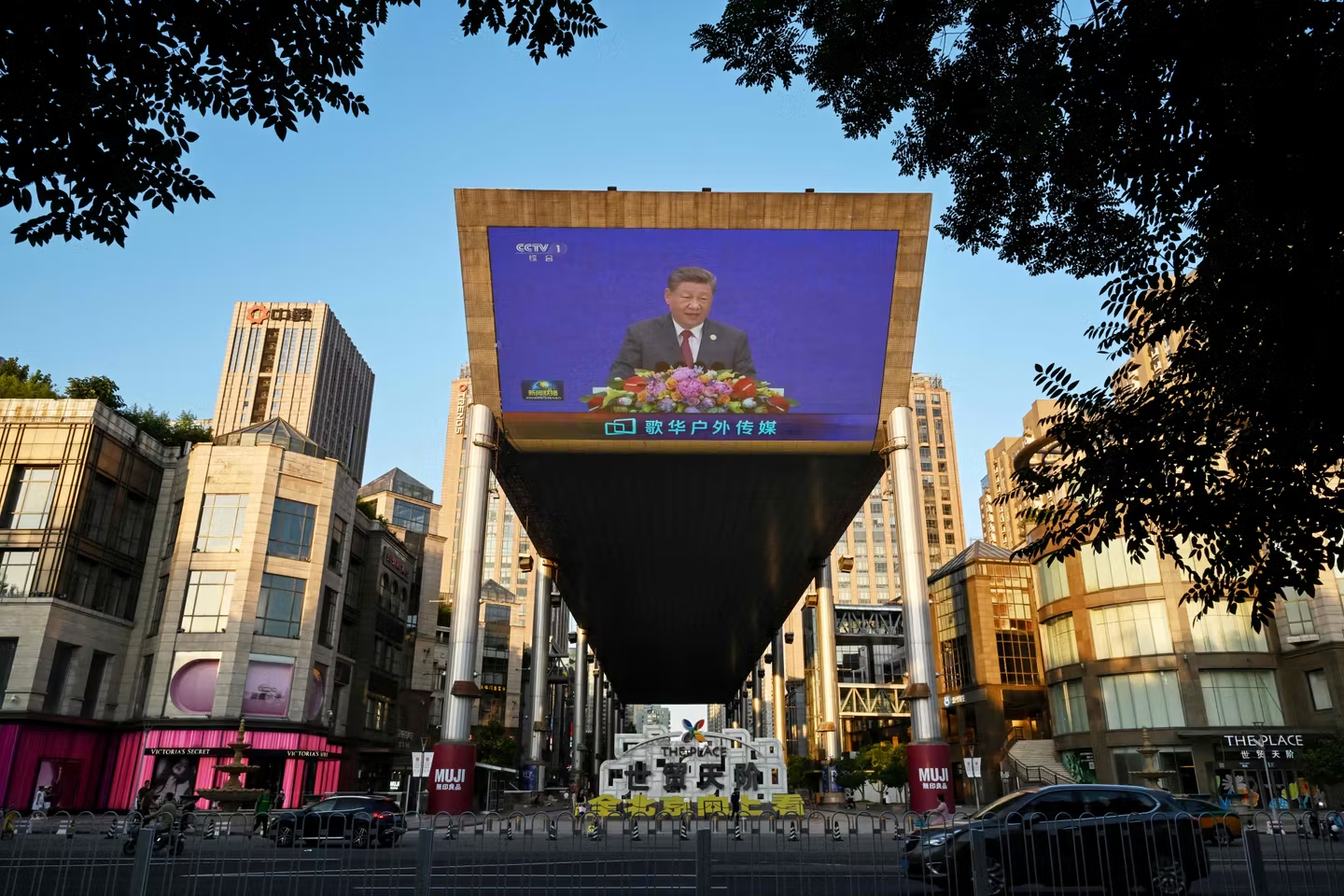
When it comes to artificial intelligence (AI), the future is never set in stone. So far, the prevailing view has been that the US holds a decisive technological lead, China is playing catch-up and Europe tries to rein in excesses through regulation. The World Conference in Shanghai on July 17 disrupted that narrative. Chinese President Xi Jinping did not simply acknowledge China's progress; he presented a doctrine for organizing AI that could reshape the global technological balance of power.
Acting as the spokesperson for a "symphony of international cooperation," the Chinese president showcased his country's corporate advances as the hallmark of a larger political project. Behind promises of open, affordable and accessible AI for developing countries, Beijing is seeking to impose its own vision of digital governance. The demonstration went beyond rhetoric. Representatives from 29 countries signed the founding document for a World AI Cooperation Organization, which will be headquartered in Shanghai.
China is following a well-tested strategy. As with solar panels, batteries or electric vehicles, it does not necessarily aim to produce the most advanced technology, but rather the most accessible. Models developed by DeepSeek, Moonshot or Zhipu AI offer performance close to that of American leaders, but at vastly lower costs. For much of the world, this balance of quality and price is likely to outweigh marginal gains in absolute performance.
But China's ambition goes beyond economics. Beijing wants to convince the world that its approach, more tightly controlled and more closely aligned with state objectives, offers a credible response to concerns raised by this technological revolution. Admittedly, these safeguards rely on censorship that is incompatible with fundamental freedoms, and it would be dangerous to confuse democratic regulation with authoritarian control. Nonetheless, China is capitalizing on an undeniable trend: everywhere, including in democracies, the era of self-regulation for digital platforms is coming to an end.
Europe believed it had a lead on regulatory standards. The idea was that its ambition to set ethical standards would make up for its industrial lag. Today, Beijing threatens to neutralize that advantage, not by regulating better, but by combining a competitive technological offering with a political message promoted at the highest levels of the state.
Without developing a true third way, Europe now finds itself caught between two models. Washington imposes its rules through technological dominance, the extraterritorial application of its law and the potential use of a kill switch that could cut access to technology deemed strategic – as seen with the most advanced models from the company Anthropic. China, for its part, advances through a clever form of soft power, built on technical cooperation and multilateral diplomacy. The result is an unexpected reversal. The authoritarian regime is deploying the most sophisticated approach, while the so-called progressive democracy is imposing its will by force.
The lesson for the 27 member states is clear: a standard only wields influence if it is accompanied by the ability to bring others along. And Europe today has neither the might of the United States nor China's power of attraction. Without industrial ambition to match its principles, Europe's rules risk binding no one but itself.
Translation of an original article published in French on lemonde.fr; the publisher may only be liable for the French version.
Related Stories
 AI News
Bill Gross bets AI can help mass
1 day ago
 AI News
Nigeria records 93% rise in AI micro
1 day ago
 AI News
The Italian gelato maker using AI to invent new flavours
1 day ago
 AI News
Closing the Gap Between Agentic CX Pilots and Production
1 day ago
 AI News
New Brunswick data centre debate highlights cross
1 day ago
 AI News
How to Structure an AI Agent Referral Fee Agreement Between Startups
1 day ago
 AI News
No, AI didn’t delete a Swedish reality TV series
1 day ago
 AI News
There is no AI in Armageddon. Artificial intelligence is a tool, not an apocalypse
1 day ago