
Carney says latest Trump tariffs 'not a surprise' after U.S. promises new 10% levy on Canada
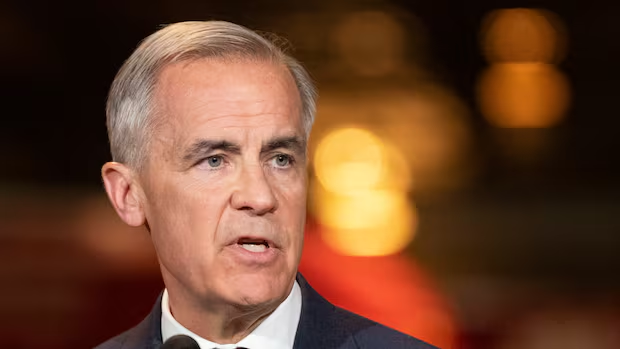
Carney says latest Trump tariffs 'not a surprise' after U.S. promises new 10% levy on Canada
Ottawa to propose strengthened rules to keep alleged forced-labour goods out
Prime Minister Mark Carney says he isn't surprised by the Trump administration's plan to slap import levies on goods allegedly made with forced labour.
A report released from U.S. Trade Representative Jamieson Greer's office on Tuesday listed dozens of countries, including Canada, as having varying degrees of ineffective enforcement rules around goods made with forced labour.
The report accused Canada and a handful of other countries of failing to "effectively enforce" import bans on such items.
As a result, the U.S. is proposing a new 10 per cent levy on Canada and others — though the tariff won't apply to goods compliant with the Canada-U.S.-Mexico Agreement (CUSMA), meaning a large majority of Canada's exports to the U.S. will be exempt.
"This is not a surprise; it's something that the U.S. has been planning for a few months," Carney told reporters Wednesday on Parliament Hill.
Carney says CUSMA spares most Canadian trade from proposed U.S. forced labour tariff
This latest round of tariffs come after previous levies imposed under the International Emergency Economic Powers Act (IEEPA) were struck down by the U.S. Supreme Court in February.
U.S. President Donald Trump had used the IEEPA law to slap tariffs on Canada and Mexico to combat what he called a "flood of fentanyl" coming in from both countries. Trump used the same law to impose his Liberation Day global tariffs.
After the Supreme Court ruling, the U.S. president vowed to impose new tariffs using other mechanisms. Trump immediately imposed temporary tariffs under Section 122 of the U.S. Trade Act, but those levies have an expiry date unless Congress approves an extension.
What to know about proposed U.S. tariffs over forced labour
In March, Greer launched an investigation into forced labour practices under Section 301 of the U.S. Trade Act of 1974. Tuesday's report was the culmination of that investigation.
Dozens of other countries will be hit with a higher tariff of 12.5 per cent for having "failed to impose" an importation ban on goods made with forced labour, the report says.
Dominic LeBlanc, Canada's minister responsible for Canada-U.S. trade, made an explicit link between the overturning of the IEEPA tariffs and Tuesday's report from Greer's office.
"This does not come as a surprise, as the United States has stated its intention to replace existing baseline global tariffs imposed under Section 122 when they expire in July," the minister wrote on X.
New enforcement rules coming, PM says
Still, Carney said he shared concerns about the importing of goods made with forced labour and that new rules are in the works to strengthen Canada's enforcement regime. The government will propose those rules in the coming weeks, he said.
Greer's report came only hours after he met with LeBlanc on Tuesday in Washington. The minister told reporters after Tuesday's meeting that the two shared proposals for the CUSMA review and said he was optimistic about this year's review of the trade deal.
CUSMA requires Canada to work with American officials to ensure goods manufactured using forced labour are prohibited in the North American market. Any perceived failures on this front could become issues in this year's mandatory review of the deal.
The Americans have accused Canada of being laggards on enforcing the import ban in the past and there have been reports of goods made with forced labour appearing in the Canadian market.
In 2021, CBC's Marketplace probed evidence of forced labour in supply chains for clothing originating from North Korea and tomato products from Xinjiang.
Carney said Wednesday that Canada has a "strong" regime to prevent products made with forced labour from entering the country. But he added there are still improvements that could be made.
"We don't want any element of forced labour coming in goods and services, and we want to use our influence to eliminate this practice of forced labour and child labour," the prime minister said.
Darren Major is a senior writer for CBC's parliamentary bureau in Ottawa. He previously worked as a digital reporter for CBC Ottawa and a producer for CBC's Power & Politics. He holds a master's degree in journalism and a bachelor's degree in public affairs and policy management, both from Carleton University. He also holds a master's degree in arts from Queen's University. He can be reached at darren.major@cbc.ca.
With files from The Canadian Press
Related Stories
 Canada
Canada Life lets Gen Z save short term while employer match stays for retirement
9 minutes ago
 Canada
Prime Minister Carney speaks with President of the United States Donald J. Trump
10 minutes ago
 Canada
How a loophole in Canada's species-at
1 hour ago
 Canada
Canada advises no travel to Riyadh airport after Houthi attacks
2 hours ago
 Canada
'We can’t deal with it in Canada': Some women turn to Mexico for endometriosis care
2 hours ago
 Canada
Motorway delays as M3 southbound closed
2 hours ago
 Canada
How a loophole in Canada's species-at
2 hours ago
 Canada
Brown & Brown takes Marcus & Millichap preferred
2 hours ago