
Carney confronts our national home reno nightmare at 24 Sussex
Carney confronts our national home reno nightmare at 24 Sussex
The long, sad story of a historic home might finally be resolved
Our long national home renovation nightmare is nearly over.
Or at least it is finally being acknowledged.
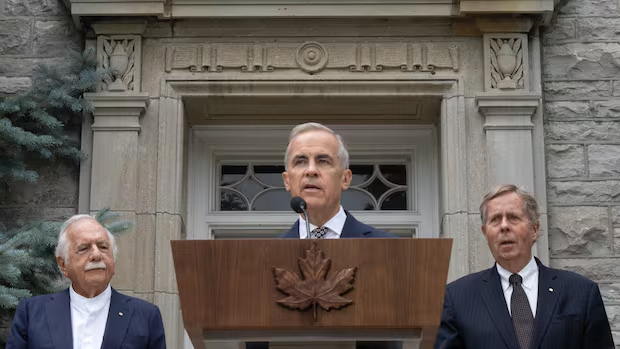
"Twenty-four Sussex Drive is more than a residence. It's greater than a mere backdrop to history. It's a symbol of the public office, of the head of our federal government and of the democratic traditions that office represents," Prime Minister Mark Carney said on Friday, standing in front of a building that is currently uninhabitable.
The 19th-century residence that housed every prime minister from Louis St. Laurent in 1951 to Stephen Harper in 2015 — that has been visited by countless luminaries of world history, from John F. Kennedy to Winston Churchill to Queen Elizabeth II — "has not been cared for with the respect that it deserves," Carney ventured.
"For years, many have agreed that 24 Sussex should be saved, but it was left to languish," he said, "and so the damage spread and the repair costs climbed, and now it's in critical condition."
Carney says donor list for 24 Sussex restoration will be public
State of 24 Sussex 'an embarrassment,' says Carney
Rideau Cottage 'inadequate' home for a PM as decision on 24 Sussex looms: internal memo
And so Carney is proposing to go where none of his predecessors dared — launching a design competition and a fundraising effort aimed at rebuilding an official residence for Canada's prime minister at the famous address.
One might fairly debate the details — the solicitation of private donations, albeit through a respected third party like the Rideau Hall Foundation, might raise tricky practical and political questions — but if it can be agreed that the prime minister of Canada, the leader of a G7 economy, should have an official residence, then it might at least be agreed that the situation has finally reached the point at which something should be done.
Indeed, it can be fairly argued that the situation reached that point long before now.
The residence at 24 Sussex — nice, but never a stunner — was said to be in a "state of advanced disrepair" as far back as 1984. In 2005, Rick Mercer visited the residence to interview Paul Martin and made light of the home's condition — the comedian and the prime minister famously purchased plastic sheeting at Canadian Tire and then affixed it to the drafty back doors with hair dryers.
Three years later, the auditor general reported that "a number of the residence's systems are reaching the end of their useful lives, are in poor condition and will have to be replaced in the near future." With a litany of problems identified, it was said that fully addressing the to-do list would require the prime minister to vacate the property for at least 12 to 15 months.
But whatever the inconvenience, "the constant postponement of the rehabilitation of 24 Sussex Drive" would "entail a number of consequences" including "further deterioration of this heritage property" and "an increase in rehabilitation costs."
The prime minister at the time, Stephen Harper, declined to tackle the problem. And the next prime minister, Justin Trudeau, decided to live somewhere else entirely.
Carney announces national design competition to restore 24 Sussex Drive
The easiest explanation for decades of neglect is politics.
Brian Mulroney spent some amount of money to make renovations in the 1980s and the resulting furor became known as "Gucci-gate" — a reference to how many pairs of expensive shoes were said to be able to fit in one of the new closets. None of his successors dared do anything that might earn them similar trouble.
In truth, Mulroney's renos were hardly the original sin — political concerns about the cost of upkeep go back at least as far back as 1953, barely two years after St. Laurent moved in, when a Progressive Conservative MP worried about an annual repair bill of $10,000.
Billions of dollars spent on an unnecessary tax cut or subsidy is a rather abstract concern. But thousands or millions of dollars on a home renovation — for a home occupied by the prime minister — is easy to understand and personalize. (If the federal government had a loonie for every news story and opinion column written about 24 Sussex in the last 20 years, much of the rebuilding cost would already be covered.)
Asked on Thursday whether he had any thoughts on what should be done with 24 Sussex, Conservative Leader Pierre Poilievre claimed to be uninterested in even thinking about it.
"When I see the homelessness on our streets and I see the young people who are desperate to start families but can't get a house to do it, I just think the last thing on our minds should be 24 Sussex Drive," said Poilievre, who has lived at Stornoway, the official residence of the Opposition leader, for nearly four years.
Is that really the choice though? Is it too much to hope that the federal government might expend every effort toward making housing more affordable while also responsibly managing official residences? Or should 24 Sussex be left untouched until homelessness in Canada has been eliminated?
(In 2019, the Conservatives said the lack of a fix for 24 Sussex was a "failure" on the part of Justin Trudeau and that they would somehow resolve the "debacle" if they formed government.)
Even as Carney announced a plan to do something about 24 Sussex, his proposed fundraising campaign seemed like an attempt to undercut concerns about the cost. But as the auditor general warned in 2008, at least some of the cost now could be viewed as a penalty for decades of inaction.
When does frugality become silly?
There is a distinctive streak of acute frugality — some might say parsimony or cheapskatedness — that runs through Canadian politics, at least when it comes to expenses that might have some direct bearing on the lives and welfare of the people elected to office. A $16 glass of orange juice is one of the most infamous political scandals in our nation's history.
That's perhaps not the worst impulse, at least as compared to the alternative.
Consider the situation in the world capital nine hours south of Ottawa, where an entire wing of the White House has been demolished and untold sums have been solicited from major American companies and billionaires so that the president might build a ballroom and bunker at a total cost of $800 million US. (Corporations will not be allowed to donate to the 24 Sussex fund.) The White House's Rose Garden has also been paved over at a cost of $2 million US.
By comparison, Canadians might take justifiable pride in a political culture that left successive prime ministers unwilling to risk installing central air conditioning in the official residence.
Future of 24 Sussex should be 'last thing on our minds,' says Poilievre
But at some point frugality might become unreasonable, or at least unnecessary. And that threshold might be crossed when the walls of the official residence of the prime minister are revealed to be filled with dead rodents.
An official residence is, of course, a home for the prime minister and their family — it can be considered something of a perk, at least in cases where the residence is properly maintained and the presence of rodent carcasses is limited. But it is also a publicly owned, historic property entrusted to the care of the government of Canada.
At some point, the failure of the government's leaders to maintain such a property might seem careless. And at some point allowing some sense of frugality to paralyze decision-making on how to house the leader of a G7 nation might seem silly, or even lacking in self-respect.
"The future of our institutions, all our institutions, depends on us leaving them better than we found them," Carney said on Friday.
Twenty-four Sussex is not Canada's most important institution. And Canadians might still be expected to look askance at extravagance. But some level of functionality, comfort and upkeep might not be too much to expect, despite the cost.
To Poilievre's point: the sooner the question of 24 Sussex is answered, the more time there'll be to worry about more important matters.
Aaron Wherry has covered Parliament Hill since 2007 and has written for Maclean's, the National Post and the Globe and Mail. He is the author of Promise & Peril, a book about Justin Trudeau's years in power.
Related Stories
 Canada
Albertans head to polls in historic referendum on whether they want to stay in Canada
1 week ago
 Canada
In the news today: four soldiers killed, Alberta referendum, AI privacy fears
1 week ago
 Canada
How a grass fire at a Canadian military base killed four soldiers
1 week ago
 Canada
How will household electricity rebate reduction, temporary winter pricing change impact Ontarians?
1 week ago
 Canada
Residents told to boil tap water due to bacteria
1 week ago
 Canada
Oil
1 week ago
 Canada
Albertans vote on path to independence as Carney fights to keep Canada united
1 week ago
 Canada
Two of 4 soldiers killed in fast
1 week ago