
Canada led a 2022 deal to protect the world's nature. Has there been progress since then?
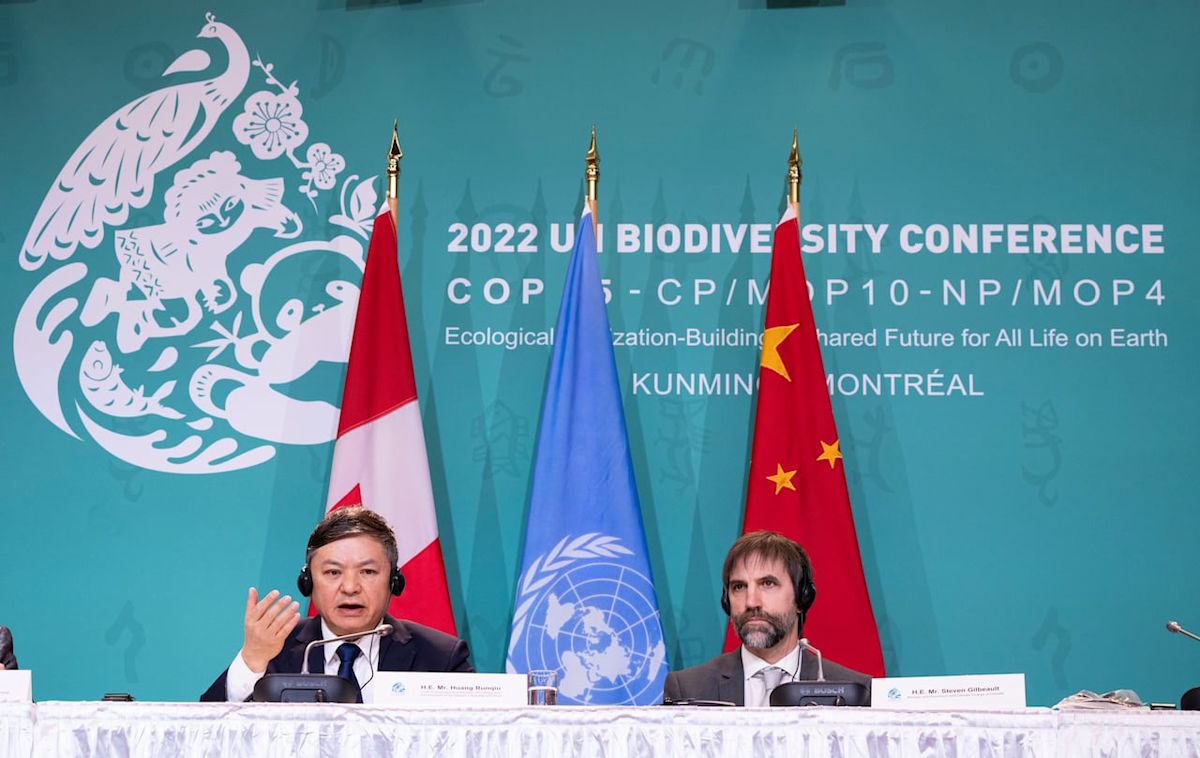
During a snowy Montreal winter in 2022, Canada welcomed over 180 UN member countries to negotiate an ambitious new agreement to protect nature. The world's biodiversity was in an unprecedented crisis — with more than one million species facing the threat of extinction, leaders were finally waking up to how close ecosystems were to collapsing.
Steven Guilbeault, then-minister of environment, helped wrangle a consensus and establish a new goal of protecting 30 per cent of global land and oceans by 2030, meant to halt the mass extinction. These spaces would be protected for the long-term goal of conservation, with human activities like fishing and mining banned or heavily restricted.
The agreement also included a promise to help lower-income countries with funding: money to establish and manage these protected spaces.
"That was the compromise in Montreal," said Guilbeault, while on his way back from Climate Week NYC, held alongside the UN General Assembly to bring together climate advocates and policymakers.
"Those people who wanted more ambition had to agree to commit to more funding, and those who wanted more funding had to agree to more ambition."
LISTEN | World leaders discuss climate in New York:
But that funding is now the main roadblock in reaching the goals of the Montreal agreement. A new assessment report released in New York this week projected that, based on commitments made so far, just 27 per cent of lands and only 12 per cent of oceans will be protected by 2030.
"We have a reasonable shot of reaching our terrestrial targets. We won't be at 30 per cent [but] we'll be close to it," said Guibeault, who resigned as an MP earlier this year because of the Carney's government's climate rollbacks.
"That's certainly something that should give us comfort. But on oceans protection, there is a lot more work that needs to be done."
The assessment also comes as Canada, the country where the 2022 deal was made, has shifted its priorities toward fast-tracking resource projects, putting it behind on its own climate targets.
Rich countries need to put up more money: report
Speeding up nature protection and reaching goals will primarily involve increasing funding, according to the assessment, led by international advocacy groups Campaign for Nature and Together for the Ocean.
The Montreal agreement included a target of $30 billion US per year in international financing for biodiversity conservation in developing nations, of which about $6 billion US of that target is needed specifically to establish protected areas on land and in the oceans.
But international finance has only reached $1.1 billion US per year, it said. This money is supposed to flow from higher-income countries like Canada and Japan to developing ones, meant to create parks and conserved areas, pay for programs like park rangers and support communities and institutions in those regions.
"More money is flowing to countries in the Global South than before, but it's still not enough," Guilbeault said.
The report also said most of the funding is coming from just five major sources: the World Bank; the European Union; Germany; the Global Environment Facility, a multilateral development fund; and the non-profit Rainforest Trust.
The report warned that changes by even one of these funders could jeopardize the total amount.
Still, it also highlighted successes: More than 50 countries already report terrestrial coverage of at least 30 per cent. To date, 20 per cent of lands and 10 per cent of oceans have been protected.
And more help is on the way. This week, Canada ratified the High Seas Treaty, a new global agreement to regulate the oceans and seas currently outside of national jurisdictions. With the majority of world nations now signed on, experts say it will be easier to designate large areas of ocean as protected.
Steve Guilbeault, Canada'a former environment minister, with Huang Runqiu, China's environment minister, at a COP15 press conference in Montreal in 2022. (Paul Chiasson/The Canadian Press)
Until now, 101 countries have ratified the High Seas Treaty. Opened to signatures in 2023, it forms a new kind of international law to govern the oceans, such as new mechanisms to propose conserved areas, to fight climate change and to safeguard marine resources like fisheries that support billions of people.
The treaty has officially come into force last January and its first gathering is set for January 2027.
Canada is leading in ocean protection, as well, by hosting the Our Ocean Conference in Halifax in April. Prime Minister Mark Carney also committed $82 million toward monitoring the ocean — especially in the fast-changing Arctic — and named his wife, Diana Fox Carney, as Canada's ocean envoy.
Sien Van den broeke, a campaigner with Greenpeace Canada, says the Halifax conference will be a place for countries to showcase commitments they're making on oceans protection. She expects Canada will make some promises of its own, too.
With the new global treaty, Canada could also support new protection proposals off its vast coastlines. Van den broeke pointed to the Emperor Seamounts, a biodiversity hotspot in the northern Pacific, and the Sargasso Sea, another important ecosystem in the Atlantic, as potential areas the country could champion.
A kelp forest off the coast of California. (Annika Hammerschlag/The Associated Press)
But advocates are also watching nervously as the Carney government has weakened environmental rules back at home, as part of the prime minister's agenda to build major new infrastructure and resource projects amid the ongoing trade conflict with the U.S.
Canada has protected about 14 per cent of its lands and 15.5 per cent of its oceans, according to the Canadian Parks and Wilderness Society (CPAWS). Its president, Sandra Schwartz, said that protecting nature is more than just hitting numerical targets.
"Nature really is quite foundational to our way of life and to our long-term success," she said. "And that's both in terms of economic success as well as our overall well-being."
As the host country of the 2022 conference that landed the global deal, Canada should lead by example, Schwartz said. But this month, the Carney government introduced a new law that will significantly speed up the federal environmental review process and change how oil and gas pipelines are assessed.
That comes on top of laws to designate and speed up major projects that have received widespread pushback from environmental groups.
"Canada's going to fall behind," said Schwartz.
"And it's unfortunate that we appear to be pitting the environment against the economy."
Related Stories
 Canada
U.S. bans on Canadian booze hit producers on one of the trade war's thorniest fronts
6 minutes ago
 Canada
Bank cash machines ripped out in overnight raid
6 minutes ago
 Canada
CBC’s ‘Hockey Night in Canada’ to return this season with PWHL games
1 hour ago
 Canada
Internal Montreal police documents describe ‘radicalized’ subculture among officers
1 hour ago
 Canada
Ottawa's most exclusive restaurant has only nine regulars
1 hour ago
 Canada
White Rock gathering honours Miller, raises $5,500 for Mito Canada
2 hours ago
 Canada
‘Small probability’: Former top soldier on risk of U.S. military action against Canada
2 hours ago
 Canada
‘Chaos’ breaks out at Ontario university’s Homecoming celebration
3 hours ago