
Bringing the data to every sideline
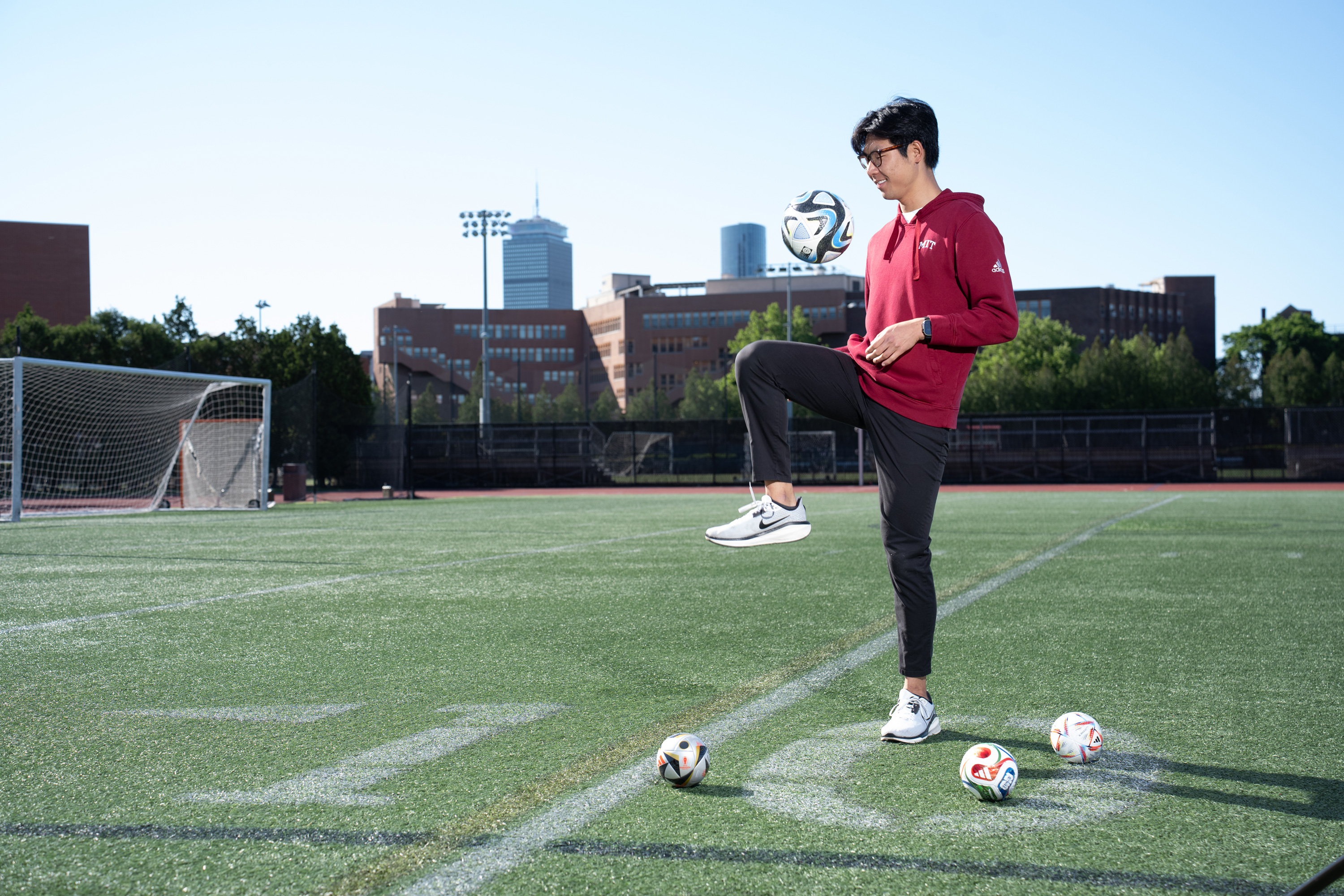
With Boston serving as a host city for the FIFA World Cup, the whole Bay State has soccer fever, including Henry Wang. As a child growing up in Dallas, sports were everything to him. Today, Wang is working on research that could impact some of the biggest sporting events in the world, including future World Cups.
The first such event that made a big impression on Wang involved a different form of football.
“The first ever sports game I remember watching was Super Bowl XLII in 2008,” he says. “I was really drawn to the competition, and the way it was presented. It’s this whole big spectacle.”
Wang, a fourth-year PhD candidate in social and engineering systems within MIT’s Institute for Data, Systems, and Society, studies how data and technology can improve the way sports are played, analyzed, and refereed. Working in the MIT Sports Lab in collaboration with FIFA, he develops systems with the goals of helping referees make faster, more accurate decisions and expanding access to performance analytics across the globe.
Now in the final stretch of his doctoral program and preparing to defend his thesis at the end of this year, Wang has spent nearly a decade at MIT. After earning his undergraduate degree in 2023 with a double major in computer science, economics, and data science and business analytics, he transitioned directly into graduate school. Sports have been a constant throughout that journey.
A competitive swimmer since age 7, Wang says athletics shaped both his identity and his community.
“Athletic competition was always a really big part of my life,” he says. “It’s kind of how I made a lot of friends, around the pool, and now at school, or in the lab and office.”
Ironically, swimming entered his life not because of a burning passion for sports, but because of a doctor’s recommendation.
“I don’t really come from a huge sports family,” Wang says. When he was diagnosed with asthma as a child, his pediatrician suggested swimming to strengthen his lungs.
His parents, both scientific researchers in radiology and medical physics, supported his growing passion. That support eventually led Wang to MIT, where he served as captain of the men’s swimming and diving team. In tandem, he continued pursuing research opportunities that merged his technical interests with his love of sports.
His first sports analytics project began with a cold email.
As a first-year student, Wang reached out to MIT Sloan School of Management Senior Lecturer Ben Shields to see if he could assist Shields with his research on sports strategy and analytics. Shields later connected Wang with a coach he knew who was interested in analyzing the two-point conversion strategy for MIT’s football team.
The project revealed that MIT could benefit from attempting two-point conversions much more frequently. The experience opened the door to the MIT Sports Lab, where Wang found mentors including Lecturer Christina Chase, Professor Anette “Peko” Hosoi, and former research scientist Ferran Vidal-Codina.
His research now focuses on two central questions: How can technology democratize access to sports data, and how can it help officials make better decisions?
Wang works with FIFA Innovation, the group within soccer’s global governing body that leads the development and testing of match technology used on the field. His research explores automatic event detection and officiating technologies designed to assist referees without disrupting the fan experience.
In one recent project, Wang helped develop a semi-automated system that uses players’ skeletal data and ball tracking to determine which player last touched the ball before it goes out of bounds. The research prototype aims to assist goal kick and corner kick decisions while minimizing interruptions to the game.
For Wang, success means that referees find the tools helpful, and fans barely notice it at all.
“A ball goes out of bounds, and we can immediately tell the referee it’s a corner kick,” he says. “The fans don’t even notice it.”
Alongside his doctoral research, Wang has gained experience across professional sports, spending two years with the Boston Red Sox’s baseball sciences team before accepting a role as a senior data scientist in basketball research and development with the Philadelphia 76ers, where he will continue working after graduation.
Despite his demanding schedule, he says the work rarely feels like work.
“I enjoy it so much,” he says. “I really don’t know what else I would be doing.”
Outside the lab, sports continue to anchor his life. Swimming at MIT provided structure and community during challenging moments.
“MIT can be pretty hard,” Wang says. “Having a consistent 5-to-7 o’clock swim practice every day definitely helped a lot.”
For Wang, sports have always been more than competition. They have shaped his friendships, inspired his research, and guided his career trajectory.
Now, as he works to build technologies that could change how billions of people experience the world’s most popular games, he is still driven by the same sense of love he felt watching sports as a child.
“I want every kid who plays sports to have the best experience possible, because I know how meaningful that can be toward someone’s life journey,” Wang says.
Related Stories
 World
World
Heavy rain shuts down Istanbul, causing flooding and 2 deaths
48 minutes ago
 World
World
Clock ticking for leap second: Why timekeeping could change forever
48 minutes ago
 World
World
Fuel crisis hits Bali
1 hour ago
 World
World
The problem with living in a rich man’s world | Letters
1 hour ago
 World
World
North Korea holds first underwater
1 hour ago
 World
World
Nepal and the World Bank Group Announce Partnership to Explore Catastrophe Bond for Earthquake Risk
1 hour ago
 World
World
Where to watch Rugby League World Cup 2026: TV channel, live stream, schedule for tournament
2 hours ago
 World
World
Hot testing of Chinese SMR under way
2 hours ago