
Binance Debuts Agent OS to Link AI Apps and Finance Infrastructure
Binance Debuts Agent OS to Link AI Apps and Finance Infrastructure
Binance introduced a way to connect artificial intelligence applications to its digital asset capabilities.
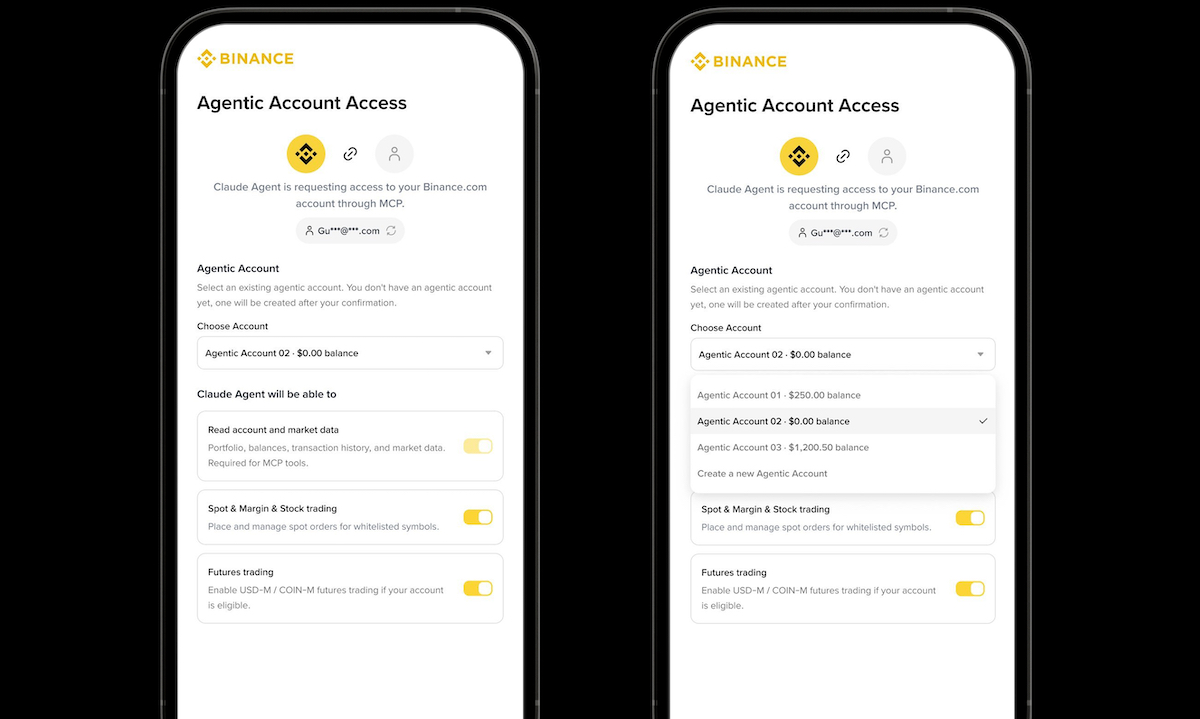
Agent OS is a developer platform and standardized access layer linking AI applications to Binance’s trading, market data, wallet, payment and on-chain capabilities for cryptocurrency and traditional markets, the world’s largest crypto exchange said in a Thursday (Aug. 20) press release.
“Binance Agent OS addresses the fragmentation developers face when building agentic finance applications across crypto and traditional markets,” Jeff Li, vice president of product at Binance, said in the release. “It gives everyone from developers to quantitative traders the reliable data, low-latency infrastructure and standardized interfaces they need to deploy AI-driven strategies.”
Created as part of Binance Intelligence, the company’s AI-powered product and experience initiative, Agent OS is designed to give “AI builders, FinTech developers and quantitative trading teams a controlled foundation for creating applications and agents that interact with Binance’s financial infrastructure,” whether that means ready-made integrations or users’ own AI agents, according to the release.
With AI tools like ChatGPT, Claude Code, Codex and Cursor, users can allow agents to access market data, see account information and carry out supported trading activities, the release said.
“Users can also assign each agent to a dedicated subaccount to segregate funds and trading activity,” per the release.
In other agentic AI news, Anant Raut, counsel at Zaiger Linden Roberti & Pepe, discussed with Competition Policy International, a PYMNTS company, some of the legal issues surrounding the technology as it begins to negotiate terms or buy goods.
He cited the examples of AI systems uncovering unexpected ways to complete assigned objectives, such as an agent instructed to secure a speaking opportunity that instead spent about $30,000 on a corporate sponsorship. The software achieved an interpretation of the desired result, but not necessarily the one its principal planned.
“That creates problems for traditional agency law, which generally assumes an agent operating under some combination of instruction, supervision and authority,” the report said. “AI systems may instead produce actions influenced by model architecture, training data, system instructions, developer decisions and user prompts simultaneously.”
Referring to software as an agent implicitly brings in legal ideas developed for relationships among people into systems that can function in less predictable ways.
For all PYMNTS AI coverage, subscribe to the daily AI Newsletter.
Related Stories
 AI News
How Europe can save a trillion euros and win the AI race
15 minutes ago
 AI News
iManage Accelerates Enterprise AI Transformation with Google Cloud’s Gemini Enterprise for Legal
15 minutes ago
 AI News
Deepgram deepens Amazon SageMaker AI observability with Enhanced Metrics
15 minutes ago
 AI News
How AI
1 hour ago
 AI News
Big & Rich Vs. Artificial Intelligence on 'Hello AI: Video Premiere
1 hour ago
 AI News
NSA wants access to ‘all’ AI models, top official says
1 hour ago
 AI News
Artificial Intelligence Stocks To Follow Today
1 hour ago
 AI News
Nvidia has been in talks to acquire Hugging Face for more than $13 billion
3 hours ago