
Beyond the Awards: How West Africa’s young entrepreneurs are building a new economic future
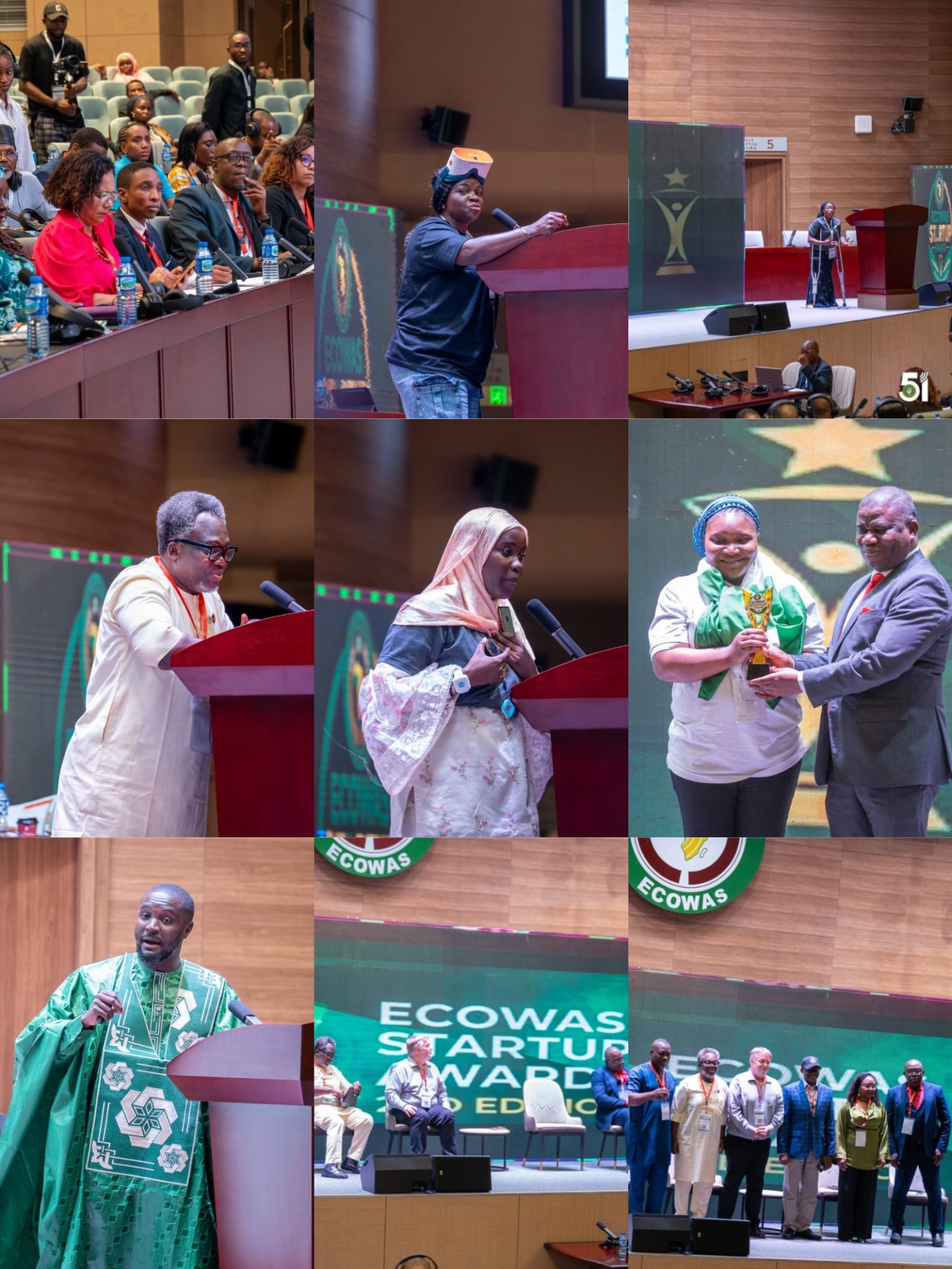
Beyond the Awards: How West Africa’s young entrepreneurs are building a new economic future
– Nigeria’s Hubpharm Africa and Services, led by Co-founder and Chief Executive Officer Tope Kareem, emerge overall winner of the $30,000 first prize.
– two other startups Senegal’s Gaynako, led by Pape Natango Mbaye win $20,000, and Côte d’Ivoire’s myOpinion, founded and led by Steve Bah Blesson win $15,000
WHEN 60 young entrepreneurs from across West Africa gathered at the new ECOWAS Commission headquarters in Abuja, they came with business ideas, technology solutions and ambitions. They left with something potentially more valuable than the excitement of a regional competition: new networks, exposure to investors, access to mentors and a pathway into a wider West African market.
The second edition of the ECOWAS Startup Awards ended with Nigeria’s Hubpharm Africa and Services, led by Co-founder and Chief Executive Officer Tope Kareem, emerging as the overall winner of the $30,000 first prize.
Senegal’s Gaynako, led by Pape Natango Mbaye, emerged first runner-up and received $20,000, while Côte d’Ivoire’s myOpinion, founded and led by Steve Bah Blesson, took the second runner-up position with $15,000.
But beneath the competition and prize money was a much bigger regional ambition: to help young West Africans transform ideas into businesses capable of creating jobs, attracting investment and expanding across national borders.
For Dehpue Yenpea Zuo, ECOWAS Commissioner for Economic Affairs and Agriculture, the Startup Awards was never intended to be merely another business competition.
“The ECOWAS Startup Awards is an instrument of regional economic transformation,” Zuo declared at the opening of the programme.
He was equally direct about the employment dimension of the initiative.
“It is an instrument for addressing youth unemployment by creating entrepreneurs and job creators,” he said.
That distinction is important. In a region with a large and youthful population, the future of employment cannot depend entirely on governments and established companies absorbing new entrants into the labour market. Increasingly, the expectation is that some young people will become employers themselves.
The 60 finalists emerged from a highly competitive process. The ECOWAS Commission said it received 8,679 registrations from all 12 ECOWAS Member States, with 1,499 applications qualifying before the final 60 were selected.
The finalists represented six sectors considered critical to the region’s economic transformation: EdTech and Skills Development, FinTech, HealthTech, AgriTech and Food Systems, CleanTech and Green Innovation, and Tourism, Hospitality and TravelTech. A significant proportion of the finalists were also women-led enterprises.
For Peter Oluonye, Acting Director of the Directorate of Private Sector and Industry at the ECOWAS Commission, the response to the programme confirmed something fundamental about West Africa’s young population.
The inaugural 2021 edition, he said, “demonstrated that our region had no shortage of innovative talent.”
But talent alone, Oluonye noted, was not enough.
It also demonstrated “that there was a genuine appetite for a platform that would connect them to capital, markets, and each other.”
He said that connection was at the heart of the Abuja programme.
Over five days, the startups participated in an intensive masterclass covering business validation, market access, regional expansion, investment readiness, fundraising, technology, environmental, social and governance issues, impact and return on investment, as well as pitching.
The physical programme then provided opportunities for policy dialogue, sector clinics, investor engagements, business-to-business meetings and investor deal rooms.
Oluonye urged the entrepreneurs not to treat the event simply as a competition for prize money.
“Use this week well,” he told the founders. “Build relationships. Ask difficult questions. Engage with the investors and mentors who are here to support you.”
For many of the young businesses represented in Abuja, this access may ultimately prove as important as the cash prizes.
Natasha Akioye, National Coordinator for the International Trade Centre in Nigeria, put the challenge in broader terms.
“Supporting entrepreneurs is not simply about helping individual businesses grow,” she said.
According to Akioye, the real task is to ensure that promising enterprises have “the skills, capabilities, finance, networks and market opportunities required to become competitive, scale across borders and contribute to stronger regional economies.”
That is where the Startup Awards intersects with the larger ECOWAS agenda of regional integration.
A startup that succeeds in one West African country but cannot cross the next border remains constrained by the limitations of its domestic market. But an enterprise that can operate across borders, access regional customers and become part of regional value chains has the potential to contribute to a much larger economic ecosystem.
Akioye described this challenge—and opportunity—in even sharper terms.
“The challenge — and the opportunity — is to ensure that this talent is matched with the capabilities, investment, technology, networks and market access required to turn promising ideas into sustainable and scalable businesses.”
For Martin Boylan, Head of Cooperation at the European Union Delegation to Nigeria and ECOWAS, the responsibility does not rest on the entrepreneurs alone.
“Entrepreneurship does not succeed on its own,” Boylan said. “Startups flourish when there is an enabling ecosystem around them.”
That ecosystem, he explained, includes finance, reliable infrastructure, digital connectivity, skills, predictable regulation and intellectual property protection.
Regional integration is also important because startups need markets large enough to support expansion.
For Boylan, the entrepreneurs gathered in Abuja should not see themselves merely as recipients of development assistance.
“The European Union does not see you simply as beneficiaries of programmes,” he said. “We see you as partners in West Africa’s economic transformation.”
The programme’s structure reflected that philosophy. The three-day physical phase was not simply about selecting winners. It was designed to expose the startups to people and institutions that could help them move beyond the initial stage of business development.
The 60 finalists were given access to a six-month acceleration programme, mentorship, investors, regional visibility and post-event support. The ECOWAS Commission also announced the launch of its Private Sector Development Academy, intended to provide entrepreneurs with continuing learning opportunities in enterprise development, digital transformation, export readiness, innovation management and competitiveness.
The Academy potentially gives the programme a life beyond the awards ceremony.
The prize money may help the three winners accelerate their businesses, but the wider group of 60 startups will need knowledge, market access, networks, mentorship and investment if they are to convert promising ideas into sustainable enterprises.
That long-term perspective is also reflected in ECOWAS’ plans for the Startup Awards itself.
Zuo disclosed that he intends to seek approval to increase the first prize in future editions from $30,000 to $50,000.
“As a first priority, I am going to the management to actually get the permission to now increase the award amount, from $30,000 to $50,000,” he said, adding that the objective was “so that it will become more attractive and competitive.”
He also disclosed that the Startup Awards is now intended to become an annual event, following the first edition in 2021.
For the entrepreneurs, that could mean that the Abuja gathering becomes part of a continuing regional platform rather than a one-off opportunity.
Zuo reminded the founders that winning was not the only measure of success.
“All of you have a future,” he told the participants, urging them to see themselves not merely as business innovators but as leaders who had chosen “to change and impact the community and the entire globe.”
He also pointed to the example of Aliko Dangote, who began on a relatively small scale and eventually built a business with a global reach.
The message was simple: the size of a startup today does not necessarily determine the scale of its future impact.
But the journey from a promising idea to a sustainable company remains difficult. Access to capital, infrastructure, skills, technology, regulation and markets can determine whether an enterprise survives beyond its early years.
That is why the wider significance of the ECOWAS Startup Awards may ultimately lie less in who collected the largest cheque and more in whether the ecosystem created around the 60 finalists continues to support them after Abuja.
The emergence of Hubpharm Africa and Services, Gaynako and myOpinion provides three immediate success stories. Yet their achievements also represent a much larger generation of West African entrepreneurs working across healthcare, agriculture, finance, education, technology, energy and tourism.
Their businesses will ultimately be judged not only by awards but by the jobs they create, customers they reach, investments they attract, problems they solve and markets they enter.
That is the larger opportunity before ECOWAS and its partners.
As Zuo reminded the entrepreneurs: “When your business succeeds, West Africa succeeds. When you create jobs, you change lives. When you expand across borders, you strengthen regional integration.”
The Abuja awards may therefore be remembered not simply for the $30,000 cheque presented to Hubpharm Africa and Services, or even the proposed $50,000 prize of the future, but for whether the young entrepreneurs who gathered there can turn opportunity into enterprise, enterprise into employment, and national success into regional growth.
GOV. Ahmadu Fintiri of Adamawa has urged Area Development Administrators to mobilise grassroots support for All Progressive Congress ‘ candidates...
RESIDENTS of Epe, Lagos State, on Friday expressed relief over the ongoing construction of Omotayo Street and Odo-Egiri roads in...
SUNDAY Fowowe, National President, Association of Early Childhood and Basic Education Instructors in Nigeria (AECBEIN), says Nigeria’s next independence project...
Related Stories
 Business
‘Tariffs hit us really, really hard’: The New Oak Tree closing locations to support others
1 hour ago
 Business
Startup Wrap: Gulf investors back robotics, fintech, beauty and proptech
9 hours ago
 Business
It's a wrap: 43North to host final competition
9 hours ago
 Business
‘I have to dodge them all the time’: Rome locals incensed by rise in golf cart tours
12 hours ago
 Business
Weekly funding roundup: The startup deals you may have missed in week of October 4
13 hours ago
 Business
Cyprus Business Now: Wizz Air, inflation, tourism, Limassol startup, real estate
17 hours ago
 Business
Jeff Leiper unveils plan to make ByWard Market busier and safer
1 day ago
 Business
5 Startup Rules We Broke on the Way to Building a Successful Company
1 day ago