
Mark Carney doesn't stop the United States from driving negotiations over a cliff

Mark Carney doesn't stop the United States from driving negotiations over a cliff
What's next for the trade war — and the Canada-U.S. relationship?
After a week of manufactured drama and unnecessary strain, Prime Minister Mark Carney emerged on Saturday morning to explain "why we're walking away from a bad deal — and what comes next."
"For over a year, Canada has worked intensively and in good faith with the United States to negotiate a new, comprehensive trade deal," Carney said. "We've been pragmatic, patient and persistent."
Apparently that was not sufficient. In a statement released 20 minutes to midnight on Friday night, Carney said that "last-minute changes" in the terms proposed by American negotiators were "unfair, uneconomic, and called into question the reliability of any deal."
Minutes earlier, U.S. Trade Representative Jamieson Greer had announced to reporters on a conference call that Canada had "declined to finalize" an agreement.
Up until that moment it had seemed, after days of speculation and leaks, that Carney's task in the days ahead would be convincing Canadians — many of whom are no doubt disinclined to accept anything short of unconditional surrender from the Americans — that the deal he accepted was worth taking.
Carney says trade deal became untenable when U.S. 'asked too much and offered too little'
The acceptability of an unknown and uncompleted deal is hard to gauge. But Steve Verheul, Canada's former chief negotiator, was reportedly concerned that Canada had given up too much. And Chrystia Freeland, the former foreign affairs minister, worried aloud that any implicit acceptance of U.S. tariffs would put Canada on the other side of the proverbial Rubicon.
That might be true. But it is fair to ask whether there is any path forward that doesn't involve crossing that barrier — all of Donald Trump's other latest trade deals would suggest that some kind of tariff is table stakes.
It is also necessary to note that the new tariffs Trump has now imposed will be far from painless. Trevor Tombe, an economist at the University of Calgary, had estimated that as many as 90,000 Canadians could lose their job as a result.
Janice Charette, Canada's current chief negotiator, had reportedly warned her American counterparts that the imposition of new tariffs could represent something of a "cliff" for these negotiations — that public and provincial reaction could make it harder, not easier, for her side to negotiate.
That would now seem to leave Canadian and American officials dangling in mid-air like Wile E. Coyote. What happens next could be unpleasant.
A neighbour that can't be taken for granted
In an interview with the New York Times in July, a senior official in the Trump administration said American foreign policy might be summed up by the idea that "people can no longer take the United States for granted."
"I think that’s one thing that’s really important at a structural level that this administration is doing differently, in what is perhaps a tough way sometimes, but also in a rational and common sense way, which is to accurately price the partnership and relationship with the United States," explained Elbridge Colby, a senior adviser to the secretary of war, "both in terms of access and things like AI or energy, but also in terms of leverage things like burden-sharing issues or tariffs, etc."
Carney outlines the last-minute changes U.S. tacked onto trade deal terms
It might be fairly argued that Americans derived innumerable benefits from the world as it was — and that the United States was aided by the co-operation and assistance of numerous countries along the way. But the suggestion here is that the benefits of a friendly relationship with the U.S. were not accurately priced, and so other countries were getting too good of a deal.
Other countries might quibble, but they might agree that the U.S. is no longer to be taken for granted — that it can no longer be taken for granted that the U.S. will stand by its traditional allies, that it can no longer be taken for granted that the U.S. will abide by its own trade agreements, that it can no longer be taken for granted that the American political system will produce presidents like those who governed between 1932 and 2016.
In a recent appearance on the Herle Burly podcast, Conservative political strategist Kory Teneycke offered his own analogy for what Canada is now experiencing. The era of long-term trade agreements is over, he said. The tumultuous uncertainty of this moment is not merely a passing "cold."
American tariffs on Canadian goods take effect after trade talks fall apart
"We're managing a chronic disease. This is diabetes," Tenycke said. "We're going to be doing insulin checks and taking injections on a daily basis for as long as this administration's around and probably for the next several. We're in a long-term cycle of trade protectionism and might-makes-right bullying and reshuffling of the international order in a fundamental way."
In an analysis of this week's negotiations, Patrick Leblond, a professor of business and public policy at the University of Ottawa, compared Canada and the United States to two drivers speeding their cars at each other in a game of chicken.
The common denominator in all of these analogies might be that none of them sound like a fun time.
Where do Canada and the U.S. go from here?
Speaking to reporters on Saturday, Carney said he and his government have been "under no illusions."
"We recognized from the start that America has changed," he said.
The government recognized, he said, that the United States would "transform all of its commercial relationships," "use economic integration as a weapon" and that "sometimes its signature was written in pencil." But Canadian officials nevertheless tried to "strike a fair deal on which Canadian businesses and workers could rely."
"I believe that people on the ground, on both sides of our border, want this relationship to work," Carney said.
But the "cumulative effect of U.S. demands" had "revealed the limits" of the American government's "commitment to a true economic partnership."
Premier Ford says suspended trade talks avoided a 'bad deal' for steel, auto sectors
In the bigger picture, what kind of relationship with the U.S. is still possible? Carney said that Canadian negotiators had sought "long-term partnerships," but there is a certain tension — not necessarily unresolvable — between that and the idea that the U.S. now sometimes signs its name in pencil.
It would likely serve Canadians to hear more from their leaders about what to expect or hope for from the foreseeable future. Carney's appearance before reporters on Saturday was useful for illuminating exactly why he thought these particular negotiations had broken down and where his red lines were.
Maybe some wouldn't have loved the kind of deal Carney could have signed this week, but in the absence of a deal, American tariffs against Canadian products took effect at 12:01 a.m. Saturday. The federal and provincial governments will now have to support impacted businesses, and new counter-tariffs on American products will now be set to come into force after Labour Day.
Read Mark Carney's full speech after trade talks with the U.S. collapsed
Will the Trump administration retaliate in response to Canadian retaliation? Would that compel another round of counter-tariffs? What will it take to get the two sides back to the negotiating table? What might the terms of a ceasefire look like at this point?
Carney has said in the past that "no deal is better than a bad deal" — a sentiment that Ontario Premier Doug Ford echoed on Saturday.
That may generally be true. But it doesn't mean the "no deal" option is easy.
Aaron Wherry has covered Parliament Hill since 2007 and has written for Maclean's, the National Post and the Globe and Mail. He is the author of Promise & Peril, a book about Justin Trudeau's years in power.
Related Stories
 Canada
Premier says B.C. government will support Canada's countermeasures to U.S.
1 hour ago
 Canada
U.S. administration not unified during trade negotiations, Carney says
1 hour ago
 Canada
Manitoba Premier Wab Kinew 100% behind prime minister's decision to pull out of U.S. trade negotiations
1 hour ago
 Canada
Canadians like to think we're nice. But loaning my car to a stranger made me question what that really means
2 hours ago
 Canada
Canadians backing tough response to U.S. tariffs, says Windsor professor
2 hours ago
 Canada
'We got attacked': Carney says retaliatory tariffs on U.S. to take effect next month
2 hours ago
 Canada
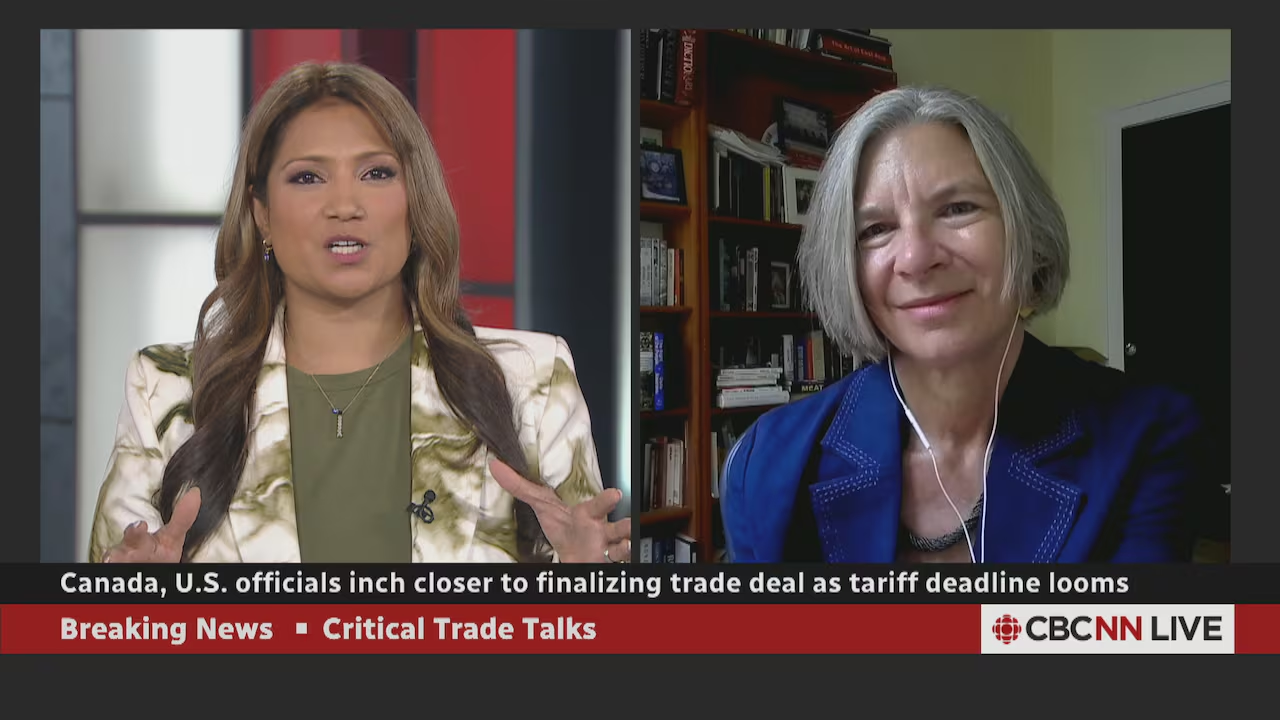
CBC News speaks with Heather Hurlburt about Canada
2 hours ago
 Canada
A trade war between Canada and the US deepens rupture in what had been a close and durable alliance
3 hours ago