
Beyond Identity: What Kulgam Teaches the Indian Left
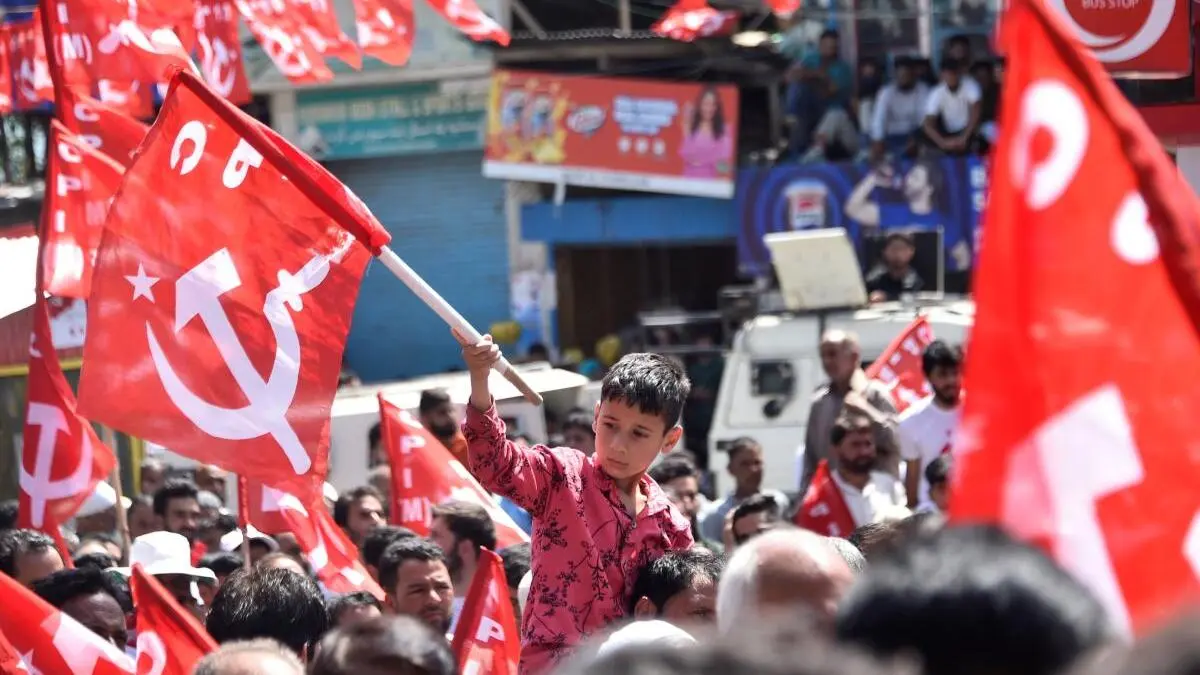
The 2024 Jammu and Kashmir Assembly elections marked a watershed in the region’s political history. The elections witnessed the return of electoral politics after a prolonged constitutional and political rupture, the emergence of new political actors, and renewed debates over identity, representation and governance. Amid this shifting political landscape, one result received remarkably little national attention. In Kulgam, the Communist Party of India (Marxist) [CPI(M)] leader Mohammad Yousuf Tarigami retained his seat despite a spirited challenge from independent candidates widely perceived to be backed by the banned Jamaat-e-Islami, including Sayar Ahmad Reshi. In an election where identity and symbolism appeared to dominate much of the political discourse, Kulgam reaffirmed something altogether different: the enduring appeal of secular, class-oriented politics rooted in everyday public engagement.
The result invites comparison with an unlikely source. In A Village Against the World, British writer Dan Hancox narrates the story of Marinaleda, a small village in southern Spain that resisted the dominant logic of neoliberal capitalism through collective ownership, participatory democracy, and social solidarity. Marinaleda is significant not because it transformed Spain, but because it demonstrated that alternative political futures could survive within overwhelmingly adverse conditions. Kulgam occupies a similar place in India’s political imagination. It may not alter the national trajectory of Left politics, but it compels us to ask why communist politics continues to command democratic legitimacy here while it has receded across much of the country.
The answer lies not in ideological nostalgia but in the social practice of politics. Since the mid-1990s, the CPI(M), represented by Tarigami, has repeatedly secured the confidence of voters in what is today the Kulgam Assembly constituency. This continuity is not merely an electoral statistic; it represents nearly three decades of sustained political trust built through everyday interaction between representatives and citizens. In a region marked by conflict, political uncertainty, and competing ideological narratives, such consistency demands explanation.
Too often, analyses of Kashmir reduce electoral behaviour either to questions of identity or to the exceptional circumstances of the conflict. Kulgam complicates both assumptions. It suggests that citizens are equally capable of judging political representatives by their responsiveness, credibility and ability to address material concerns. The repeated electoral success of the Left indicates that governance, accessibility, and public service continue to matter even in one of India’s most politically contested regions.
Unlike many political leaders whose visibility peaks during election campaigns, Tarigami and the CPI(M) have remained embedded in everyday public life. Whether raising the concerns of government employees, advocating for horticulturists whose livelihoods sustain the district’s economy, supporting labourers and marginal farmers, demanding better healthcare and educational infrastructure, or intervening in questions of road connectivity and public services, the party has cultivated a politics of continuous presence rather than episodic mobilisation. Accessibility itself has become a form of political legitimacy. People do not merely vote for an ideology; they vote for representatives whom they encounter beyond election rallies, in villages, orchards, hospitals, government offices, and sites of everyday grievance.
This helps explain why Kulgam continues to return a Left representative despite profound changes in the broader political landscape. Electoral support here is less an expression of doctrinaire Marxism than of accumulated democratic trust. It reflects a belief that representation must extend beyond legislative speeches to sustained engagement with the lives of ordinary people. Development, in this context, is understood not as spectacular infrastructure projects or populist announcements but as the patient resolution of local problems, the defence of public institutions and the protection of vulnerable communities.
The significance of the 2024 election becomes even clearer when viewed against the challenge posed by Jamaat-backed independents. The contest was widely interpreted as a test of whether religious legitimacy could translate into electoral success after years of political exclusion. Yet Kulgam’s voters reaffirmed their support for a secular Left candidate. This was not a rejection of religious identity, nor should it be interpreted as such. Rather, it demonstrated that religious affiliation need not become the decisive basis of electoral choice. Faced with competing claims to political legitimacy, many voters privileged decades of public service over symbolic appeals.
This distinction is important because contemporary discussions of Kashmir often assume that identity politics inevitably eclipses all other forms of democratic engagement. Kulgam offers a more nuanced picture. It shows that class-based politics and secular constitutionalism retain meaningful political space when they are rooted in everyday experience rather than abstract ideological rhetoric. The constituency therefore challenges the increasingly popular assumption that secular politics has become electorally obsolete in regions where religious identity carries significant political weight.
CPI(M) leader Mohammad Yusuf Tarigami addresses an election rally in Kulgam district, South Kashmir, on 15 September 2024. | Photo Credit: IMRAN NISSAR
Kulgam’s experience also carries implications far beyond Jammu and Kashmir. It arrives at a moment when the Indian Left confronts perhaps the deepest crisis in its post-Independence history. There was a time when communist parties constituted one of the largest and most intellectually influential opposition forces in Parliament. They shaped national debates on land reforms, labour rights, federalism, agrarian justice, public education, decentralisation, and democratic rights. West Bengal, Kerala, and Tripura were not merely electoral bastions; they represented laboratories of alternative governance that profoundly influenced India’s political development.
Today, that landscape has changed dramatically. The Left has lost political power in West Bengal and Tripura, while Kerala remains its last major governmental foothold, though even there its long-term electoral dominance faces increasing uncertainty. Parliamentary representation has shrunk, organisational networks have weakened, and ideological influence has diminished. It would, however, be intellectually insufficient to attribute this decline solely to the rise of Hindu majoritarian politics or the electoral dominance of the BJP.
The crisis of the Indian Left is also self-inflicted. Over time, many Left organisations became increasingly institutionalised and bureaucratic, losing the dynamism that had once connected them to everyday struggles. Trade union politics remained concentrated within the organised sector even as the overwhelming majority of India’s workforce shifted into informal employment. The Left struggled to organise gig workers, migrant labourers, contract employees, and the precarious workforce produced by neoliberal restructuring. As India’s political economy changed, its social base evolved faster than its organisational imagination.
Equally significant was the Left’s uneven engagement with questions of caste, gender, ethnicity, and regional aspirations. Although Marxist scholarship has long acknowledged multiple forms of oppression, political practice frequently privileged class in ways that underestimated the autonomous political significance of caste hierarchies, gender discrimination, and identity-based exclusions. Regional parties successfully occupied spaces where questions of dignity, recognition, and social justice demanded political articulation beyond conventional class analysis.
The transformation of political communication further exposed organisational weaknesses. While contemporary politics increasingly moved onto digital platforms and social media, the Left often remained dependent on older modes of cadre mobilisation. It continued to defend its historical achievements but struggled to narrate a compelling future. Ideology gradually became memory rather than political imagination. Younger generations confronting climate change, technological disruption, unemployment, housing insecurity, and educational precarity rarely encountered Left politics in a language that addressed their everyday anxieties.
Yet Kulgam demonstrates that the decline of the Left is not inevitable. It suggests that wherever communist politics remains socially embedded, organisationally accessible and responsive to local concerns, electoral support remains possible. The lesson is not that Kulgam is an extraordinary exception but that it reveals conditions under which Left politics continues to resonate. The constituency reminds us that ideological relevance is earned not through historical prestige but through continuous democratic practice.
Also Read | India needs a resurgent Left: M.A. Baby
This is perhaps the most important lesson for the future of the Indian Left. Those who try for political renewal only by invoking the memories of former success or past ideological victories are doomed to fail. Instead, any party, and more so the Left, should rebuild durable relationships with the many communities in India who are experiencing the insecurities of 21st-century capitalism, such as gig workers and migrant labourers, unemployed graduates, women in informal segments, and climate-vulnerable and debt-laden farmers; they all constitute the social landscape from within which any meaningful Left politics must now emerge as well as operate. If the Left wishes to recover national relevance, it must cultivate hundreds of “Kulgams”, spaces where ideology is translated into everyday governance, everyday meetings with the people, and joining hands with them in solving their daily challenges.
Spain’s Marinaleda municipality, renowned for operating as a self-managed, left-wing cooperative region, reminds us that such small islands can illuminate the great possibilities that are overlooked by dominant political narratives. Kulgam performs a similar function in contemporary India. More important than the fact that it stands out amidst the overall national decline of the Left in India, Kulgam reminds us that even in an era marked by ideological polarisation and shrinking democratic spaces, citizens continue to reward those who are present beside them in their everyday struggles.
If we study Kulgam, we find that it is possible even in these present times for political parties and their representatives to stay relevant by organising, listening, remaining accessible, and governing with credibility. If there is a future for the Indian Left, it will not emerge from grand ideological declarations alone but also from places like Kulgam. This small and picturesque district in the Valley shows that politics can be more about solid presence than about vague promises.
Waseem Ahmad Bhat is an independent researcher based in Kulgam.
Related Stories
 India
India
What we know about deadly Nepal
1 minute ago
 India
India
India news: Police used 'excessive force' on CJP protesters
1 hour ago
 India
India
24 Canadians among missing in Nepal flash floods: local spokesperson
2 hours ago
 India
India
The politics of religious 'purification'
2 hours ago
 India
India
24 Canadians among hundreds missing after flash floods kill at least 157 in Nepal, Tibet
2 hours ago
 India
India
Singer Mary Millben Hits Back Over ‘Anti
6 hours ago
 India
India
No one should engage in narrow politics: BSP supremo Mayawati on hijab row
14 hours ago
 India
India
India police clash with protesters a month after Gen Z demonstrations
15 hours ago