
B.C. food giveaway sets Guinness World Record
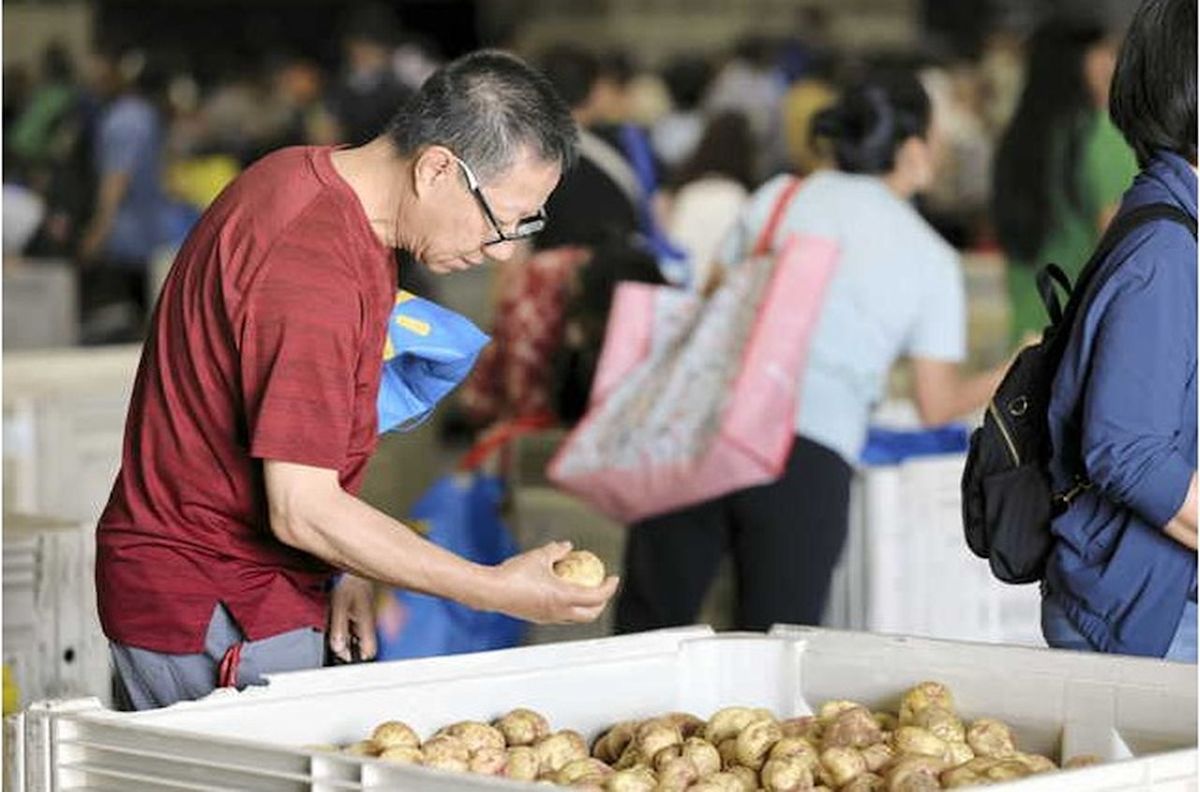
For an event named Ugly Potato Day, it offered an attractive opportunity for crowds looking for free food. On a recent sunny Saturday in Surrey, B.C., more than half a million pounds of imperfect produce filled the Cloverdale Agriplex, the yield a combined donation from 25 farms — 70 per cent of them local.
As the day unfolded, roughly 30,000 people streamed in to stuff as many fruits and vegetables as they could into a maximum of two bags each. Motivational speaker Tony Robbins was on hand for the giveaway, as well as reps from Canadian produce company Odd Bunch and U.S.-based food rescue non-profit Sharing Excess.
"It was beautiful chaos," says Evan Ehlers, founder and CEO of Sharing Excess. "We had carrots, potatoes, we had corn, we had lettuce, we had watermelon, cantaloupes, cherry tomatoes, and bins and bins of it."
He adds that although the logistics of the day were complicated — from confirming donors to transporting the food, to ensuring a safe environment and more — watching people secure one of life's basic necessities at no cost made it worth it.
"Everybody's walking out like they just did a huge shop at a grocery store, and they're kind of waddling on their way out with the food," he recalls. "And that's what we love to see because it's a literal representation of how much abundance there is in our food industry, both in Canada and the U.S."
By the end of the day, Aug. 8, organizers had broken the Guinness World Record for the largest donation of fruits and vegetables in 24 hours. They gave away 246,528.61 kilograms (543,501 pounds) of produce, confirmed by an adjudicator from Guinness World Records.
"We were not sure that we had broken the record until the moment they announced it on stage," says Ehlers. "Guinness World Records is so stringent on every single entry. So although we knew that we provided enough food to be able to break the record, it really comes down to what the officiator is able to qualify."
The previous record was 224,064.2 kg (493,977 lbs) of produce, which the Sacramento Convention & Visitors Bureau in Sacramento, Calif., set on Sept. 7, 2016.
Aside from snagging superlatives from Guinness World Records, these types of events spotlight the intersection between food waste and food insecurity.
More than 46 per cent of all food in Canada is wasted every year, according to a 2024 report from food rescue organization Second Harvest. And when dumped into landfills, food and other organic waste create the greenhouse gas methane.
Methane comprised roughly 16 per cent of Canada's total greenhouse gas emissions in 2023, according to Environment and Climate Change Canada, and it continues to contribute to rising global temperatures.
Meanwhile, 25.5 per cent of people in our 10 provinces lived in a food-insecure household in 2024, according to Statistics Canada. That's about 10 million people, including 2.5 million children.
When you juxtapose those kinds of numbers, rerouting imperfect yet edible fruits and veggies from landfills to people who need them just makes sense. It's a connection that farmer Tyler Heppell has championed for years.
He started Ugly Potato Day in 2022 by inviting people to his family's farm in Surrey, where they could help themselves to the imperfect produce — that is, food with blemishes, odd shapes and sizes, or uneven colours — that was destined for the dumpster. Twelve people showed up for that first event.
Speaking with Victoria News, Heppell said that Ugly Potato Day is ultimately rooted in kindness and a sense of community.
"I think that's what this day is about: the small things compound, and it doesn't matter if you have millions of followers (online) or 30,000 people coming out to your event, or if you're just impacting one person's life. It's all the same," he said.
Ehlers agrees. He's also grateful that the prestige of Guinness World Records can start conversations about issues like food waste and possibly lead to large-scale change.
"I hope that it inspires people to break more records that are about doing good instead of eating hotdogs or, you know, chasing speed titles or longest this or highest that. We should be trying to set examples for humanity of kindness and compassion," he says.
"And that was one of the reasons that we did this — not so much to make a name for ourselves or try to improve our business. In reality, it has no financial payoff whatsoever for either one of our organizations. Rather, it just helps to spread awareness about a problem."
Related Stories
 Lifestyle
Trump to temporarily lower beef tariffs, angering U.S. cattle producers
5 hours ago
 Lifestyle
Reform under fire for remote job listings after Farage vows to end home working and introduce Musk
10 hours ago
 Lifestyle
Trump to sign order making it easier for ranchers to sell, process own beef
19 hours ago
 Lifestyle
Judge set to declare mistrial in Lindsay Clancy case after jury deadlocked again
1 day ago
 Lifestyle
Food, Faith, Politics: Bengal’s Durga Puja, VHP’s Non
1 day ago
 Lifestyle
Belgian food quality AI startup Backbone raises €4 million pre-Seed round
1 day ago
 Lifestyle
80+ events happening in September
1 day ago
 Lifestyle
Indonesia wildfire live updates: Toxic haze spreads to Malaysia and Philippines
2 days ago