
As the traditional job market is shaken by the spread of artificial intelligence (AI), more and more..
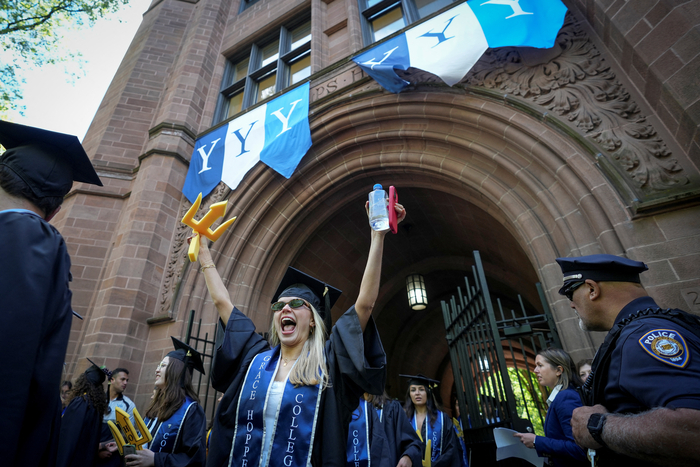
As the traditional job market is shaken by the spread of artificial intelligence (AI), more and more students from prestigious universities in the United States are jumping into startups instead of internships at large companies.
The Wall Street Journal (WSJ) on the 5th (local time) highlighted the students of prestigious universities in the United States who are trying to start a business in Silicon Valley.
A case in point is Princeton University student Charles Mülberger. This summer, he rejected both large IT companies and rocket engineering companies' internship proposals and chose to start an AI start-up. Currently, we are developing technologies that can run open-source AI models on local devices without an Internet connection.
It is the startup incubator that supports students' enthusiasm for start-ups. A case in point is "Yale Hacker House," which is supported by venture capital and Yale alumni. They rent apartments in the Nov Hill area of San Francisco and use them as start-up spaces. About 15 students live in one place and are committed to starting a business. Energy drinks and various hardware equipment are piled up throughout this space.
Leia Ryan, a second-year Yale student who led the establishment of the Yale Hackerhouse, gave up her offer to join a state-of-the-art biotech company and her plan to go on to a PhD in genetics. Instead, he co-founded "Cortex," a startup that develops knowledge management systems for life science research institutes. Founded in March, the company attracted $600,000 in investment in recognition of its $10 million enterprise value and also signed its first commercial contract.
Another founder, Nicholas Gertler, who led the establishment of Yale Hackerhouse, said, "The most lacking thing for students interested in starting a business is a community to share their concerns together. We wanted to create a community to solve the difficulties together because the founders are so busy with their schedules that there are few opportunities to meet each other."
The startup incubator TekTrek, which was launched for the first time this year, also recruited participants from MIT, Harvard University, and Princeton University to set up a temporary campus in the Presidio area of San Francisco.
The day of Yale Hackerhouse and Tekrek students is mostly filled with coding and networking. The WSJ reported that founders meet with investors and corporate executives to present business ideas, and in the evening, they walk through the city or enjoy rock climbing and poker.
Students who choose to start a business are also contemplating whether to continue their studies. Ryan, who is currently taking a leave of absence, has decided not to go back to school. "It is rather irresponsible for investors to go to school in a situation where they have been invested," he said. "If you are a serious founder, you should quit school in the end."
On the other hand, Gauri Khetri, who founded an AI start-up as a junior at Princeton University, said, "University education is a process for intellectual growth and also serves as a safety net," expressing his intention to continue his studies.
Ann Miurako, a partner at venture capital Floodgate, also advised students to be cautious about their hasty decision to drop out. "It's hard to be sure that the business we're promoting now will be the next unicorn company," he said. "It's desirable to finish your studies if possible."
Related Stories
 AI News
AI scammers may use vacation photos to determine travelers' locations, experts at McAfee warn
2 minutes ago
 AI News
Anthropic IPO filing will show AI backlash as a risk factor, sources say
2 minutes ago
 AI News
How AI accounting startup Rillet raised $100M and became a unicorn in 48
32 minutes ago
 AI News
From political prize to campaign liability: Data centers become a midterm battleground
1 hour ago
 AI News
Montreal teen accused of using AI to plot school attack
1 hour ago
 AI News
ARTIFICIAL intelligence (AI) deserves criticism. Its environmental costs, embedded biases, labor implications, capacity to manufacture falsehoods and possible reliance on copyrighted material require serious scrutiny. The corporations developing AI m...
1 hour ago
 AI News
Exclusive | Waico vs Pax Silica: Southeast Asia caught between China and US in AI race
2 hours ago
 AI News
CEO of viral backflipping robot company says robots may be years from their ‘ChatGPT moment
2 hours ago