
ALL IN 2026 conference opens with focus on sovereign AI, digital trust
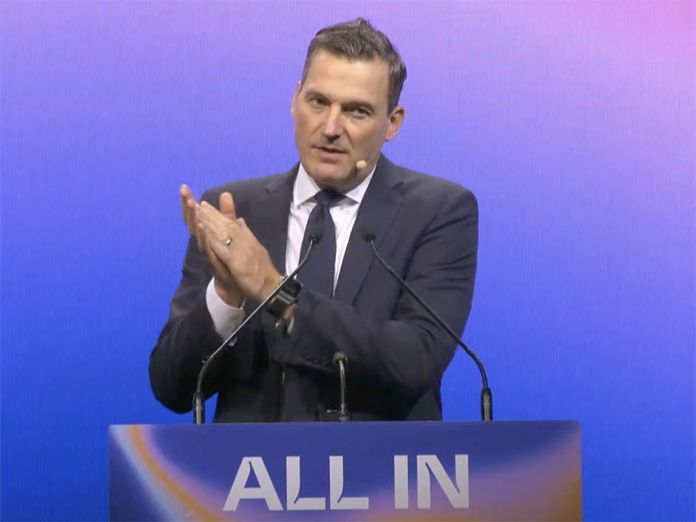
Drawing over 9,000 participants from more than 50 countries, ALL IN 2026 opened at the Palais des congrès de Montréal on Wednesday with a strong focus on sovereign tech infrastructure, regulatory guardrails, and international trade alliances.
Organized by Scale AI, the conference welcomed Germany as its official Country of Honour, bringing a delegation of over 30 companies to highlight transatlantic technology partnerships. The event kicked off on the heels of Canada’s national investment summit earlier this week, where federal officials touted $500 billion in cross-sector commitments to Canadian infrastructure and energy projects.
Opening the conference, ALL IN CEO Isabelle Turcotte and Scale AI Co-Founder Hélène Desmarais framed artificial intelligence as a core driver for economic transformation.
“Canada is at a crucial moment of its economic history,” Turcotte told the audience. “The goal this week is clear: to turn this momentum into business opportunities, concrete collaboration, and lasting partnerships…AI is not a goal, it’s a means. It is a powerful engine for economic transformation.”
Evan Solomon, Canada’s Minister of Artificial Intelligence and Digital Innovation, delivered opening remarks alongside Dr. Karsten Wildberger, Germany’s Federal Minister for Digital Transformation and Government Modernization. Solomon announced the formal launch of the Canada-Germany Sovereign Technology Alliance, designed to pool research capacity, secure hardware supply chains, and build joint AI compute capacity.
“No country can build alone,” Solomon told the conference. “Every country needs the capacity to make choices about the technologies shaping its future, and we need options… Our partnership is not about sharing principles, though we do. It’s about connecting our researchers, helping our companies find real partners and real customers, and building trusted infrastructure together.”
For telecom operators and infrastructure providers, Solomon underscored rapid domestic expansion and allocations under Canada’s national strategy that include a $1.5-billion scale-up fund for enterprise tech, $100 million for privacy-preserving data infrastructure, and an upcoming announcement regarding the location of Canada’s $1-billion public AI supercomputer.
Solomon also outlined a five-point national framework negotiated with the Federation of Canadian Municipalities (FCM) to govern compute expansion that includes guidelines stipulating that data centres must not inflate residential power rates, must implement closed-loop water cooling to protect local aquifers, and provide verifiable economic benefits to the community.
With synthetic media and automated distribution reshaping broadcasting and digital publishing, Solomon also addressed key legislative guardrails that have implications for Canadian media.
He highlighted four pieces of tabled federal legislation directly targeting digital trust: criminalizing non-consensual AI deepfakes, shielding democratic elections from synthetic manipulation, restricting social media and AI chatbot exposure for minors under 16, and modernizing consumer privacy laws with rights to data deletion.
“If we don’t build it here, we have to buy it from someone else. If we don’t innovate here, we have to rent it from someone else,” Solomon noted. “It is too consequential a technology to discard carelessly, and it is too consequential to develop carelessly.”
Wildberger emphasized that democratic “middle” powers must maintain independent control over their communications networks and digital platforms rather than relying entirely on offshore providers.
“To me, sovereignty means being able to make our own decisions, even under pressure,” Wildberger stated. “It means protecting our data, examining the systems we depend on, changing providers, and keeping services running. Those freedoms require knowledge, infrastructure, and credible alternatives. A choice is only real if you have an alternative.”
The two-day conference continues through Thursday with sessions covering AI safety led by Mila founder Yoshua Bengio, enterprise telecom integration, and automated workflow safety frameworks.
Related Stories
 AI News
The 2.5-hour AI
6 minutes ago
 AI News
Montreal AI research institute denounces violence after office vandalized
8 minutes ago
 AI News
AI risks wider gender inequality in jobs market: WEF
1 hour ago
 AI News
Why this fast-growing German AI start
1 hour ago
 AI News
New AI technique could make minimally invasive surgeries safer and more precise
1 hour ago
 AI News
Improving HCLS AI reasoning with open
2 hours ago
 AI News
A Governor's Dozen: 13+ Bills Addressing Artificial Intelligence, Online Youth Safety, and Privacy Signed in California
2 hours ago
 AI News
Build data centres here or ‘rent’ from neighbours, AI minister says
2 hours ago