
Alberta's government to study ability of province's water supply to support population, economic growth
Alberta's government to study ability of province's water supply to support population, economic growth
Study will review major water transfer projects around the world
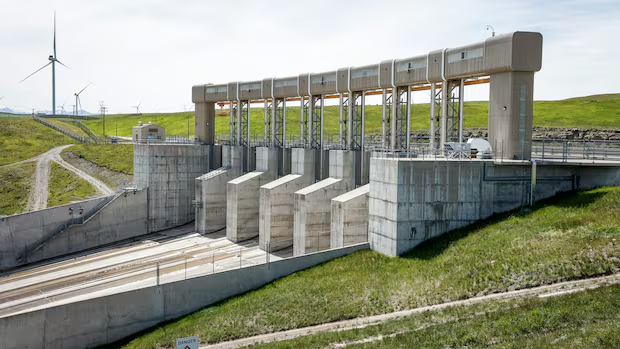
Alberta's government says it's looking to do a study on the long-term security of the province's water supply as it stares down a challenge with a water-rich north and a demand-heavy south.
In a news release issued Thursday, Environment Minister Grant Hunter said Alberta's population, industry and farming sector are all growing and reliable access to water is needed to sustain the growth.
"Water is the foundation of Alberta's future," Hunter said.
"We're looking 100 years ahead and asking what Alberta needs to build, invest in and do differently today to secure our water supply for generations to come."
The request for proposals says much of the available water supply in Alberta is in the north, while a number of southern river basins, including the Bow, Oldman and South Saskatchewan, have been closed to new water diversion licences for almost two decades.
It also notes Alberta is subject to cross-jurisdictional limitations for basins that are shared with Saskatchewan or the United States.
"There is a need to assess, plan and act to ensure population and economic growth in southern Alberta is not constrained by limited water supply but rather matched with reliable water supplies, systematically implementing new water management approaches and infrastructure investments," the document says.
Farmers and ranchers in southeastern Alberta contending with bone-dry summer
It also says the company that's eventually awarded the contract to undertake the study will be asked to review major water transfer projects around the world — such as the California aqueduct and China's South-North Water Transfer system — and analyze whether Alberta could do something similar.
Both of those systems are designed to channel water over hundreds of kilometres from more water-rich areas to more arid or demand-heavy regions.
While much of Alberta is experiencing a particularly wet summer season, especially in Edmonton which saw its summer rain record shattered before the start of August, there have been severe droughts in recent years, notably in 2023 and 2021.
Edmonton mops up — again — in what is officially the rainiest summer on record
The government says the study will inform a new long-term plan for water management and kickstart discussions between the province and local governments and Indigenous communities about planning for the future.
The study also comes as the province works to make Alberta an ideal destination for artificial intelligence data centres, many of which use substantial amounts of water as part of the cooling process.
Last month, Premier Danielle Smith and tech giant Meta announced the company's plans to build its first data centre in Canada just north of Edmonton.
Smith and Meta have said the facility will use a closed-loop water system so that it won't use nearly as much water as other data centres.
The government says it has budgeted $400,000 for the study, which is expected to be finished next spring.
Related Stories
 Canada
More than 174,530 Albertans cast referendum ballots on first day of advance polls
48 minutes ago
 Canada
Trump says Canada will become 51st state ‘because that’s the only way it works’
48 minutes ago
 Canada
Alberta’s referendum draws 174K ballots in the 1st day of advance polls
48 minutes ago
 Canada
Lloydminster is split between two provinces. But what happens if Alberta votes to separate?
48 minutes ago
 Canada
Toronto Raptors looking for more three
1 hour ago
 Canada
Liberals allege Ford government has political ties to career colleges under OSAP probe
1 hour ago
 Canada
Emergency backups getting 2nd crack at NHL dream
1 hour ago
 Canada
Canada's economic ambitions face skilled workforce challenges, Liberal MPs warn
1 hour ago