
Is AI going to replace human intelligence? Don’t count on it
I find AI bots to be an incredibly useful tool in helping me organize various trips. This technology obviously has more profound and consequential applications in a variety of fields of activity, from logistics to policy research to medicine. I also used one such bot for the initial research for this opinion piece and asked it to write portions of it, which I mostly rewrote afterwards.
However, in my opinion, and in the opinion of several astute observers, AI is not “intelligent.” At least not in a heuristic sense. It mimics intelligence in a truly impressive manner through its incredible memory, mastery of language, and raw power, but it is not intelligent per se.
But before we go any further, let us define what I mean here, specifically, by “intelligence”: something that is embodied in us and that fosters self-directed problem-solving for the sake of staying alive and thriving in an unpredictable world.
AI bots don’t have it because they have no skin in the game. Real intelligence evolved because organisms die if they choose wrong. You learn because mistakes hurt. An AI bot can’t die or feel hunger. No consequences means no real stakes and, ultimately, no genuine understanding of the issues at stake.
Furthermore, AI does not have self-directed goals. Intelligence, as previously defined, sets its own ends: survive, reproduce, protect kin, seek status. A bot has no ends of its own. It doesn’t “want” anything. It executes the goals humans pump into the prompt. Turn off the server and it “wants” nothing. AIs are brilliant parrots, and often incredibly brilliant parrots, not minds.
AI bots can recognize a cow, for example, because they have been fed a vast number of images of cows, but put a cow on, say, a beach, and most bots won’t be able to recognize it. But a toddler would be able to. Said differently, AI understands the look of a cow and possesses detailed definitions of what a cow is, but it doesn’t have an intrinsic or intuitive understanding of its true nature.
Eminent expert Professor Yann LeCun, for one, has argued that today’s AI is dumber than a house cat. LeCun served as chief AI scientist at Meta Platforms before co-founding Advanced Machine Intelligence Labs in December 2025. He is a laureate of the Turing Award, an annual prize given by the Association for Computing Machinery, and a professor of Computer Science at the Courant Institute of Mathematical Sciences at New York University.
LeCun is obviously not saying that large language models (LLMs) are not useful. But rather, that they lack even the basic animal-level intelligence of your house pet.
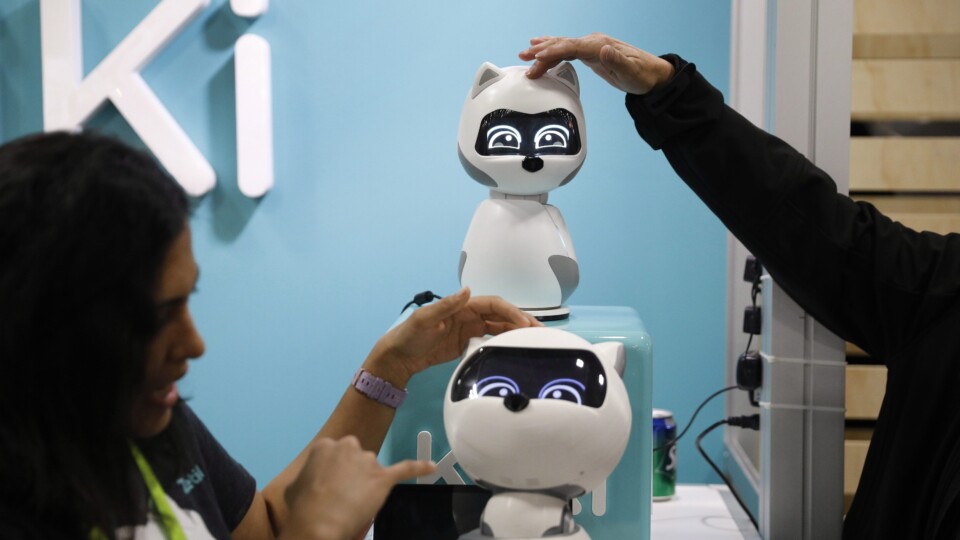
People take photos of an AI robot at the All In artificial intelligence conference, Wednesday, September 27, 2023 in Montreal. Ryan Remiorz/The Canadian Press.
A cat, he points out, has a rudimentary understanding of the physical world and can plan based on this understanding. Place it on a table with a ball, and the cat knows what will happen if it bats the ball. It can plan to jump off the table and chase the ball when it falls to the floor. It has a basic grasp of gravity and object permanence.
In contrast, an LLM can, if prompted, write a text about the ball falling, but it has no understanding of why it falls. It just predicts what the next word in such a text should be, and then the next, based on the oceans of text it has been trained on, with no real knowledge. Even in control of a robot, it could not independently make a plan and execute it the way a cat does.
LeCun adds that a cat has persistent memory and some degree of common sense. It remembers where its food is kept, what the sound of the electric can opener (probably) means, where to hide from the much less enticing sound of the vacuum cleaner, and so on. LLMs, on the other hand, have enormous memory capacity, but it’s just a regurgitation of the data used to train it, and it has no common sense built on experience of the physical world, motor skills, or spatial reasoning.
It’s true that LLMs have a huge number of parameters, with ChatGPT-4 having well over a trillion. But, interestingly, that’s roughly equivalent to the number of synapses in a cat’s brain. Yet a synapse is far more complex than an LLM parameter. A cat uses its synapses for processing visual input, maintaining balance, hunting prey, decoding social cues, and other sophisticated activities. An LLM, LeCun reminds us, uses its parameters to predict the next word.
A cat, moreover, actually reasons, albeit on a primitive level compared to humans. LLMs are just good at appearing smart by manipulating language fluently. This is problematic if you ask it to do some financial analysis, say, and it confidently spews out a response that seems plausible but is wrong. A cat won’t fool you in this way.
In large part because of these intrinsic limitations of LLMs, the doomsday scenarios often heard regarding the impact of AI on employment are most likely overblown. And I am not the only one who feels that way. A survey of leading economists carried out by the University of Chicago found that only 11 percent of them agree that the use of AI over the next decade will lead to a substantial increase in unemployment in the industrialized world.
Again, and at the risk of repeating myself, AI is obviously a powerful tool and will become increasingly so. As indicated earlier, I have, for instance, used an AI bot to summarize the work of Professor LeCun in researching this piece. However, acknowledging this is a far cry from engaging in this (sometimes hysterical) fad about AI being on the cusp of becoming more intelligent than humans. It is increasingly capable of performing certain specific tasks better than humans. But this is not to be confused with intelligence, properly defined, let alone consciousness.
Michel Kelly-Gagnon is the founding president of the MEI (www.iedm.org), a public policy think tank with offices in Montreal, Ottawa, and Calgary.
While AI is a powerful tool with impressive capabilities, it lacks true intelligence as defined by self-directed problem-solving and understanding. AI mimics human-like responses but does not possess intrinsic goals or awareness. The author cites expert opinions, including Professor Yann LeCun, who compares AI’s capabilities unfavourably to even basic animal intelligence. The article concludes that fears about AI replacing human jobs are likely exaggerated, as AI’s limitations prevent it from achieving genuine understanding or consciousness, despite its utility in specific tasks.
AI mimics intelligence in a truly impressive manner through its incredible memory, mastery of language, and raw power, but it is not intelligent per se.
The doomsday scenarios often heard regarding the impact of AI on employment are most likely overblown.
What distinguishes AI's capabilities from true human intelligence?
How might AI impact employment in the coming decade?
What are the implications of AI's limitations for policy-making?
Related Stories
 AI News
India’s AI opportunity could run into trillions of dollars, creating new possibilities for startups
12 minutes ago
 AI News
Dublin-based LearnUpon secures €44.5 million to scale its agentic learning platform
12 minutes ago
Strasbourg-founded Goodweek raises €10.69 million to become the AI Manager for SMBs
12 minutes ago
 AI News
'AI artists' perform improvised music at Jarasum Jazz Festival
1 hour ago
 AI News
How my son showed me AI is now the world’s biggest lose
3 hours ago
 AI News
Artificial intelligence enters the corporate sphere: how can companies turn it into an opportunity?
3 hours ago
 AI News
AI agents on Tencent Cloud try to break into Alibaba’s Amap: researchers
5 hours ago
 AI News
AI startups are now swallowing roughly four out of five venture dollars in the US
6 hours ago